Mandaviya hails Cabinet decision to ensure women's reservation
Synopsis
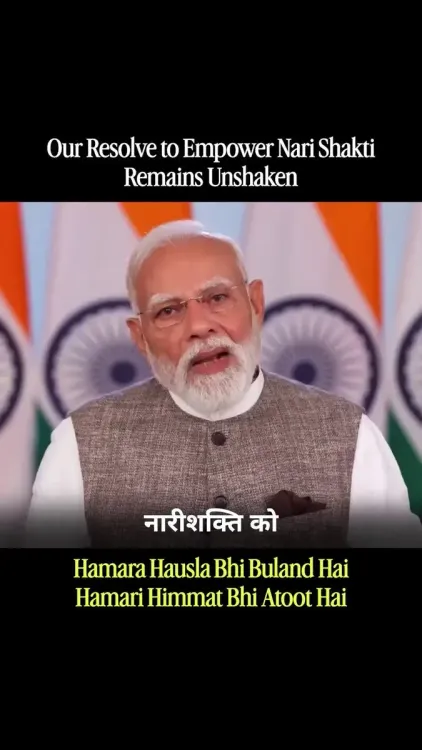
Union Labour and Sports Minister Mansukh Mandaviya welcomed a Union Cabinet decision under Prime Minister Narendra Modi to ensure women's reservation, calling it historic proof of commitment to Nari Shakti. He said it would raise women's political representation, strengthen every state's share, and mark a milestone toward Viksit Bharat.
Key Takeaways
Union Labour and Sports Minister Mansukh Mandaviya on 28 November 2026 welcomed a Union Cabinet decision under Prime Minister Narendra Modi to ensure women's reservation.
He called the move historic proof of commitment to Nari Shakti and a milestone for Viksit Bharat.
He said it would raise women's political participation and equally strengthen every state's share.
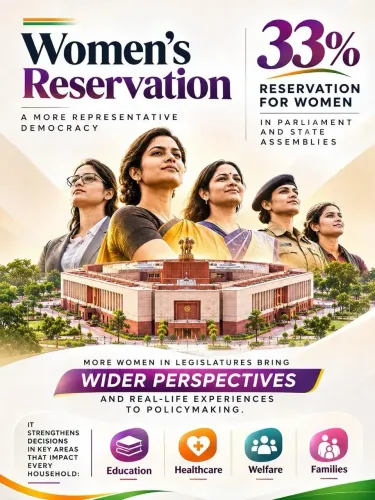
Parliament passed the Nari Shakti Vandan Adhiniyam in September 2023 as the 128th Constitutional Amendment, reserving one-third of seats for women in the Lok Sabha and state assemblies.
Implementation of that reservation is tied to a census and a subsequent delimitation exercise.
Union Labour and Sports Minister Mansukh Mandaviya on Saturday, 28 November 2026, hailed what he called a historic Union Cabinet decision under Prime Minister Narendra Modi to ensure women's reservation, branding it proof of an unwavering resolve on Nari Shakti. He said the step would lift the participation of India's mothers and sisters in politics and equally strengthen every state's share, a milestone, in his words, for Viksit Bharat.
Writing in Hindi, Mandaviya said the Cabinet's call was nari shakti ke sashaktikaran (empowerment of women's strength) made visible. He offered a full-throated welcome: he heartily congratulated the 'visionary decision'. 'This will increase the participation and representation of our mothers and sisters in politics and equally strengthen the share of all states of the country,' he wrote. The close was a national-purpose line: the move would prove a milestone in realising the resolve of Viksit Bharat.
Mandaviya's welcome for a Cabinet reservation call
The minister, who also holds Youth Affairs and Sports, did not unpack operational fine print. He framed a political and constitutional promise: more women on the benches, a firmer stake for every state, and a government that wants women's reservation treated as settled purpose, not unfinished argument.
That pairing matters. Women's seats and state-wise maps have always been twins in this debate. When Mandaviya says every state's share will be strengthened in equal measure, he is pointing at the federal arithmetic that will decide where reserved constituencies actually fall.
From 1992 panchayat quotas to the 2023 amendment
India first wrote one-third reservation for women into local government through the 73rd and 74th Constitutional Amendments in 1992, covering panchayats and municipalities. A bill to reserve seats in the Lok Sabha and state assemblies arrived as early as 1996 and lapsed more than once.
Parliament passed the measure in September 2023 as the 128th Constitutional Amendment, known as the Nari Shakti Vandan Adhiniyam. It provides for reservation of one-third of seats for women in the Lok Sabha and in state legislative assemblies. That statute is the spine of today's argument over how, and how soon, the quota appears on the ballot.
The census-and-delimitation clock still runs
The 2023 amendment does not switch on by itself. Implementation is tied to a census and a subsequent delimitation, the redrawing of constituencies that will decide which seats are reserved. Women political aspirants, party ticket committees and state assemblies have been watching that sequence, because candidate lists and state-wise maps will both move once the boundaries are frozen.
Mandaviya's message, as posted, is unambiguous: the Cabinet, in his telling, has chosen to lock in the promise. The political test is whether the next electoral map makes one-third real, and whether parties put women on the ticket in numbers that match the Constitution's new arithmetic.
Point of View
Not unfinished business. The sharper test remains operational. Until census and delimitation finish, one-third remains a promise on paper, and parties will read this welcome as pressure to build women's candidate pipelines now.
NationPress
28 Nov 2026
Frequently Asked Questions
What did Mansukh Mandaviya say about the women's reservation Cabinet decision?
He welcomed a Union Cabinet decision under Prime Minister Narendra Modi to ensure women's reservation, calling it historic proof of commitment to Nari Shakti. He said it would increase women's political participation and representation, equally strengthen the share of all states, and prove a milestone for Viksit Bharat.
What is the Nari Shakti Vandan Adhiniyam?
It is the 128th Constitutional Amendment passed by Parliament in September 2023. It provides for reservation of one-third of seats for women in the Lok Sabha and in state legislative assemblies.
When will women's reservation in the Lok Sabha come into effect?
The 2023 amendment is linked to a census and a subsequent delimitation of constituencies. Seats are expected to be reserved for women after that process is completed, not automatically at the next election.
How is local-body reservation different from Lok Sabha reservation?
The 73rd and 74th Constitutional Amendments of 1992 already reserve one-third of seats for women in panchayats and municipalities. The 2023 law extends a similar one-third principle to Parliament and state assemblies, subject to census and delimitation.
Who is Mansukh Mandaviya?
He is the Union Minister of Labour and Employment and Youth Affairs and Sports, and a senior BJP leader. He posted his welcome for the Cabinet's women's reservation decision on 28 November 2026.