Mandaviya Congratulates Padma Shri Awardee K. Pajanivel for Silambam
Synopsis
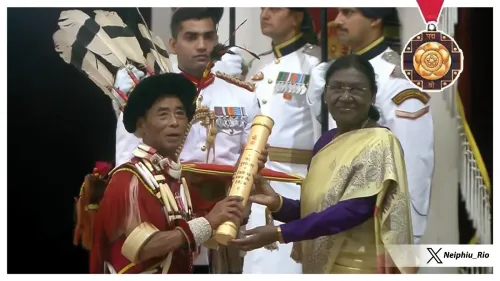
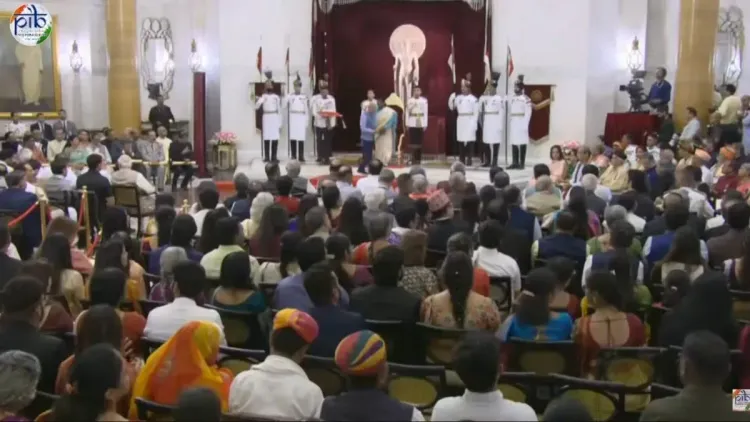
Union Sports Minister Mansukh Mandaviya congratulated K. Pajanivel on being conferred the Padma Shri for his work reviving Silambam, a traditional Tamil stick-fighting martial art, under the government's #PeoplesPadma initiative recognising grassroots cultural contributions.
Key Takeaways
Mansukh Mandaviya , Union Minister of Labour and Sports, congratulated K.
Pajanivel on receiving the Padma Shri on 25 May 2026 .
Silambam is a traditional stick-fighting martial art originating in Tamil Nadu , recognised as part of India's intangible cultural heritage.
The Padma Shri is India's fourth-highest civilian honour, awarded annually for distinguished contributions across arts, sports, and culture.
The award aligns with central government policy under the Khelo India programme and Fit India Movement to support indigenous martial arts.
The #PeoplesPadma tag reflects the government's framing of such honours as recognition of grassroots, community-level contributions.
Possible next steps include inclusion of Silambam in Khelo India games editions and Sports Ministry circulars on traditional martial arts curricula.
Union Labour and Sports Minister Mansukh Mandaviya on Monday, 25 May 2026 congratulated K. Pajanivel on being conferred the Padma Shri award, recognising his lifelong dedication to reviving Silambam, the ancient Tamil martial art of stick-fighting.
Context
In his post on X, Minister Mandaviya wrote: 'Congratulations to Shri K. Pajanivel on being conferred Padma Shri award for his dedication to reviving the ancient martial art form of Silambam,' tagging the tribute under the hashtag #PeoplesPadma. The Padma Shri is the fourth-highest civilian honour of the Republic of India, awarded annually for distinguished service across arts, sports, culture, and other fields. The hashtag #PeoplesPadma signals the government's framing of such awards as recognition emerging from grassroots contributions rather than elite institutions.
K. Pajanivel is a Tamil Nadu-based practitioner credited with sustained efforts to keep Silambam alive as a living discipline. Silambam is a traditional stick-fighting martial art with roots in Tamil Nadu, recognised as part of India's intangible cultural heritage.
Policy Backdrop
The recognition of Pajanivel fits within a broader policy direction that successive central governments have pursued since 2014 — expanding formal honours and sports schemes to cover practitioners of regional martial arts and indigenous games that were previously outside mainstream recognition frameworks. The Khelo India programme, launched in 2017, explicitly includes support for indigenous martial arts and traditional games. The Fit India Movement, announced in 2019, similarly promotes the revival and popularisation of indigenous physical disciplines, including Silambam.
These policy instruments have created a scaffolding through which state-level cultural traditions receive central visibility without requiring the creation of new statutory bodies. Civilian honours like the Padma Shri function as a complementary signalling mechanism within this framework.
Stakeholders and Impact
For traditional martial artists and Tamil Nadu cultural organisations, the award represents formal acknowledgement of a discipline that has historically struggled for institutional support and student enrolment. Practitioners of indigenous martial arts such as Kalaripayattu, Thang-Ta, and Gatka — alongside Silambam — have increasingly sought parity with modern sports in government funding and curriculum inclusion. An award at this level can meaningfully raise a discipline's profile, attracting younger practitioners and state-level funding.
The Sports Ministry's involvement in amplifying the honour also signals that the Ministry of Youth Affairs and Sports views traditional martial arts as within its policy remit, not solely the domain of culture ministries.
What's Next
Observers of sports and cultural policy will watch whether Silambam receives a dedicated slot in upcoming editions of the Khelo India University Games or national games, and whether the Sports Ministry issues circulars encouraging its inclusion in school and university physical education curricula. The award to Pajanivel could serve as a catalyst for state governments — particularly Tamil Nadu — to formalise Silambam coaching academies and competitive structures. The broader pattern of honouring grassroots cultural practitioners suggests such recognition is unlikely to remain symbolic alone.
Point of View
The Sports Ministry signals cross-regional cultural sensitivity at a time when the Centre's relationship with southern states carries political weight. The move also fits a deliberate policy arc — from the Khelo India programme to the Fit India Movement — of bringing indigenous martial arts into the formal sports ecosystem. Whether this recognition translates into structural support for Silambam, such as curriculum inclusion or dedicated funding, will be the real test of its policy substance.
NationPress
9 Oct 2026
Frequently Asked Questions
Who is K. Pajanivel and why did he receive the Padma Shri?
K. Pajanivel is a Tamil Nadu -based martial arts practitioner recognised for his sustained efforts to revive Silambam , the traditional Tamil stick-fighting art. He was conferred the Padma Shri , India's fourth-highest civilian honour, for this contribution to India's intangible cultural heritage.
What is the Padma Shri award?
The Padma Shri is the fourth-highest civilian award of the Republic of India, announced annually on Republic Day. It is conferred for distinguished service in fields including arts, sports, social work, science, and culture.
What is the #PeoplesPadma hashtag about?
The #PeoplesPadma hashtag is used by government officials and supporters to highlight Padma award recipients who represent grassroots or community-level contributions, as distinct from prominent public figures, framing the honours as recognition of ordinary citizens with extraordinary dedication.
How does Silambam fit into India's sports policy?
Silambam falls under the umbrella of indigenous martial arts supported by the Khelo India programme (launched 2017 ) and the Fit India Movement (launched 2019 ), both of which include provisions for promoting traditional physical disciplines alongside modern competitive sports.