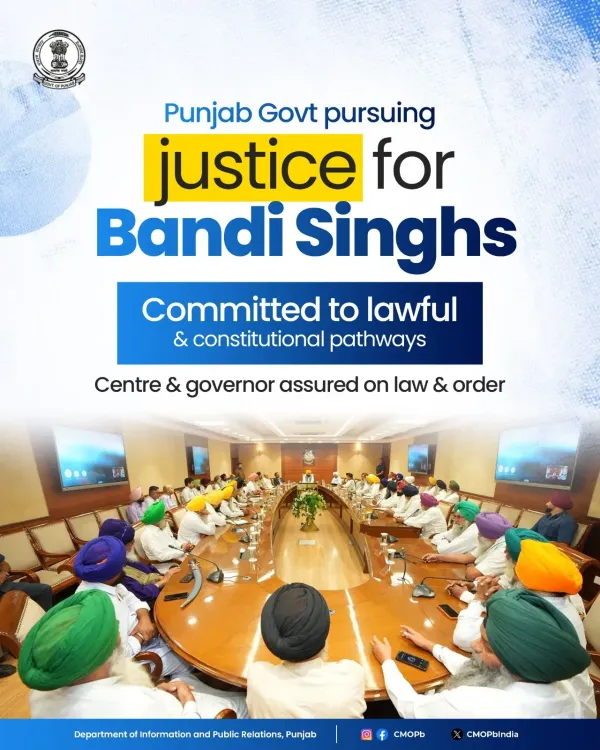
CM Bhagwant Mann vows legal push for Bandi Singhs' release
Synopsis
Chief Minister Bhagwant Mann on 13 October 2026 reiterated that the Punjab Government will pursue every legal and constitutional avenue to secure the release of Bandi Singhs — prisoners from the 1980s–90s militancy era still incarcerated decades after their formal sentences, in a case that cuts across federal jurisdiction, Sikh sentiment, and individual rights.
Key Takeaways
CM Bhagwant Mann on 13 October 2026 publicly reaffirmed Punjab's commitment to seeking the release of the Bandi Singhs .
The government pledged to use 'all possible legal and constitutional steps,' pointing toward potential petitions in the Punjab and Haryana High Court or the Supreme Court .
Bandi Singhs are prisoners convicted in cases from Punjab's 1980s–1990s militancy period , many held beyond their original sentences under Union Government jurisdiction.
The Punjab Legislative Assembly has passed resolutions calling for clemency or release multiple times since the 2000s — no government has resolved the issue.
Remission and clemency powers in such cases rest with the Union Ministry of Home Affairs , creating a structural federal friction the state must navigate through courts or formal correspondence.
Possible next steps include fresh petitions in higher courts and formal communication with the Centre on remission recommendations.
A long-festering wound in Punjab's political conscience came back to the surface on Tuesday, 13 October 2026, as Chief Minister Bhagwant Mann reaffirmed that his government will exhaust every legal and constitutional option available to secure the release of the Bandi Singhs — prisoners from the militancy era who have spent decades behind bars long after completing their formal sentences.
What Mann said — and what it signals
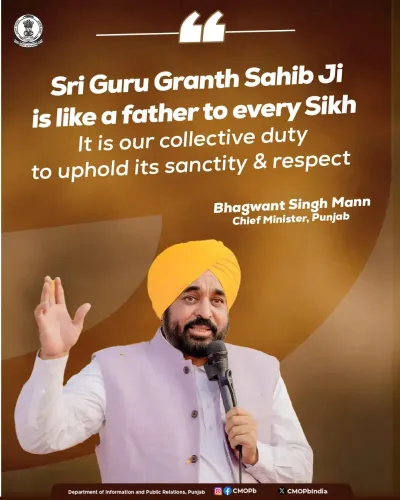
Speaking directly on the issue, the Chief Minister stated: 'The Punjab Government will take all possible legal and constitutional steps to seek the release of Bandi Singhs languishing in jails, as this involves matters of justice, humanity and the rights of individuals who have already undergone prolonged periods of incarceration.' He added that the government would 'approach the matter with sensitivity, responsibility and a clear commitment to justice, while fully respecting the constitutional and legal framework.'
The language is deliberate. By anchoring the commitment firmly within constitutional bounds, Mann is signalling both urgency and restraint — a careful calibration given the federal sensitivities the issue inevitably stirs.
Decades of detention, layers of jurisdiction
The Bandi Singhs are prisoners convicted in cases linked to Punjab's turbulent 1980s–1990s militancy period. Many have served sentences far exceeding their original terms, remaining incarcerated under Central Government jurisdiction even as state governments have repeatedly sought their release. The Punjab Legislative Assembly has passed resolutions urging clemency and release multiple times since the 2000s, each time running into the jurisdictional reality that remission and clemency powers — particularly for cases tried under central laws — rest with the Union Ministry of Home Affairs in New Delhi.
That federal friction is the core of the problem. A state government can recommend, petition, and litigate — but the final lever sits at the Centre. This is precisely why Mann's invocation of 'every legal and constitutional avenue' points toward possible fresh petitions in the Punjab and Haryana High Court or the Supreme Court of India, alongside formal correspondence seeking remission recommendations from the Union government.
A recurring demand that no government has closed
What makes the issue politically durable is that it has survived across ideological lines — multiple state governments of different parties have raised the demand without resolving it. The Aam Aadmi Party government under Mann now picks up a thread woven long before its 2022 arrival in power. The families of the incarcerated and large sections of the Sikh community have kept the pressure alive, making it as much a question of religious and cultural sentiment as of criminal justice reform.
Prolonged incarceration beyond the original sentence, on grounds of continuing security risk, sits at an uncomfortable intersection of individual rights and state security calculus — a tension the courts will ultimately have to weigh if petitions follow.
Punjab–Centre dynamics enter the frame
Mann's public reiteration on this date is not purely humanitarian signalling. It arrives in the broader context of a state government that has frequently pressed New Delhi on issues touching Punjabi identity and federal resource-sharing. A formal legal or diplomatic push on Bandi Singhs would add another front to that relationship — one where the moral optics strongly favour the state, regardless of the legal outcome.
The next visible marker will be whether the Punjab Government files new petitions, writes formally to the Union Home Ministry, or moves through the state's law department in the weeks ahead. Until then, the Chief Minister has put the question firmly back on the national agenda — and on record.
Point of View
Humanity, and rights' makes it politically costly for the Centre to be seen as the obstacle. The issue has an unusual longevity precisely because it straddles Sikh religious identity and criminal justice, meaning it never fully loses electoral salience in Punjab. By committing to court-based and constitutional routes rather than confrontational rhetoric, Mann's AAP government is threading a needle: energising the Sikh community base without the inflammatory optics that have historically complicated such demands. The real test is whether formal legal action follows the statement, or whether it remains a periodic reiteration that stops short of decisive juridical pressure.
NationPress
13 Oct 2026
Frequently Asked Questions
Who are the Bandi Singhs?
Bandi Singhs are Sikh prisoners convicted in cases linked to Punjab's militancy period of the 1980s and 1990s , many of whom remain incarcerated even after serving their original sentences, primarily under the jurisdiction of the Central Government.
What has Bhagwant Mann said about Bandi Singhs?
On 13 October 2026 , Chief Minister Bhagwant Mann stated that the Punjab Government will take 'all possible legal and constitutional steps' to seek the release of Bandi Singhs, framing the matter as one of justice, humanity, and individual rights.
Can the Punjab Government directly release Bandi Singhs?
Not unilaterally. Many Bandi Singhs are held under Central Government jurisdiction, meaning remission and clemency powers rest with the Union Ministry of Home Affairs . Punjab can recommend, petition courts, or formally write to the Centre, but the final decision lies at the federal level.
Has Punjab previously tried to secure the release of Bandi Singhs?
Yes. The Punjab Legislative Assembly has passed multiple resolutions since the 2000s urging clemency or release, under governments of different parties. The issue has not been resolved by any administration so far.
What legal steps could Punjab take next?
Possible steps include fresh petitions in the Punjab and Haryana High Court or the Supreme Court of India , as well as formal communication to the Union Ministry of Home Affairs recommending remission — all options consistent with the constitutional framework Mann's statement invokes.