Medieval chamber found at Golconda Fort: ASI launches investigation
Synopsis
What social media flagged as a tunnel at Golconda Fort turned out to be something potentially more intriguing — a sealed granite chamber from the medieval period, complete with ancient potsherds, sitting inside the fort's legally protected zone. The ASI has stopped army levelling work and is now seeking Director General approval for a full excavation.
Key Takeaways
A rectangular granite chamber measuring 1.2 m × 1.8 m and 2.2 m deep was discovered at Golconda Fort , Hyderabad , during land-levelling work by the Artillery Centre .
The structure falls within the prohibited area of the fort, extending beyond 100 metres from the fortification wall.
Red-coloured potsherds found inside the chamber are believed to belong to the medieval period .
The ASI Hyderabad Circle has directed the Artillery Centre to halt all land-levelling pending further investigation.
A detailed investigation will be launched upon approval from ASI Director General Yadubir Singh Rawat .
Golconda Fort features three fortification walls and 87 bastions , making it one of the Deccan's most significant medieval monuments.
A structure believed to date from the medieval period has been unearthed at Golconda Fort in Hyderabad, a nationally protected monument under the Archaeological Survey of India (ASI). The discovery, made within the fort's prohibited zone, has prompted the ASI Hyderabad Circle to dispatch a specialist team and halt ongoing land-levelling work in the area.
What Was Found
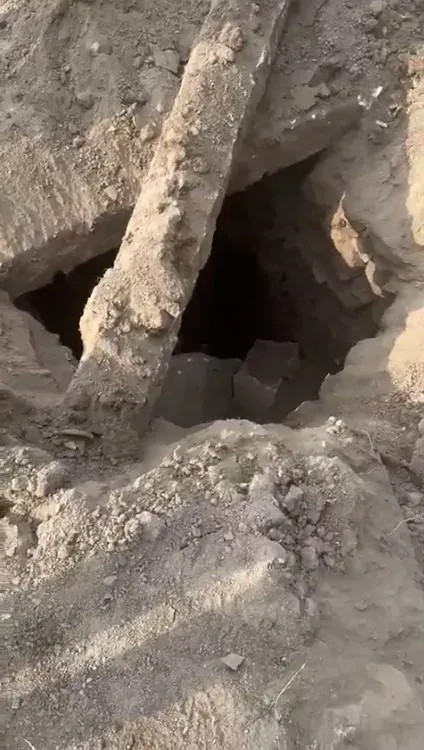
The structure, initially reported on social media as a tunnel, was found during levelling work carried out by the Artillery Centre at Golconda, located behind the fort. Upon inspection, the ASI team — comprising an archaeologist, engineer, surveyor, and the site in-charge — clarified that the find is not a tunnel.
'Upon preliminary inspection, it was said that the said structure is not a tunnel but a rectangular-shaped chamber measuring approximately 1.2 m × 1.8 m in length and width and 2.2 m in depth. It is constructed of granite stone, with rough stone masonry forming an internal wall-like structure. The team also noticed a few red-coloured potsherds, which appear to belong to the medieval period,' the ASI said in a statement.
Location and Legal Status
The site falls within the prohibited area of Golconda Fort, which extends beyond 100 metres from the fortification wall — a legally protected buffer under heritage conservation norms. The Bala Hissar portion of the fort, situated on a hillock, encloses several minor structures that historically served the public when Golconda functioned as a residential settlement.
ASI's Next Steps
The ASI Hyderabad Circle has formally communicated with the Artillery Centre, directing it to suspend further land-levelling until the investigation is concluded. The circle will report findings to ASI Director General Yadubir Singh Rawat, after whose approval a detailed excavation and survey will be undertaken. The investigation aims to determine the chamber's purpose and whether similar structures exist in the surrounding area.
Significance of Golconda Fort
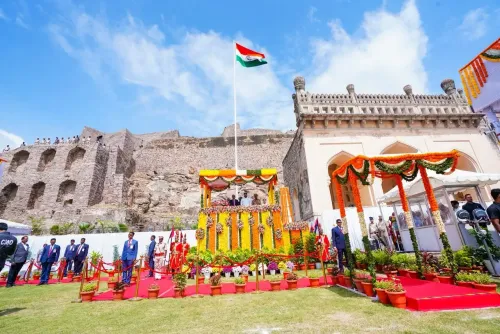
Built on a hill rising to approximately 120 metres, Golconda Fort is one of the largest and most prominent fortifications on the Deccan Plateau. The complex features three lines of fortification walls, 87 bastions, gateways, mosques, gardens, and royal residential quarters — representing a rare intact example of medieval Islamic military architecture and urban planning. The latest discovery adds a fresh layer of archaeological interest to a site already rich in historical significance.
The outcome of the detailed investigation, pending Director General approval, will determine whether the chamber is an isolated find or part of a larger subterranean network beneath the fort.
Point of View
But it raises a harder question: how was active land-levelling permitted inside a prohibited zone in the first place? The chamber's purpose is unknown, but the procedural lapse that nearly destroyed it deserves equal scrutiny. India's heritage protection framework has the rules; enforcement is the perennial gap.
NationPress
6 Oct 2026
Frequently Asked Questions
What was discovered at Golconda Fort in Hyderabad?
A rectangular granite chamber measuring approximately 1.2 m × 1.8 m and 2.2 m deep was found at Golconda Fort during land-levelling work by the Artillery Centre. Red-coloured potsherds inside the chamber are believed to date from the medieval period.
Is the structure at Golconda Fort really a tunnel?
No. Initial social media reports described it as a tunnel, but an ASI inspection team confirmed it is a small rectangular chamber, not a tunnel. The team found no evidence of a passageway.
Why has ASI halted work at the site?
The ASI Hyderabad Circle has directed the Artillery Centre to stop all land-levelling because the site falls within the fort's prohibited zone — legally protected land extending 100 metres beyond the fortification wall. Work will remain suspended until a detailed investigation is completed.
What happens next with the Golconda Fort chamber?
The ASI Hyderabad Circle will report the findings to ASI Director General Yadubir Singh Rawat. Upon his approval, a detailed investigation will be conducted to determine the chamber's purpose and whether similar structures exist nearby.
Why is Golconda Fort historically significant?
Golconda Fort is one of the largest fortifications on the Deccan Plateau, built on a hill rising to about 120 metres. It features three lines of fortification walls, 87 bastions, mosques, gardens, and royal quarters, and represents a well-preserved example of medieval Islamic military architecture.