Mizoram CM Lalduhoma Releases First-Ever ACB Annual Report
Synopsis
Chief Minister Lalduhoma released Mizoram's first-ever Anti-Corruption Bureau Annual Report for 2025-26 on 2 July 2026, reaffirming the government's zero-tolerance stance on corruption and calling it a shared responsibility of citizens and state employees alike.
Key Takeaways
Mizoram CM Lalduhoma released the state's first-ever ACB Annual Report (2025–26) on 2 July 2026 .
The report marks the first time the Anti-Corruption Bureau has publicly disclosed its annual activities in Mizoram's history.
CM Lalduhoma stated that fighting corruption is a 'shared responsibility of both citizens and government employees.' The release fulfils a key governance commitment made by the Zoram People's Movement government after its December 2023 election victory.
The move aligns Mizoram with a broader national trend of sub-national governments formalising anti-corruption accountability mechanisms.
Future editions of the report and any follow-up legislative actions in the Mizoram Legislative Assembly will be closely watched.
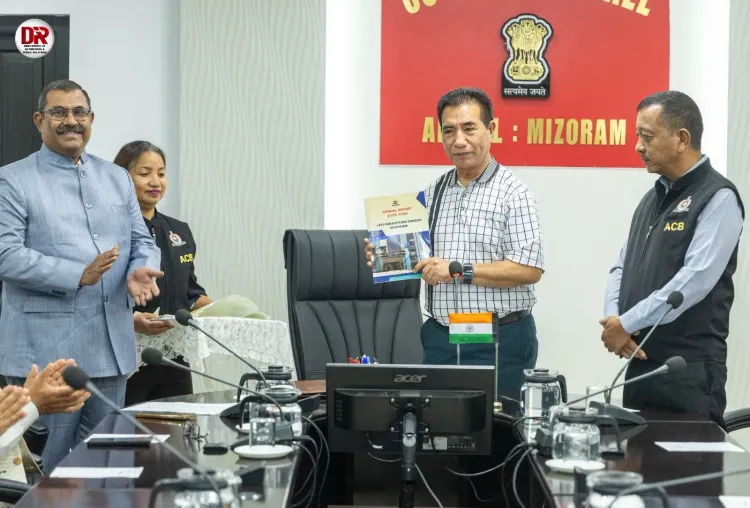
The Chief Minister's Office of Mizoram announced on Thursday, 2 July 2026, that Chief Minister Lalduhoma released the state's first-ever Anti-Corruption Bureau (ACB) Annual Report for 2025–26, marking a significant step in the Zoram People's Movement-led government's push for institutional accountability.
Releasing the report, CM Lalduhoma reaffirmed the government's commitment to 'transparency, accountability, and zero tolerance for corruption,' and stated that 'fighting corruption is a shared responsibility of both citizens and government employees.'
Context
The release of this annual report is the first of its kind for Mizoram's Anti-Corruption Bureau, a state agency tasked with investigating corruption cases and promoting integrity in public administration. The report covers the financial year 2025–26 and was formally unveiled by the Chief Minister himself, signalling executive-level ownership of the anti-corruption agenda.
The ACB Annual Report formalises what has previously been a largely internal accountability exercise, bringing it into the public domain for the first time in the state's history.
Policy Backdrop
When Lalduhoma led the Zoram People's Movement to victory in the December 2023 Mizoram assembly elections, the incoming government publicly committed to strengthening vigilance mechanisms and reducing corruption in state administration. The publication of the ACB's annual report is a concrete institutional output of that commitment, nearly two and a half years into the government's tenure.
Across India, state-level anti-corruption institutions have been incrementally formalised over the past decade, complementing central legislation such as the Prevention of Corruption Act. Mizoram now joins this sub-national trend of publishing structured accountability reports, particularly following changes of government that bring renewed political will to the issue.
Stakeholders and Impact
Mizoram's approximately 12 lakh citizens and the state's government employees are the primary stakeholders of this initiative. For citizens, the report represents a new mechanism of public oversight, enabling scrutiny of how corruption complaints are handled by the state. For government employees, the Chief Minister's explicit framing of anti-corruption work as a 'shared responsibility' signals that accountability expectations extend across the bureaucracy.
Civil society organisations and opposition legislators in the Mizoram Legislative Assembly are likely to engage with the report's findings, potentially using it as a benchmark for evaluating the government's performance on governance reforms in the years ahead.
What's Next
The release of the inaugural ACB Annual Report sets a precedent for annual public disclosure of the bureau's activities. Observers will watch whether the Mizoram government follows this with legislative or administrative actions — such as amendments to state vigilance rules or enhanced whistleblower protections — informed by the report's findings.
The continuity of this reporting practice will be a key indicator of whether the government's stated commitment to transparency translates into durable institutional reform beyond a single term.
Point of View
A message calibrated for both domestic and national audiences. By personally presiding over the release, the Chief Minister converts a bureaucratic document into a political statement, reinforcing the ZPM's founding promise to break from the patronage patterns of earlier administrations. This fits a broader arc visible across several north-eastern states where post-transition governments use institutional firsts — first audits, first RTI compliance reports, first anti-corruption disclosures — to differentiate themselves from predecessors. The real test, however, lies in whether the report triggers actionable follow-through in the assembly and within the ACB itself.
NationPress
2 Jul 2026
Frequently Asked Questions
What is the Mizoram ACB Annual Report 2025-26?
The Mizoram ACB Annual Report 2025-26 is the first-ever public annual report released by the state's Anti-Corruption Bureau, covering its activities during the financial year 2025–26. It was released by Chief Minister Lalduhoma on 2 July 2026.
Who is Lalduhoma, the Chief Minister of Mizoram?
Lalduhoma is the Chief Minister of Mizoram, heading the Zoram People's Movement-led government since December 2023 after winning the state assembly elections.
What is the Anti-Corruption Bureau (ACB) of Mizoram?
The Anti-Corruption Bureau of Mizoram is a state agency responsible for investigating corruption cases and promoting integrity in public administration under laws such as the Prevention of Corruption Act.
Why is the Mizoram ACB Annual Report significant?
It is the first time Mizoram's Anti-Corruption Bureau has published an annual report for public scrutiny, marking a step toward greater transparency and institutional accountability in the state.
What did CM Lalduhoma say about fighting corruption in Mizoram?
CM Lalduhoma stated that the government has zero tolerance for corruption and that fighting it is a shared responsibility of both citizens and government employees.