Assam Cancer Care Network expands: Mizoram joins cashless treatment pact
Synopsis
Assam's cancer care network just crossed another state border. With Mizoram now linked to the Assam Cancer Care Foundation under a cashless treatment pact — the third such interstate deal after Arunachal Pradesh and Nagaland — CM Himanta Biswa Sarma is quietly building what could become the Northeast's most consequential public health infrastructure.
Key Takeaways
Mizoram has partnered with the Assam Cancer Care Foundation (ACCF) to provide cashless cancer treatment under the Mizoram Universal Healthcare Scheme (MUHCS) .
CM Himanta Biswa Sarma announced the development on 8 July via a post on social media platform X .
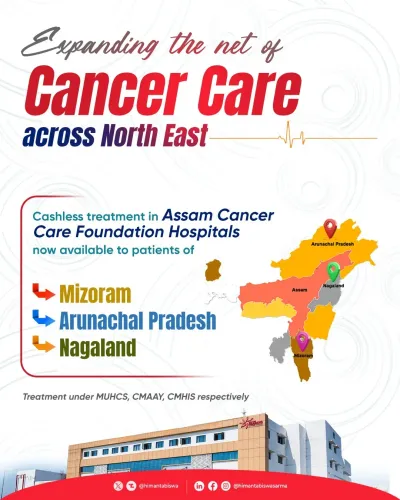
This is the third interstate partnership for the ACCF — after similar deals with Arunachal Pradesh (under CMAAY) and Nagaland (under CMHIS).
The Assam Cancer Care Foundation is a joint initiative of the Assam government and the Tata Trusts .
The tie-up aims to reduce the need for Northeast cancer patients to travel to distant metro cities for advanced oncology care.
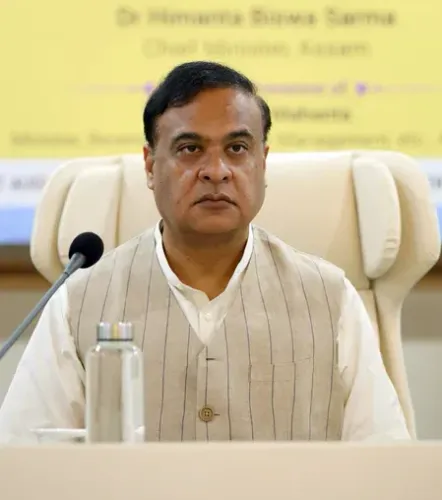
Assam Chief Minister Himanta Biswa Sarma announced on Wednesday, 8 July that Mizoram has formally partnered with the Assam Cancer Care Foundation (ACCF), allowing cancer patients from the neighbouring state to access cashless treatment at ACCF hospitals across Assam under the Mizoram Universal Healthcare Scheme (MUHCS). The development positions Assam as an expanding regional hub for specialised oncology care in the Northeast.
What the Mizoram Partnership Covers
Under the new arrangement, cancer patients from Mizoram can now receive treatment at any hospital run by the Assam Cancer Care Foundation without out-of-pocket expense, with costs covered under the MUHCS. Chief Minister Sarma described the agreement as 'another significant milestone in Assam's emergence as the country's new healthcare hub.'
The Chief Minister announced the development in a post on social media platform X, noting that the cashless access model removes a critical financial barrier for patients who previously had to travel to metropolitan cities outside the Northeast for advanced cancer care.
A Growing Northeast Cancer Care Network
The Mizoram agreement follows similar interstate arrangements already in place with Arunachal Pradesh and Nagaland. Patients from Arunachal Pradesh access ACCF hospitals under the Chief Minister Arogya Arunachal Yojana (CMAAY), while those from Nagaland are covered by the Chief Minister Health Insurance Scheme (CMHIS). With Mizoram now on board, the network spans at least three Northeast states beyond Assam itself.
This is the third such interstate collaboration, and it signals a deliberate effort to build a sub-regional oncology corridor anchored in Assam — a model that reduces patient migration to cities like Delhi, Mumbai, or Vellore for cancer treatment.
About the Assam Cancer Care Foundation
The Assam Cancer Care Foundation is a joint initiative of the Assam government and the Tata Trusts, established to expand specialised oncology services across the state through a dedicated network of cancer hospitals. The foundation has been progressively scaling its infrastructure to handle both intra-state and inter-state patient load.
Notably, the Tata Trusts partnership lends the ACCF a degree of institutional credibility and clinical expertise that has made it an attractive referral destination for neighbouring states seeking quality cancer care without the cost and distance of metro hospitals.
Impact on Patients and the Region
For cancer patients in Mizoram — a landlocked state with limited specialised medical infrastructure — the tie-up offers a materially improved treatment pathway. The cashless model under MUHCS means patients are spared the dual burden of travel costs and treatment expenses, which critics of Northeast healthcare access have long flagged as deterrents to timely diagnosis and care.
As Assam deepens these interstate health compacts, the broader Northeast stands to benefit from a more integrated approach to tertiary care — one that leverages Assam's geographic centrality and the ACCF's growing oncology capacity. Further expansion to other states in the region remains a possibility, according to official statements.
Point of View
Arunachal Pradesh, and Nagaland route patients into ACCF hospitals, whether the foundation can scale throughput without compromising quality for Assam's own patients will determine whether this is a lasting regional asset or a well-intentioned bottleneck.
NationPress
7 Oct 2026
Frequently Asked Questions
What is the new Mizoram-Assam cancer care partnership?
Mizoram has partnered with the Assam Cancer Care Foundation (ACCF) to allow cancer patients from Mizoram to receive cashless treatment at ACCF hospitals across Assam under the Mizoram Universal Healthcare Scheme (MUHCS). The agreement was announced by Assam Chief Minister Himanta Biswa Sarma on 8 July.
Which other Northeast states have similar arrangements with the ACCF?
Arunachal Pradesh and Nagaland already have similar interstate health compacts with the ACCF. Arunachal Pradesh patients are covered under the Chief Minister Arogya Arunachal Yojana (CMAAY), while Nagaland patients access care under the Chief Minister Health Insurance Scheme (CMHIS). Mizoram is the third such state.
What is the Assam Cancer Care Foundation?
The Assam Cancer Care Foundation is a joint initiative of the Assam government and the Tata Trusts, set up to expand specialised oncology services across Assam through a network of dedicated cancer hospitals. It has been scaling infrastructure to serve both Assam residents and patients from neighbouring states.
Why does this matter for cancer patients in the Northeast?
Many Northeast states lack advanced oncology infrastructure, forcing patients to travel to distant cities like Delhi, Mumbai, or Vellore for treatment. The cashless access model under state health schemes removes both the financial and logistical burden, enabling earlier and more affordable cancer care closer to home.
What is the Mizoram Universal Healthcare Scheme (MUHCS)?
The Mizoram Universal Healthcare Scheme (MUHCS) is Mizoram's state health coverage programme. Under the new partnership, it now covers cashless cancer treatment at ACCF hospitals in Assam, extending its benefits beyond Mizoram's own medical facilities.