INS Dunagiri, Sanshodhak, Agray commissioned: Modi's naval push in Bengal
Synopsis
Three warships — INS Dunagiri, INS Sanshodhak, and INS Agray — were inducted into the Indian Navy in a single ceremony in West Bengal on 21 June, with PM Modi framing the event as proof that India is shifting from arms buyer to defence creator. With 45 more platforms under construction and 200-plus MSMEs already in the supply chain, this is less a ribbon-cutting and more a statement of industrial intent.
Key Takeaways
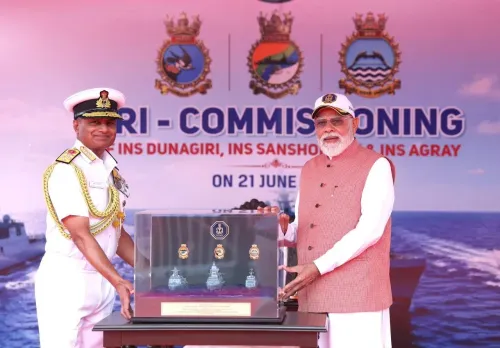
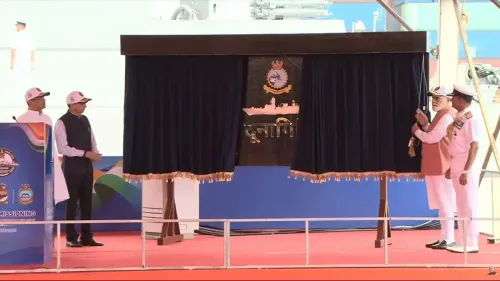
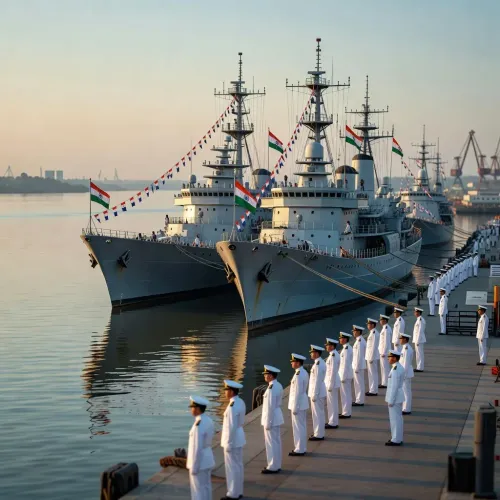
PM Narendra Modi commissioned INS Dunagiri , INS Sanshodhak , and INS Agray on 21 June 2025 at the Syama Prasad Mookerjee Port , West Bengal.
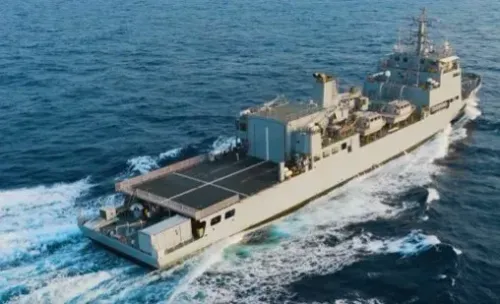
INS Sanshodhak is described as India's most advanced hydrographic survey ship, commissioned on World Hydrography Day .
More than 200 MSMEs contributed to the construction of the three vessels, underlining the domestic defence manufacturing push.
Around 45 major naval platforms are currently under construction across Indian shipyards, according to Modi.
Modi declared India's intent to move from being a defence buyer to a 'creator' capable of shaping global outcomes.
The ceremony coincided with International Yoga Day and World Hydrography Day .
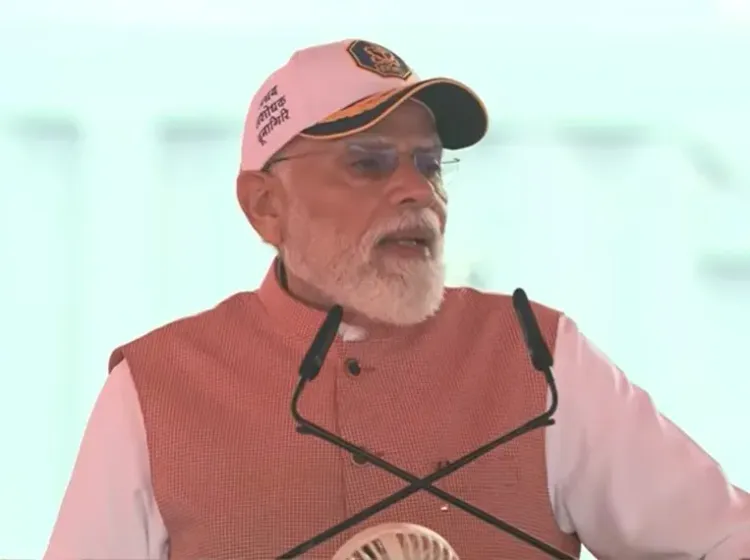
Prime Minister Narendra Modi on Sunday, 21 June 2025 presided over the Tri-Commissioning ceremony of INS Dunagiri, INS Sanshodhak, and INS Agray at the Syama Prasad Mookerjee Port in West Bengal, inducting three major naval platforms into the Indian Navy in a single event. The ceremony marks one of the most significant single-day expansions of India's naval fleet in recent years, and underscores the Centre's push for maritime self-reliance under the Viksit Bharat framework.
What Was Commissioned
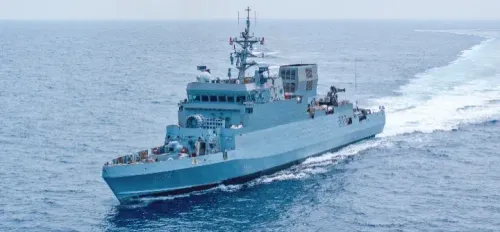
INS Dunagiri is a stealth frigate, INS Agray a missile vessel, and INS Sanshodhak India's most advanced hydrographic survey ship. The induction of all three on the same day was deliberate — the event coincided with International Yoga Day and World Hydrography Day, lending symbolic weight to the occasion. Modi specifically called out INS Sanshodhak's commissioning as a milestone for maritime domain awareness, noting its relevance to World Hydrography Day.
What Modi Said
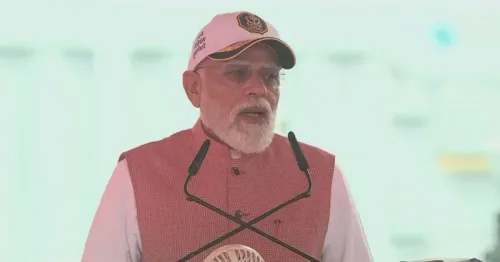
Addressing the gathering, Modi said, 'Today is special in many ways. The whole world is celebrating International Day of Yoga. I am happy that on this occasion I got the opportunity to come to the soil of Bengal. This land has given new direction and momentum to India's ideology and progress, and for centuries, it has connected India to the world through sea routes.'
On India's strategic maritime ambitions, he stated, 'The world is witnessing that without maritime capability, no country can become a major power. Oceans are linked with development and security. Today, most global trade moves through sea routes, and even data networks pass through deep-sea cables. Future resources, including new energy sources, will also be connected through the oceans. Therefore, the nation with strong maritime capability will have a strong economy.'
Modi also drew a direct line from the commissioning of INS Vikrant — India's first domestically built aircraft carrier — to the current milestone: 'From INS Vikrant till today, this journey reflects India's growing self-reliance.'
Defence Manufacturing and the MSME Ecosystem
A notable aspect of the ceremony was Modi's emphasis on the industrial ecosystem behind the three ships. He stated that more than 200 MSMEs contributed to their construction, and that a modern warship requires tonnes of steel, electronics, and machinery — generating employment across thousands of supplier companies. 'In the coming days, India's maritime sector will generate employment for lakhs of people. That is why we do not see it as an isolated sector but as an employment engine for Viksit Bharat,' he said.
Notably, around 45 major naval platforms are currently under construction across Indian shipyards, according to the Prime Minister — a figure he cited as evidence of India's expanding industrial capability rather than just military intent.
Strategic Shift: From Buyer to Builder
Modi framed India's naval expansion explicitly as a departure from import dependence. 'India today does not want to remain just a buyer. Our armed forces cannot be dependent only on global markets. India wants to become a creator and, the day we become a creator, we will also become decisive in shaping global outcomes,' he said. This comes amid a broader government push to raise domestic defence production, with indigenisation targets set across platforms ranging from submarines to fighter jets.
What Comes Next
The induction of these three vessels adds direct operational capacity to the Indian Navy's eastern and survey commands. With 45 platforms still in the pipeline, the pace of fleet expansion is set to continue. Analysts note that India's maritime posture in the Indian Ocean Region — increasingly contested — will be shaped significantly by how fast these platforms become operationally ready.
Point of View
But shipyard bottlenecks and supply-chain delays have historically pushed delivery schedules. More critically, the shift from 'buyer to creator' rhetoric must be tested against export outcomes and technology transfer depth — two metrics where India's defence indigenisation record remains uneven. The MSME ecosystem angle is the most underreported story here: if 200-plus small firms are now embedded in naval supply chains, that is a structural change worth tracking beyond the headline ceremony.
NationPress
20 Sept 2026
Frequently Asked Questions
Which ships were commissioned at the Tri-Commissioning ceremony in West Bengal?
INS Dunagiri, INS Sanshodhak, and INS Agray were commissioned into the Indian Navy at the Syama Prasad Mookerjee Port in West Bengal on 21 June 2025. INS Sanshodhak is India's most advanced hydrographic survey ship, while INS Dunagiri is a stealth frigate and INS Agray a missile vessel.
What did PM Modi say at the naval commissioning ceremony?
Modi said India no longer wants to remain 'just a buyer' in defence and aims to become a 'creator' that shapes global outcomes. He also highlighted that around 45 major naval platforms are under construction and that more than 200 MSMEs contributed to the three commissioned ships.
Why is the INS Sanshodhak commissioning significant?
INS Sanshodhak is described as India's most advanced hydrographic survey ship, critical for maritime domain awareness, charting sea routes, and supporting naval operations. Its commissioning on World Hydrography Day added strategic symbolism to the event.
How many naval platforms is India currently building?
According to PM Modi, around 45 major naval platforms are currently under construction in India. He cited this as evidence of India's growing industrial and defence manufacturing capability.
What is the connection between the naval commissioning and Viksit Bharat?
Modi framed the maritime sector as an 'employment engine for Viksit Bharat,' noting that warship construction generates jobs across steel, electronics, and machinery supply chains. He said India's maritime expansion is integral to its broader economic development vision.