CM Rekha Gupta shares Modi's vision for Ladakh education

Synopsis
Delhi CM Rekha Gupta shared PM Modi's statement outlining plans for a Center of Excellence in Leh and satellite campuses of IIT Jammu and IIM Jammu to give Ladakhi youth access to quality higher education and skills within their own region.
Key Takeaways
A large Center of Excellence is being built in Leh to provide higher education and technology skills to Ladakhi youth locally.
Proposals to establish satellite campuses of IIT Jammu and IIM Jammu in Ladakh are being advanced by the central government.
The initiative aims to end Ladakhi students' dependence on distant cities for quality higher education, research, and skill development.
Ladakh became a Union Territory in 2019 ; since then, the central government has accelerated higher-education infrastructure in the region.
Formal approvals, land allocation, and construction timelines for the campuses and the Center of Excellence are the key next milestones.
A Center of Excellence in Leh and satellite campuses of two of India's most prestigious institutions — the blueprint for transforming higher education in Ladakh is taking shape, and Delhi Chief Minister Rekha Gupta amplified the push on Thursday, October 15, 2026, sharing Prime Minister Narendra Modi's statement on equipping the region's youth with world-class learning opportunities at home.
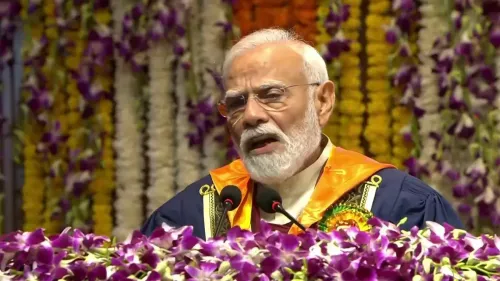
Quoting PM Modi directly, the post states: 'Our special focus is on the new generation of Ladakh. Young people here should get good education, an opportunity to learn new technology, and should not have to depend on other cities — a large Center of Excellence is being built in Leh for this purpose.'
IIT Jammu and IIM Jammu satellite campuses move forward
The statement goes further, noting that proposals to establish satellite campuses of IIT Jammu and IIM Jammu in Ladakh are being advanced. If realised, this would give Ladakhi students access to premier technical and management education without having to relocate to distant cities — a significant shift for a Union Territory that has historically lacked top-tier higher-education infrastructure.
The government's framing is deliberate: 'उच्च शिक्षा, Research और नई Skills' (higher education, research, and new skills) within the region itself. The combination of a locally built Center of Excellence and two nationally recognised institutional anchors is designed to stop the outward drift of young talent from one of India's most strategically sensitive borders.
Ladakh's education gap since 2019
When Ladakh became a Union Territory in 2019, separating from Jammu and Kashmir, the central government inherited a region with limited higher-education options relative to its geography and demographic ambitions. Successive policy moves have tried to close that gap — expanding institutions through satellite campuses in border and hill regions is part of a wider strategy to build human-capital infrastructure in newly reorganised territories.
The satellite-campus model has been used elsewhere to bring IIT and IIM-quality education closer to underserved populations without the cost and timeline of building standalone institutions. Applied to Leh, it means Ladakhi students could potentially access engineering, management, and research programmes without leaving their home region.
What moves next: approvals, land, timelines
The proposals are described as being 'advanced' — formal approvals, land allocation, and construction schedules for both the Leh Center of Excellence and the two satellite campuses remain the critical next steps. The pace of those decisions will determine whether this vision translates into classrooms before the next generation of Ladakhi students faces the same choice their predecessors did: stay or leave.
For a Union Territory that sits at the intersection of India's borders with China and Pakistan, investing in the education and retention of local youth carries consequences well beyond the classroom.
Point of View
Given the Union Territory's sensitive border geography. By anchoring the pitch around reducing youth out-migration, the BJP is also building a long-term political narrative of transformation in a region that has been central to its national-security messaging since 2019. The satellite-campus model, if executed, offers a faster and cheaper route to institutional credibility than building standalone IITs or IIMs, making it a replicable template for other frontier UTs. The real test will come in the approvals and funding pipeline — announcements in this region have historically moved more slowly than the political calendar.
NationPress
15 Oct 2026
Frequently Asked Questions
What is the Center of Excellence being built in Leh?
A large Center of Excellence is being constructed in Leh, Ladakh to provide local youth with quality higher education, new technology training, and skill development, reducing the need to travel to other cities.
Will IIT Jammu open a campus in Ladakh?
A proposal to establish a satellite campus of IIT Jammu in Ladakh is being advanced, though formal approvals and timelines have not yet been confirmed.
Will IIM Jammu open a campus in Ladakh?
Similarly, a proposal for a satellite campus of IIM Jammu in Ladakh is also being advanced as part of the same higher-education expansion initiative.
Why is the government focused on education in Ladakh?
Since Ladakh became a Union Territory in 2019 , the central government has prioritised closing the region's higher-education gap to retain local talent and build human capital in a strategically important border region.
What did PM Modi say about Ladakh youth education?
PM Modi stated that Ladakhi youth should get good education and technology skills in their own region and should not have to depend on other cities — anchoring the Leh Center of Excellence and satellite campus proposals in that vision.