Gadkari: PM Modi Inaugurates Key NH Projects in Chandigarh
Synopsis
Prime Minister Narendra Modi inaugurated the 31.23 km IT City–Kurali section of NH-205A in Chandigarh on July 17, 2026, and laid the foundation stone for the 10.3 km PR-7 Spur. The projects will bypass Mohali, Panchkula and Zirakpur, cut travel time by 45 minutes, and complete a vital link of the Tricity Ring Road.
Key Takeaways
PM Modi inaugurated the 31.23 km IT City–Kurali section of NH-205A in Chandigarh on July 17, 2026 .
The corridor bypasses Mohali and Kharar and will reduce travel time by up to 45 minutes .
The project will decongest Airport Road , lower vehicular emissions, and support growth in IT City and New Chandigarh .
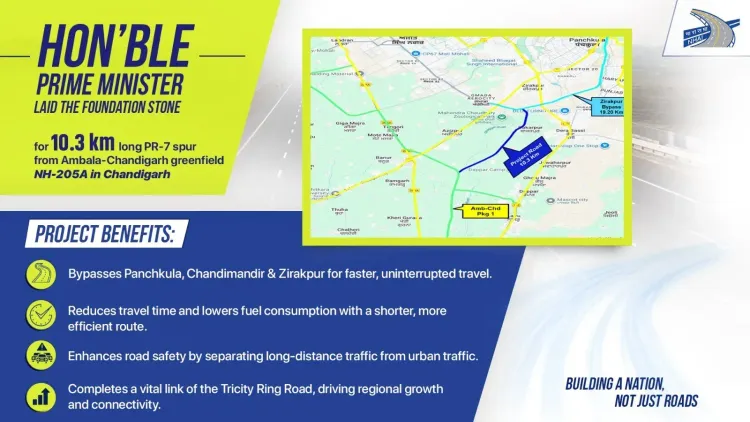
PM Modi also laid the foundation stone for the 10.3 km PR-7 Spur connecting the Ambala–Chandigarh Greenfield NH-205A.
The PR-7 Spur will bypass Panchkula , Chandimandir , and Zirakpur , completing a vital link of the Tricity Ring Road .
Both projects are anchored in the PM GatiShakti National Master Plan framework.
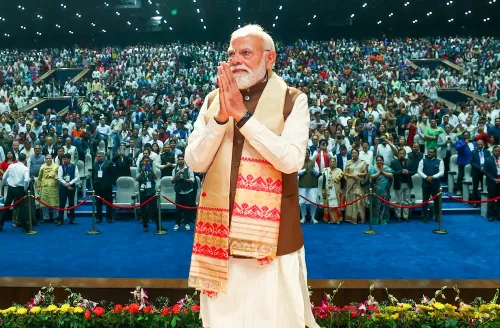
Union Road Transport and Highways Minister Nitin Gadkari announced on Friday, July 17, 2026, that Prime Minister Narendra Modi, in Chandigarh, inaugurated and laid the foundation stone of key National Highway projects aimed at strengthening regional connectivity and reducing travel time across the Tricity region.
What Was Inaugurated
Prime Minister Modi inaugurated the 31.23 km IT City–Kurali section of NH-205A, a corridor that bypasses Mohali and Kharar. According to Minister Gadkari's post, the project will reduce travel time by up to 45 minutes, decongest Airport Road, lower vehicular emissions, and support the growth of IT City, New Chandigarh, Kharar, and Kurali.
The Prime Minister also laid the foundation stone for the 10.3 km PR-7 Spur connecting the Ambala–Chandigarh Greenfield NH-205A. This spur is designed to bypass Panchkula, Chandimandir, and Zirakpur, enabling faster and safer travel while reducing fuel consumption through a shorter route.
Context
The Tricity region — comprising Chandigarh, Mohali, and Panchkula — has long faced traffic congestion challenges driven by rapid urbanisation, expanding IT and industrial zones, and growing inter-city commuter volumes. Airport Road in particular has been a persistent bottleneck, handling both local and long-distance traffic without adequate separation.
The NH-205A Greenfield corridor is part of a broader national push to build ring roads and bypass corridors around major urban agglomerations, reducing the burden on existing city road networks while improving last-mile connectivity to economic hubs.
Policy Backdrop
Both projects are aligned with the government's PM GatiShakti National Master Plan, which seeks to integrate infrastructure planning across ministries and reduce logistics costs. The hashtags #PragatiKaHighway and #GatiShakti used by Minister Gadkari in his post explicitly situate these projects within that national framework.
The Tricity Ring Road — of which the PR-7 Spur is described as a 'vital link' — is intended to separate long-distance traffic from urban traffic, a design principle increasingly adopted in highway planning around Indian metros. Completing such ring corridors is seen as essential to unlocking the economic potential of satellite towns like Kurali, Kharar, and New Chandigarh.
Stakeholders and Impact
Residents and daily commuters across Mohali, Panchkula, Zirakpur, and Kharar stand to benefit most directly from reduced travel times and lower fuel costs. The IT and real-estate sectors around IT City and New Chandigarh are expected to see improved accessibility, which could accelerate commercial and residential development in those corridors.
Environmental benefits cited include lower vehicular emissions resulting from reduced idling in congested zones and shorter route distances — outcomes that align with broader urban air-quality targets for the region.
What's Next
With the foundation stone for the PR-7 Spur now laid, construction timelines and contractor details are expected to be announced through the National Highways Authority of India (NHAI) in the coming weeks. The inauguration of the IT City–Kurali section signals that this stretch is ready for public use, while the Spur project moves into its execution phase. Completion of the full Tricity Ring Road will depend on the pace at which the remaining links are tendered and built.
Point of View
Straddling Punjab, Haryana, and a Union Territory, is a complex political geography, and high-profile highway events here carry symbolic weight beyond logistics. Minister Gadkari's framing of both projects under the GatiShakti banner reflects a deliberate effort to present dispersed highway investments as part of a coherent national plan rather than isolated local works. The emphasis on emission reduction and fuel savings also signals an attempt to align hard infrastructure with sustainability narratives increasingly demanded by urban middle-class voters.
NationPress
16 Oct 2026
Frequently Asked Questions
What is the IT City–Kurali section of NH-205A?
It is a 31.23 km national highway corridor inaugurated by PM Modi on July 17, 2026, that connects IT City to Kurali while bypassing Mohali and Kharar, reducing travel time by up to 45 minutes.
What is the PR-7 Spur and where does it connect?
The PR-7 Spur is a 10.3 km road that connects the Ambala–Chandigarh Greenfield NH-205A. It bypasses Panchkula, Chandimandir, and Zirakpur, and forms a vital link of the Tricity Ring Road.
How will the NH-205A corridor benefit commuters in the Tricity region?
Commuters will benefit from up to 45 minutes saved in travel time , reduced congestion on Airport Road, lower fuel consumption due to a shorter route, and separation of long-distance traffic from urban roads.
What is the GatiShakti plan and how are these projects linked to it?
The PM GatiShakti National Master Plan is a government framework that integrates infrastructure planning across ministries to reduce logistics costs. Both the NH-205A corridor and the PR-7 Spur are positioned under this plan, as indicated by Minister Gadkari's post.
Which areas will benefit from the Tricity Ring Road completion?
Towns and districts including Mohali, Panchkula, Zirakpur, Kharar, Kurali, New Chandigarh , and IT City are expected to benefit from improved connectivity, lower travel times, and reduced urban congestion once the ring road is complete.