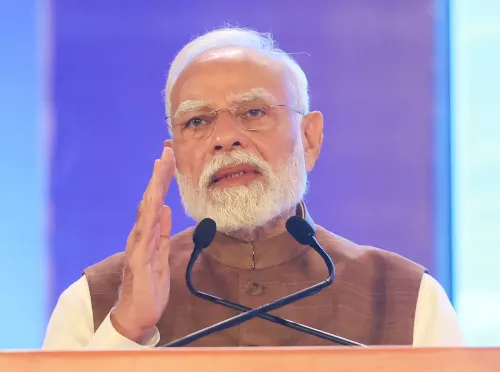
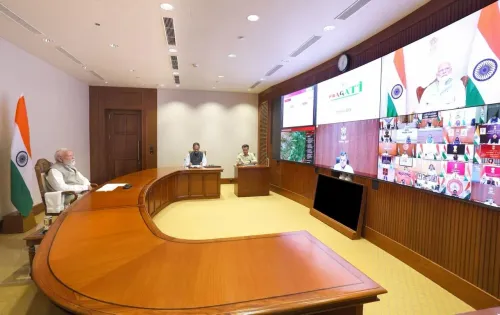
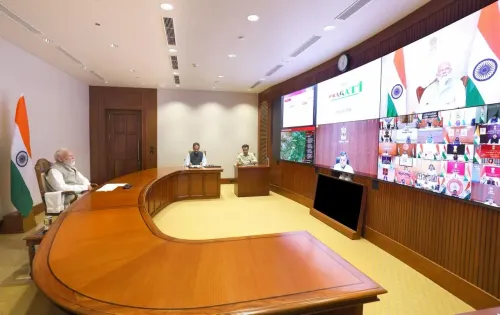
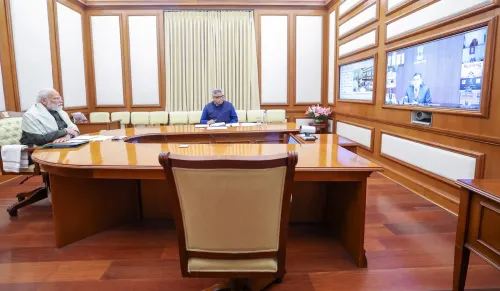
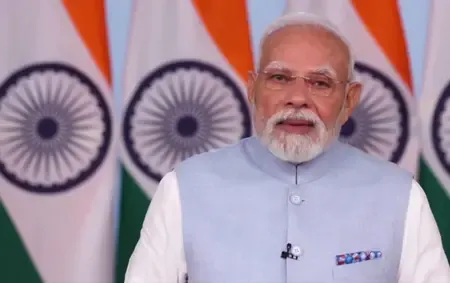
PM Modi Chairs 54th PRAGATI Meet, Reviews Rs 16,000 Cr Projects
Synopsis
Prime Minister Narendra Modi chaired the 54th PRAGATI meeting, reviewing over Rs 16,000 crore in projects across 31 States and UTs. Agenda covered railway station redevelopment, pharmaceutical self-reliance under PLI, and Ekta Malls for local artisans, reinforcing the Atmanirbhar Bharat delivery framework.
Key Takeaways
PM Modi chaired the 54th PRAGATI meeting on 29 October 2026 , reviewing projects worth over Rs 16,000 crore .
The review spanned 31 States and Union Territories , covering four main themes.
Faster redevelopment of railway stations as multimodal hubs — under the Amrit Bharat Station Scheme covering 1,300+ stations — was a key agenda item.
Pharmaceutical self-reliance under the PLI for Pharmaceuticals scheme (notified 2020) was reviewed for delivery progress.
Ekta Malls — infrastructure to empower artisans and local businesses linked to the One District One Product framework — featured on the agenda.
The meeting underscores the government's use of PRAGATI as a real-time enforcement tool for central-scheme timelines under the broader Atmanirbhar Bharat vision.
A single monthly video call — and Prime Minister Narendra Modi put Rs 16,000 crore worth of stalled or slow-moving projects under the microscope. The 54th PRAGATI meeting, chaired by the Prime Minister on Wednesday, 29 October 2026, spanned 31 States and Union Territories and zeroed in on four consequential agenda items: railway station redevelopment, pharmaceutical self-reliance, artisan empowerment through Ekta Malls, and the broader pace of project execution.
What PRAGATI Is — and Why the 54th Sitting Matters
Launched in March 2015, the PRAGATI (Pro-Active Governance and Timely Implementation) platform was conceived as a direct line between the Prime Minister's office and project officers on the ground. No intermediaries, no lengthy file-noting — just real-time data, video links to district collectors and secretaries, and a Prime Minister who asks why a bridge is three years behind schedule. Over more than a decade, the platform has become the BJP government's flagship accountability mechanism for central-scheme delivery.
The 54th edition of that exercise now puts the cumulative reviewed investment in the thousands of crores, signalling that the platform has moved well past its early proof-of-concept phase into a routine — but high-stakes — instrument of governance.
Railway Stations as Multimodal Hubs: The Amrit Bharat Push
The meeting's infrastructure centrepiece was the redevelopment of railway stations under the Amrit Bharat Station Scheme, launched in February 2023 to modernise over 1,300 stations across the country. The vision: transform functional but ageing stations into multimodal connectivity nodes — places where trains, metro links, buses and last-mile services converge. Faster redevelopment timelines were explicitly flagged at the meeting, suggesting the Prime Minister's office wants execution to accelerate beyond current pace.
Pharma Self-Reliance Back in the Spotlight
The second major theme was India's pharmaceutical manufacturing capability, reviewed under the lens of the Production Linked Incentive (PLI) scheme for Pharmaceuticals, first notified in 2020. That scheme offers output-linked incentives for domestic production of bulk drugs and formulations, directly targeting the import dependence that was starkly exposed during the pandemic years. Placing pharma on a PRAGATI agenda signals that the central government is tracking output and investment commitments — not just approvals.
Ekta Malls: Local Artisans Get an Infrastructure Play
Ekta Malls — dedicated retail and display infrastructure for local artisans and businesses — emerged as the third focus area. The concept connects directly to the One District One Product framework, which has been scaled nationally since 2018 to surface district-level craft and manufacturing into formal commerce. Bringing Ekta Malls onto the PRAGATI review table suggests the government is moving from policy announcements to tracking physical implementation and market linkage for artisan communities.
The Atmanirbhar Thread Running Through All Four Agendas
Read together, the four agenda items are not unrelated bureaucratic line items — they are a cross-sectoral expression of the Atmanirbhar Bharat framework: build domestic production in strategic sectors like health, modernise logistics infrastructure, and ensure local economies generate visible, trackable livelihoods. The Prime Minister's closing note in his post — 'the focus is clear… substantive outcomes, timely execution and long lasting benefits for people' — frames PRAGATI less as a meeting and more as a delivery guarantee.
The next PRAGATI session will tell watchers whether the reviewed projects have moved — and how many of the 31 States and UTs under the microscope this week have cleared their outstanding milestones.
Point of View
Pharma PLI and Ekta Malls each sit at the intersection of infrastructure, industrial self-reliance and rural livelihood — the three pillars the BJP has consistently used to frame its development narrative ahead of electoral cycles. Whether PRAGATI's review pressure actually accelerates on-ground fund utilisation or merely surfaces data without changing contractor and state-agency behaviour remains the central unanswered question after eleven years of the platform's existence.
NationPress
29 Oct 2026
Frequently Asked Questions
What is the PRAGATI platform launched by PM Modi?
PRAGATI — Pro-Active Governance and Timely Implementation — is a real-time project-monitoring platform launched in March 2015 that allows the Prime Minister to directly review the progress of central government schemes and grievances with state officials via video conferencing every month.
What was reviewed at the 54th PRAGATI meeting?
The 54th PRAGATI meeting chaired by PM Modi on 29 October 2026 reviewed projects worth over Rs 16,000 crore across 31 States and UTs , focusing on railway station redevelopment, pharma manufacturing self-reliance, and Ekta Malls for local artisans.
What is the Amrit Bharat Station Scheme?
The Amrit Bharat Station Scheme , launched in February 2023 , aims to redevelop more than 1,300 railway stations across India into modern multimodal hubs integrating multiple modes of transport and improved passenger amenities.
What are Ekta Malls and how do they help artisans?
Ekta Malls are dedicated retail and display infrastructure spaces designed to promote products by local artisans and businesses, linked to the One District One Product scheme that has been scaled nationally since 2018 to connect local crafts and manufacturing to wider markets.
What is the PLI scheme for pharmaceuticals?
The Production Linked Incentive scheme for Pharmaceuticals , notified in 2020 , provides output-linked financial incentives to domestic manufacturers of bulk drugs and formulations to reduce India's dependence on pharmaceutical imports and boost self-reliance in the sector.