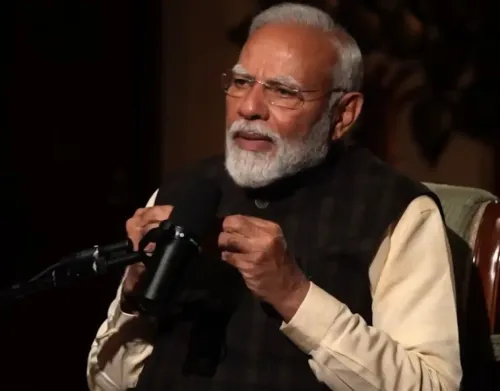
PM Modi Speaks on Safe and Rapid AI Rollout at Global Session

Synopsis
Prime Minister Narendra Modi spoke at a global session on ensuring a safe, rapid and efficient AI rollout on June 17, 2026, calling the issue of immense importance. His remarks align with India's long-standing '#AIforAll' policy and its role as a founding member of the Global Partnership on AI.
Key Takeaways
PM Modi addressed an international session on 'Ensuring a Safe, Rapid and Efficient Rollout of AI' on June 17, 2026 .
He described AI governance as a subject of 'immense importance for the global community,' noting AI has 'touched all aspects of human life.' India has been a founding member of the Global Partnership on AI (GPAI) since 2020 .
India's National Strategy for AI (#AIforAll) was released in 2018 , emphasising inclusive and responsible adoption.
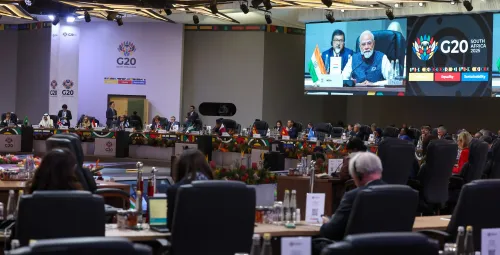
Modi's remarks are consistent with India's stated position at G20 and UN forums: AI innovation must be matched with safeguards against bias, privacy risks and inequality.
India's National AI Mission implementation and proposals at upcoming multilateral forums will be closely watched.
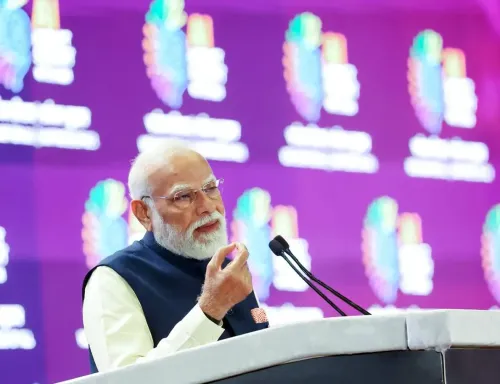
Prime Minister Narendra Modi addressed an international session on 'Ensuring a Safe, Rapid and Efficient Rollout of AI' on Wednesday, June 17, 2026, calling the subject one of 'immense importance for the global community' and noting that AI's transformative potential has 'touched all aspects of human life.'
Context
In his address, PM Modi acknowledged the widely recognised transformative power of artificial intelligence while signalling that its ultimate measure lies beyond its technical capabilities. His post, shared on June 17, 2026, quoted him as saying: 'The true test of AI is not how' — a statement whose continuation underscored the need for responsible deployment over raw speed. The remarks reflect a consistent theme in India's approach to emerging technology: innovation must be paired with safeguards.
India has been an active participant in global AI governance conversations, having joined the Global Partnership on AI (GPAI) as a founding member in 2020. The country also released its National Strategy for AI, branded #AIforAll, as far back as 2018, positioning inclusive and responsible adoption as a national priority.
Policy Backdrop
Under PM Modi, India has sought to shape international norms on emerging technologies while simultaneously accelerating domestic AI infrastructure and skilling programmes. At successive G20 summits and United Nations platforms, New Delhi has advocated for AI governance frameworks that balance innovation speed with protections against bias, privacy risks and inequality.
The government's National AI Mission represents the latest domestic push, aimed at building compute capacity, curating datasets and scaling AI applications across sectors such as agriculture, health and education. Modi's framing of AI governance as a test of values — not just technology — is consistent with the 'AI for All' philosophy that has guided Indian policy for nearly a decade.
Stakeholders and Impact
The session's subject — ensuring a safe, rapid and efficient rollout — speaks directly to the tension felt by global policymakers and AI developers alike. Deploying AI at scale risks amplifying existing inequalities if governance frameworks lag behind technological capabilities, a concern that developing economies like India have repeatedly raised at multilateral forums.
For India specifically, the stakes are high: the country has a large, young, digitally connected population and a growing technology sector that stands to benefit enormously from AI adoption. At the same time, risks around data privacy, algorithmic bias and workforce displacement require active policy attention. PM Modi's participation in such sessions signals that New Delhi intends to remain a rule-shaper, not merely a rule-taker, in global AI governance.
What's Next
Attention will now turn to India's follow-up proposals at upcoming multilateral AI forums and the pace of implementation of the National AI Mission. As major economies race to set the terms for AI regulation — from the European Union's AI Act to emerging frameworks in the United States — India's voice in these deliberations will carry increasing weight. Whether PM Modi's remarks at this session translate into concrete multilateral proposals will be closely watched by both the global technology community and domestic stakeholders.
Point of View
He is signalling that India will push for value-laden guardrails at multilateral forums, not just speed-to-market metrics. This stance also serves a domestic function: it provides political cover for measured AI regulation at home without being seen as anti-innovation. The consistency of this message across G20, GPAI and now this session suggests a coordinated, long-term diplomatic play rather than a one-off statement.
NationPress
16 Sept 2026
Frequently Asked Questions
What did PM Modi say about AI at the global session on June 17 2026?
PM Modi said AI's transformative potential is 'widely known' and has 'touched all aspects of human life,' but argued that the true test of AI lies beyond its technical capabilities — implying that safety, equity and responsible governance are the real benchmarks.
Which global AI body is India a member of?
India is a founding member of the Global Partnership on AI (GPAI) , a multi-stakeholder initiative launched in 2020 to advance responsible AI development and policy.
What is India's National AI Strategy?
India released its National Strategy for AI , branded #AIforAll , in 2018 . It guides inclusive and responsible AI adoption across sectors such as agriculture, health and education.
What is the India National AI Mission?
The National AI Mission is India's latest government initiative aimed at building domestic compute infrastructure, curating datasets and scaling AI applications, reflecting the country's ambition to be a global AI leader.
Why does India push for AI governance at global forums?
India advocates for balanced AI governance frameworks at forums like the G20 and the UN to protect against bias, privacy risks and inequality, while also ensuring that developing nations like India can benefit from — and help shape — the global AI order.