Modi-Takaichi summit: 3 landmark pacts signed at 16th India-Japan Annual Summit
Synopsis
India and Japan didn't just exchange pleasantries at the 16th Annual Summit — they signed their first-ever defence co-development agreement, adopted three landmark joint documents on economic security, AI, and energy, and laid out a roadmap for their 75th diplomatic anniversary. Takaichi's first India visit as PM has reset the pace of one of Asia's most consequential strategic partnerships.
Key Takeaways
PM Modi and Japanese PM Sanae Takaichi held the 16th India-Japan Annual Summit at Hyderabad House, New Delhi on 2 July 2025 .
Three landmark documents adopted: Joint Declaration on Economic Security , Joint Statement on AI Cooperation , and Joint Statement on Energy Resilience .
India and Japan signed their first-ever defence co-development project agreement .
Both sides agreed on activities to celebrate the 75th anniversary of India-Japan diplomatic relations.
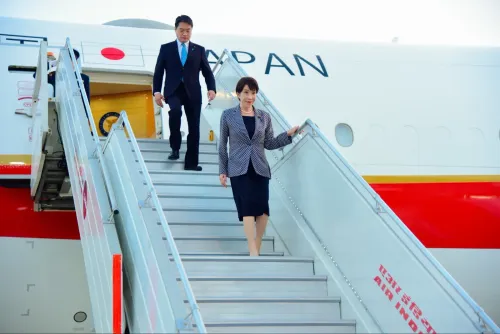
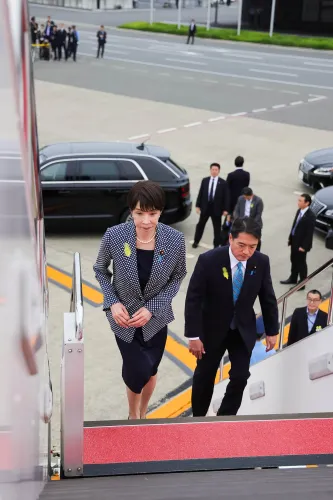
This is Takaichi's first official visit to India since assuming office; follows Modi's Tokyo visit in August 2025 .
Both leaders reaffirmed commitment to a free, rules-based Indo-Pacific as a shared strategic priority.
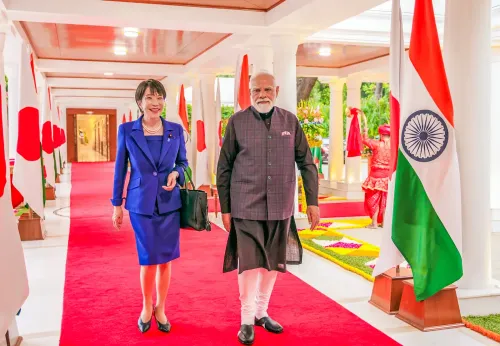
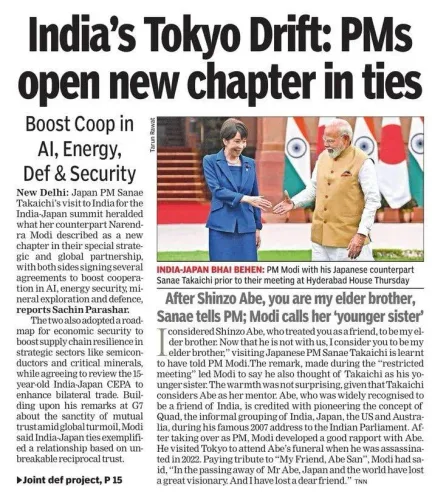
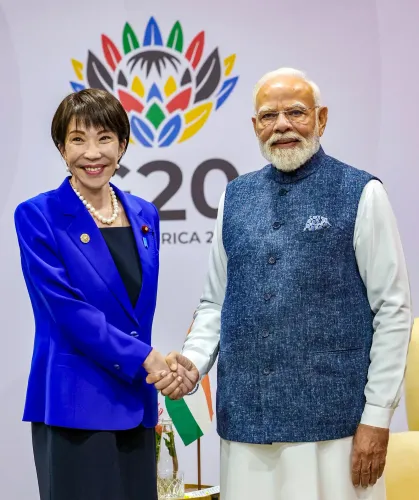
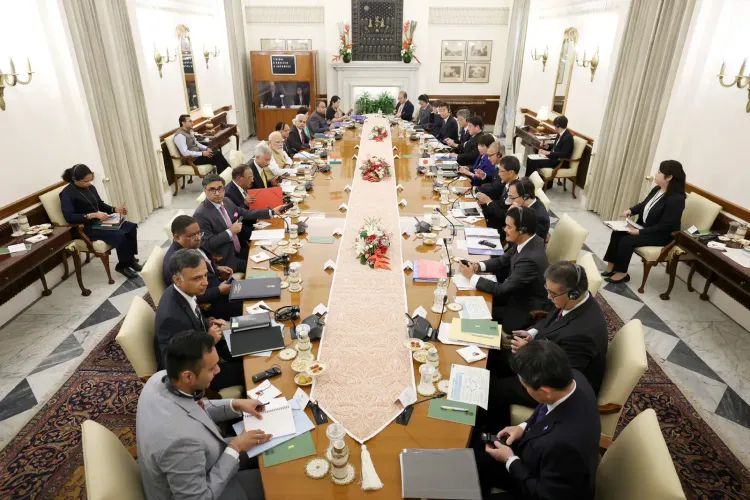
Prime Minister Narendra Modi and Japanese Prime Minister Sanae Takaichi on Thursday, 2 July 2025, held comprehensive bilateral talks at Hyderabad House in New Delhi, covering the full spectrum of India-Japan ties — from trade, defence, and energy to artificial intelligence and people-to-people exchanges. The 16th India-Japan Annual Summit produced three landmark joint documents and marked the first official India visit by Takaichi since she assumed office.
Three Landmark Documents Adopted
The two leaders adopted a Joint Declaration on Economic Security, a Joint Statement on Cooperation in the Field of Artificial Intelligence, and a Joint Statement on Energy Resilience. According to the Ministry of External Affairs (MEA), both sides also witnessed the exchange of key memoranda of understanding and agreements spanning economic security, clean energy, critical technologies, and research and development.
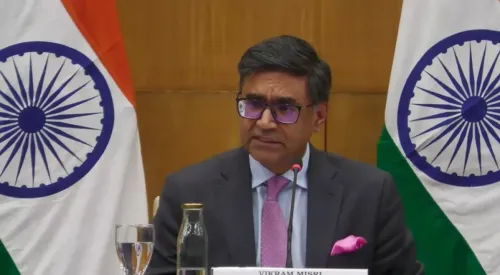
MEA spokesperson Randhir Jaiswal, in a post on X, said: 'The talks delivered concrete progress on key priorities of our bilateral ties. Both sides adopted three landmark documents.' He added that both sides agreed on a list of activities to mark the 75th anniversary of the establishment of diplomatic relations between India and Japan.
Historic First in Defence Co-Development
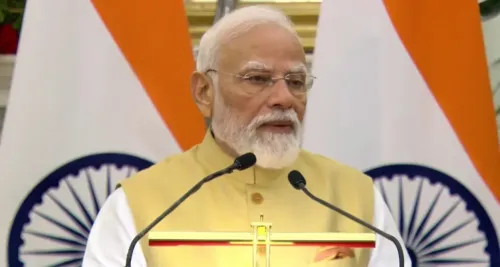
In a significant milestone for bilateral defence ties, Prime Minister Modi announced at a joint press conference that India and Japan have signed an agreement on their first-ever co-development project in the defence sector. 'In the field of defence, today we signed an agreement on the first co-development project between India and Japan,' Modi stated.
This marks a qualitative shift in the India-Japan defence relationship, moving beyond equipment procurement and technology transfers to collaborative development — a step that analysts have long viewed as a benchmark for mature strategic partnerships.
AI and Technology at the Core
Modi underscored the complementary strengths of the two nations in the technology domain. 'The convergence of Japan's precision technology and India's software capabilities will give fresh momentum and strength to the global development of AI,' he said. The dedicated joint statement on artificial intelligence cooperation signals that both governments view the technology as central to their long-term strategic alignment, not merely a commercial opportunity.
Notably, the AI and economic security frameworks adopted at this summit build on momentum from Modi's visit to Tokyo in August 2025 for the 15th India-Japan Annual Summit, reflecting a structured, year-on-year deepening of the India-Japan Special Strategic and Global Partnership.
Indo-Pacific and the Broader Strategic Message
Both leaders reaffirmed that a free, prosperous, and rules-based Indo-Pacific is a shared priority. Modi drew a direct line from his remarks at the recent G7 Summit, stating: 'In today's atmosphere of global upheaval, mutual trust is our greatest strategic asset. I am proud that the India-Japan partnership stands tall on this touchstone.'
As two of the world's largest democracies and market economies in the Indo-Pacific region, India and Japan positioned themselves as anchors for regional stability — a framing that carries implicit strategic weight amid ongoing geopolitical tensions in the region.
What Comes Next
This is Takaichi's first official visit to India since assuming the prime ministership, and its scope — three joint documents, multiple MoUs, a defence co-development agreement, and a bilateral anniversary roadmap — suggests both governments are accelerating the pace of engagement. The agreed activities for the 75th diplomatic anniversary are expected to unfold across the coming months, keeping the bilateral relationship in active focus through the year.
Point of View
Not an incremental one, and signals a level of trust that few bilateral relationships in Asia have achieved. The three joint documents on economic security, AI, and energy resilience also reflect a deliberate attempt to build institutional architecture, not just summit optics. What remains to be seen is whether the AI cooperation framework translates into actual joint projects or stays at the declaration stage — India's track record on technology partnership implementation is uneven. The 75th anniversary roadmap, if executed with ambition, could make 2025-26 the most consequential year in India-Japan ties since the Special Strategic and Global Partnership was established.
NationPress
1 Oct 2026
Frequently Asked Questions
What was agreed at the 16th India-Japan Annual Summit?
India and Japan adopted three landmark joint documents — on economic security, artificial intelligence cooperation, and energy resilience — and signed their first-ever defence co-development agreement. Both sides also exchanged multiple MoUs on clean energy, critical technologies, and R&D, and agreed on a programme to mark 75 years of diplomatic ties.
What is the India-Japan first defence co-development agreement?
It is the first agreement between India and Japan to jointly develop a defence product, announced by PM Modi at a joint press conference on 2 July 2025. It marks a shift from the earlier pattern of equipment procurement and technology transfer to collaborative development, deepening the two countries' strategic partnership.
Why is Sanae Takaichi's visit to India significant?
This is Takaichi's first official visit to India since she became Japan's Prime Minister. It follows PM Modi's visit to Tokyo in August 2025 for the 15th Annual Summit, reflecting an accelerating cadence of high-level engagement under the India-Japan Special Strategic and Global Partnership.
What did the India-Japan AI joint statement cover?
The Joint Statement on Cooperation in the Field of Artificial Intelligence formalises collaboration between the two nations on AI development. PM Modi highlighted the complementary strengths — Japan's precision technology and India's software capabilities — as a foundation for jointly advancing global AI development.
What is the significance of the India-Japan 75th diplomatic anniversary?
India and Japan established diplomatic relations 75 years ago, and both sides at the 2 July 2025 summit agreed on a list of activities to mark this milestone. The anniversary roadmap is expected to sustain bilateral momentum through the coming months across cultural, economic, and strategic domains.