How Did PM Modi Achieve His First Major Electoral Victory Just a Year After Becoming Gujarat CM?
Synopsis
On December 15, 2002, PM Modi secured a monumental electoral victory just a year after becoming Gujarat CM. This historic moment not only altered the political dynamics in Gujarat but also solidified his status as a formidable leader. Discover the details of this transformative victory that many referred to as 'Modi magic'.
Key Takeaways
Narendra Modi received his first significant electoral mandate on December 15, 2002.
The BJP achieved a landslide victory, winning 127 out of 182 seats.
The media dubbed the electoral outcome as “Modi magic.” Modi's leadership was pivotal in transforming Gujarat's political landscape.
He served as Chief Minister for nearly 13 years, the longest in the state's history.
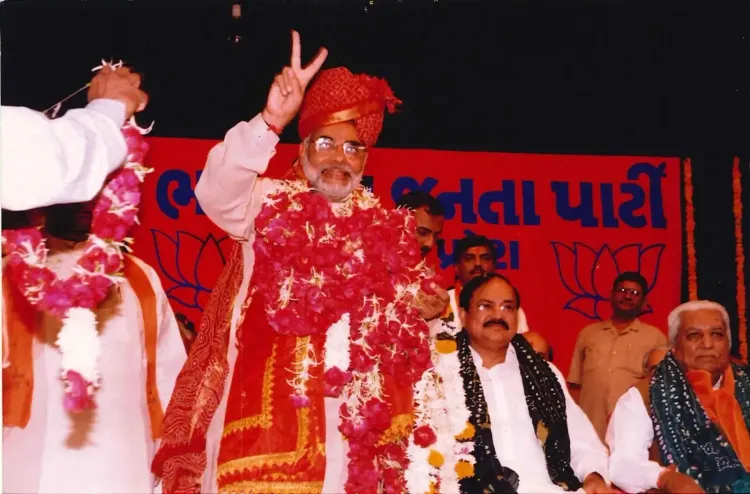
New Delhi, Dec 15 (NationPress) On this date in 2002, Narendra Modi attained his initial significant electoral mandate, merely a year after stepping into the role of Gujarat Chief Minister. This pivotal verdict not only transformed Gujarat's political scene but also heralded Modi's rise as a decisive and influential leader. During the Assembly elections of that year, the Bharatiya Janata Party (BJP) achieved a remarkable landslide victory, securing 127 out of 182 seats. At the time, the media famously referred to this outcome as “Modi magic.”
Reflecting on this historic occasion, the Modi Archive, a well-known social media account on X, remarked, “On December 15, 2002, the Gujarat Assembly election results granted @narendramodi his first substantial electoral mandate, just a year after taking office as Chief Minister.”
“The BJP registered a sweeping landslide, taking 127 of the 182 assembly seats. The outcome, termed by newspapers as ‘Modi magic’, contradicted most forecasts and was broadly viewed as a referendum on his leadership,” the post continued.
“Competing from Maninagar in Ahmedabad, Modi won by a significant margin. He characterized the result as ‘a victory for the self-respect of the five crore people of Gujarat.’ The 2002 verdict represented a significant political shift, transitioning Modi from a crisis-era administrator to a leader with a clear and unassailable democratic mandate, firmly establishing him as the predominant force in Gujarat politics,” it added.
Narendra Modi first took his oath as the Chief Minister of Gujarat on October 7, 2001. He was appointed by the BJP’s national leadership to succeed the then-incumbent Chief Minister, Keshubhai Patel. This marked the beginning of a tenure that would redefine governance and election strategies in the state.
Modi served as the 14th Chief Minister of Gujarat for nearly 13 years across four consecutive terms, concluding his tenure on May 22, 2014, when he resigned after being elected as the Prime Minister of India. To date, he remains the longest-serving Chief Minister in Gujarat's history.
Maninagar in Ahmedabad is of particular importance in PM Modi’s political narrative. It was the Assembly constituency he represented three times as Chief Minister, winning by substantial margins in the 2002, 2007, and 2012 elections. In May 2014, after assuming the Prime Minister's office, he bid an emotional farewell to the constituency. Currently, Maninagar is represented by BJP MLA Amul Bhatt, but its link to Narendra Modi is deeply ingrained in Gujarat’s political history.
Point of View
It is essential to acknowledge this historical event's significance. PM Modi's first major electoral triumph illustrates not only his political acumen but also his ability to navigate challenges effectively. The 'Modi magic' phenomenon showcases a strategic alignment of voter sentiments and party objectives, which has continued to shape Gujarat's political landscape.
NationPress
19 Sept 2026
Frequently Asked Questions
What was the significance of Modi's 2002 election victory?
Modi's victory in 2002 was significant as it marked his emergence as a dominant leader in Gujarat politics, reshaping the state's political landscape and establishing his long-term influence.
How many seats did the BJP win in the 2002 Gujarat Assembly elections?
In the 2002 Gujarat Assembly elections, the BJP won a total of 127 out of 182 seats, achieving a landslide victory.
What was the term used to describe Modi's victory in the media?
The media referred to Modi's victory as 'Modi magic' , highlighting the unexpected nature of the electoral outcome.
How long did Modi serve as Chief Minister of Gujarat?
Narendra Modi served as the Chief Minister of Gujarat for nearly 13 years, from October 2001 until May 2014.
What impact did Modi's governance have on Gujarat?
Modi's governance in Gujarat is credited with redefining electoral politics and governance, leading to significant political and economic changes in the state.