MP CM Mohan Yadav links UCC Bill to Azad's equality vision
Synopsis
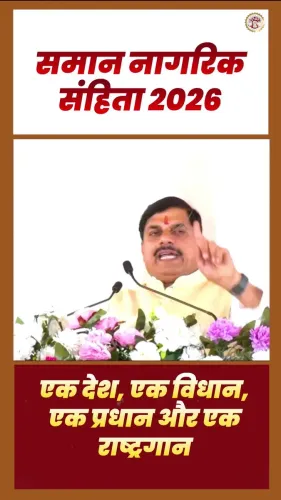
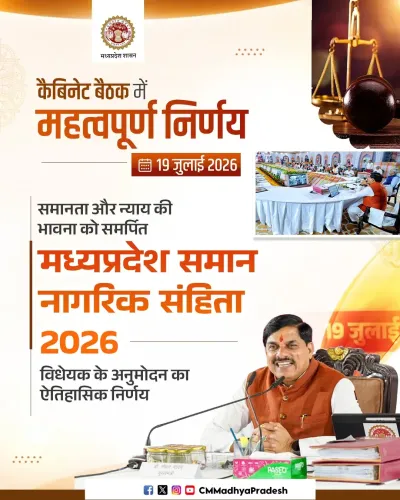
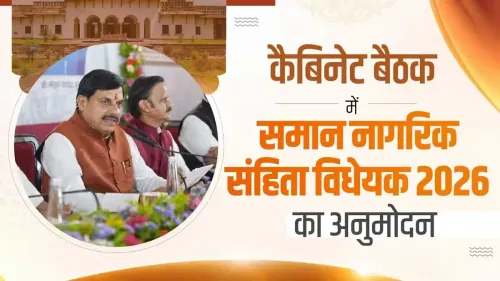
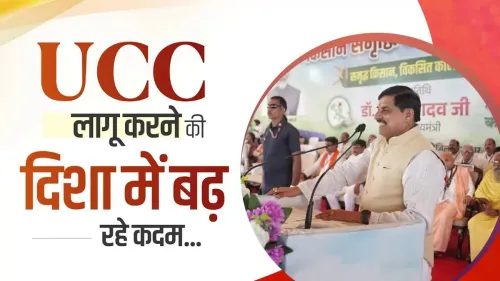
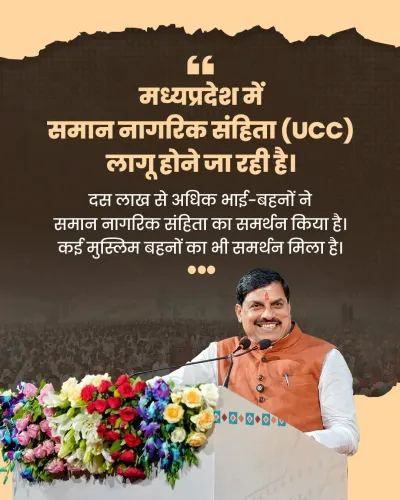
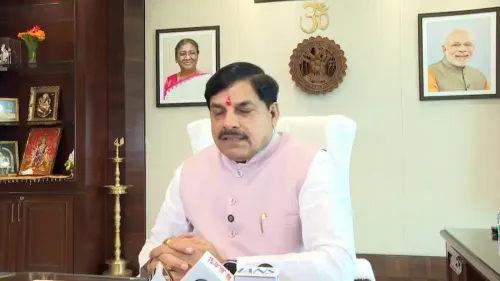
On Chandrashekhar Azad's birth anniversary, the Chief Minister's Office of Madhya Pradesh announced the state assembly has passed the Uniform Civil Code Bill. CM Dr. Mohan Yadav framed the legislation as a fulfilment of Azad's vision of equality and justice for all citizens.
Key Takeaways
The Madhya Pradesh Vidhan Sabha has passed the Samaan Nagrik Sanhita (Uniform Civil Code) Bill , as announced on 23 July 2026 .
Mohan Yadav linked the legislation directly to the ideals of freedom fighter Chandrashekhar Azad , whose birth anniversary falls on 23 July .
Chandrashekhar Azad was born in Bhavra, Madhya Pradesh in 1906 , giving the state a historically significant connection to his legacy.
The UCC is rooted in Article 44 of the Indian Constitution , a directive principle calling for a common civil code for all citizens regardless of religion.
The Bill would standardise civil laws — covering marriage, inheritance, and adoption — for all citizens of Madhya Pradesh across religious communities.
Implementation rules, timelines, and potential legal challenges are the key developments to watch following the Bill's passage.
The Chief Minister's Office of Madhya Pradesh on Thursday, 23 July 2026 marked the birth anniversary of revolutionary freedom fighter Chandrashekhar Azad by announcing that the Madhya Pradesh Vidhan Sabha has passed the Samaan Nagrik Sanhita (Uniform Civil Code) Bill, invoking Azad's vision of equality and justice for all citizens.
Context
Chief Minister Dr. Mohan Yadav, posting through the official CMO handle, paid tribute to Azad with the words: 'Amar Shaheed Chandrashekhar Azad ji ki jayanti par unhe koti-koti naman' — 'On the birth anniversary of immortal martyr Chandrashekhar Azad, we bow to him a million times.' He noted that it is the privilege of all Indians that such warriors were born on this sacred land and gave their supreme sacrifice to win the country's freedom.
Chandrashekhar Azad was born on 23 July 1906 in Bhavra, in present-day Madhya Pradesh, making the state's connection to his legacy particularly significant. His vision, as articulated in the CM's post, was of a nation where 'samanta aur nyay' — equality and justice — prevailed for every citizen.
Policy Backdrop
The Uniform Civil Code (UCC) is enshrined as a directive principle under Article 44 of the Indian Constitution (1950), which directs the state to endeavour to secure a common civil code for all citizens regardless of religion. The legislation seeks to replace religion-based personal laws — governing matters such as marriage, inheritance, and adoption — with a single, uniform framework applicable to all.
The Madhya Pradesh Vidhan Sabha passing the Samaan Nagrik Sanhita Bill places the state among those pursuing this constitutional directive through active legislation. The CM's statement directly links the passage of the Bill to the ideals of the independence movement, framing legal uniformity as a fulfilment of the promise made by leaders like Azad.
Stakeholders and Impact
The UCC Bill, if enacted into law, would affect all citizens of Madhya Pradesh across religious communities, standardising civil legal provisions that have historically differed by faith. Proponents argue it advances constitutional equality; critics from various religious communities have raised concerns about the impact on personal law traditions.
Madhya Pradesh is one of several BJP-governed states that have pursued UCC legislation as part of a broader national conversation on legal uniformity and integration. The move reflects a long-standing constitutional debate that has gained legislative momentum in recent years.
What's Next
Attention will now turn to the rollout and implementation timeline of the UCC provisions in Madhya Pradesh, including the framing of rules, potential amendments, and any legal challenges that may follow. The development is also likely to intensify similar legislative discussions in other states.
As Madhya Pradesh moves forward with the Bill, the government's framing — anchoring a contemporary legal reform in the birth anniversary of a revolutionary who envisioned equality — signals the political and symbolic weight the ruling dispensation is placing on this legislation.
Point of View
The Madhya Pradesh government is making a deliberate symbolic argument: that legal uniformity is not a partisan project but the unfinished business of the independence movement. This framing is politically significant — it attempts to place the UCC within a nationalist, rather than purely religious, discourse. The move fits a broader pattern of BJP-governed states using state-level legislation to advance constitutional directives that the Centre has yet to legislate nationally, effectively building political momentum from the ground up. How the legislation withstands judicial scrutiny and community consultation will determine whether it becomes a governance landmark or a prolonged legal contest.
NationPress
23 Jul 2026
Frequently Asked Questions
What is the Uniform Civil Code Bill passed in Madhya Pradesh?
The Madhya Pradesh Vidhan Sabha passed the Samaan Nagrik Sanhita (Uniform Civil Code) Bill, which seeks to establish a single set of civil laws — covering areas such as marriage, inheritance, and adoption — applicable to all citizens of the state regardless of their religion.
Why was the UCC Bill announced on Chandrashekhar Azad's birth anniversary?
CM Dr. Mohan Yadav framed the passage of the UCC Bill as a realisation of Chandrashekhar Azad's vision of a nation founded on equality and justice for all citizens. Azad's birth anniversary falls on 23 July, and the announcement was made on that date as a symbolic tribute.
What is the constitutional basis for a Uniform Civil Code in India?
Article 44 of the Indian Constitution, under the Directive Principles of State Policy, directs the state to endeavour to secure a Uniform Civil Code for all citizens. It has been a subject of constitutional debate since 1950.
Where was Chandrashekhar Azad born?
Chandrashekhar Azad was born on 23 July 1906 in Bhavra, a village in present-day Madhya Pradesh, which is why the state holds a particularly close connection to his legacy.
Which other states have passed or pursued a Uniform Civil Code?
Several BJP-governed states have pursued UCC legislation as part of efforts to promote legal uniformity. Madhya Pradesh's passage of the Bill is part of this broader legislative pattern seen across multiple states in recent years.