MP CM Office Highlights Green Energy Push via Floating Solar, Pumped Hydro

Synopsis
The Chief Minister's Office of Madhya Pradesh on 27 July 2026 showcased floating solar, pumped hydro, and solar storage as the three pillars of the state's green energy push under CM Dr. Mohan Yadav, aligning with India's 500 GW non-fossil target by 2030.
Key Takeaways
The Chief Minister's Office of Madhya Pradesh on 27 July 2026 highlighted floating solar , pumped hydro , and solar energy storage as the state's green energy priorities.
Mohan Yadav and the New Energy Department of Madhya Pradesh were both tagged, indicating coordinated government messaging.
Floating solar on reservoirs addresses land scarcity while also reducing water evaporation — a dual benefit for an agrarian state.
Madhya Pradesh's solar policy lineage dates to 2012 , with energy storage provisions added in the 2023-24 state budget .
The state's multi-technology approach mirrors strategies in Karnataka and Telangana and aligns with central schemes such as PM-KUSUM .
Tender outcomes and commissioning timelines for specific sites will be the key indicators of whether the state's green energy ambitions translate into capacity on the ground.
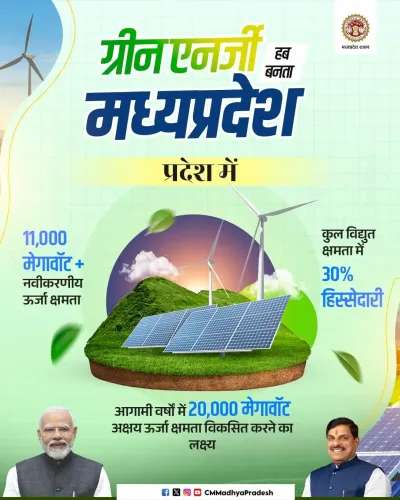
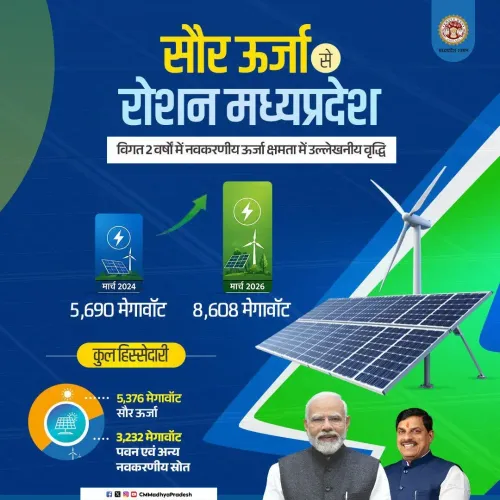
The Chief Minister's Office of Madhya Pradesh on Monday, 27 July 2026, highlighted the state's accelerating transition to green energy, spotlighting floating solar, pumped hydro storage, and solar energy storage projects as the pillars of a new chapter in sustainable development for the state.
The post, shared on the official handle of the Chief Minister's Office, stated — 'हरित ऊर्जा से समृद्ध भविष्य की ओर बढ़ता मध्यप्रदेश' ('Madhya Pradesh moving towards a prosperous future powered by green energy') — and tagged Chief Minister Dr. Mohan Yadav and the state's New Energy Department, signalling coordinated official messaging around the state's renewable energy ambitions.
Context
Madhya Pradesh has been steadily positioning itself as a renewable energy hub in central India. The state's New Energy Department has been the nodal agency driving policy and on-ground projects spanning solar parks, floating installations on reservoirs, and pumped hydro pilots. The July 2026 communication underscores that these efforts are being projected as a defining feature of the current administration under Chief Minister Dr. Mohan Yadav, who has been in office since December 2023. Floating solar — panels installed on water bodies such as reservoirs and canals — addresses one of the key constraints in solar deployment: land availability. By using existing water surfaces, the technology also reduces water evaporation, offering a dual benefit that is particularly relevant for an agrarian state like Madhya Pradesh.Policy Backdrop
The state's engagement with solar energy dates to the Madhya Pradesh Solar Policy of 2012, which set early targets for grid-connected capacity and was subsequently revised upward as national ambitions grew. India's broader National Solar Mission, launched in 2010 and expanded in 2015, established the framework within which states like Madhya Pradesh developed their own solar parks and floating projects. The 2023-24 state budget included provisions for energy storage and pumped hydro pilots, reflecting a shift from generation-only thinking to integrated grid management. Pumped hydro storage — which uses surplus electricity to pump water uphill and releases it to generate power during peak demand — is seen as a critical complement to intermittent solar generation. Nationally, the central government's PM-KUSUM scheme and dedicated energy storage missions have incentivised states to diversify their renewable portfolios beyond simple solar installations.Stakeholders and Impact
The primary stakeholders in these projects include renewable energy project developers, state power utilities, and communities living near reservoir sites that may host floating solar arrays. For utilities, the combination of solar generation and storage promises greater grid stability and reduced dependence on coal-based peaking power. For local communities, such projects can translate into improved electricity access and potential employment during construction and operation phases. Madhya Pradesh's approach mirrors strategies adopted by states such as Karnataka and Telangana, which have combined solar with storage to address grid reliability concerns. The emphasis on multiple technologies — floating solar, pumped hydro, and battery or other storage — reflects a deliberate effort to hedge against the variability of any single renewable source.What's Next
Attention will now turn to the tender outcomes and commissioning timelines for specific floating solar and pumped hydro sites that the state energy department is expected to announce. India's national target of 500 GW of non-fossil fuel capacity by 2030 places significant responsibility on large states like Madhya Pradesh to translate policy communication into on-ground megawatts. How quickly the state moves from announcement to commissioning will determine whether this green energy narrative translates into measurable capacity additions on the national grid.Point of View
Pumped hydro, and storage together — signals that Madhya Pradesh is moving beyond single-dimension solar announcements toward a more integrated grid strategy. Tagging both the Chief Minister and the New Energy Department in the same post suggests a deliberate effort to project institutional coherence on climate policy ahead of potential investor engagements or central government reviews. This kind of proactive state-level communication has become a competitive tool as states vie for renewable energy investment and central allocation under missions tied to the 2030 non-fossil target. The real test, as with similar announcements from peer states, will be the speed and scale of actual project commissioning rather than the breadth of the technology portfolio announced.
NationPress
27 Jul 2026
Frequently Asked Questions
What green energy projects is Madhya Pradesh focusing on in 2026?
Madhya Pradesh is focusing on floating solar installations on water bodies, pumped hydro storage, and solar energy storage projects as the three pillars of its green energy push, as highlighted by the Chief Minister's Office on 27 July 2026.
What is floating solar energy and why is Madhya Pradesh adopting it?
Floating solar refers to photovoltaic panels installed on reservoirs or other water surfaces. Madhya Pradesh is adopting it to overcome land scarcity constraints while gaining the added benefit of reduced water evaporation from reservoirs.
What is pumped hydro storage and how does it help solar energy?
Pumped hydro storage uses surplus electricity — including from solar — to pump water to an elevated reservoir, then releases it through turbines during peak demand. It acts as a large-scale battery, complementing the intermittent nature of solar generation.
What is Madhya Pradesh's solar energy policy history?
Madhya Pradesh introduced its Solar Policy in 2012 to set grid-connected capacity targets. The 2023-24 state budget added provisions for energy storage and pumped hydro pilots, building on the foundation of India's National Solar Mission launched in 2010.
How does Madhya Pradesh's green energy push fit into India's national targets?
India aims to achieve 500 GW of non-fossil fuel capacity by 2030. Madhya Pradesh's floating solar, pumped hydro, and storage projects are part of the state-level effort to contribute to this national target, supported by central schemes such as PM-KUSUM.