MP CM Office: State Hits 11,000 MW+ Renewable Energy
Synopsis
The Chief Minister's Office of Madhya Pradesh declared on 12 July 2026 that the state has surpassed 11,000 MW of renewable energy capacity, representing 30 percent of its total installed power capacity, reinforcing MP's role in India's clean energy transition.
Key Takeaways
The Chief Minister's Office of Madhya Pradesh announced on 12 July 2026 that the state's renewable energy capacity has crossed 11,000 megawatts .
Renewables now constitute 30 percent of Madhya Pradesh's total installed electricity capacity.
The announcement was tagged to Chief Minister Dr.
Mohan Yadav and the state's new energy department.
The milestone aligns with India's national target of 500 GW of non-fossil fuel capacity by 2030 .
The Ministry of New and Renewable Energy has supported state-level renewable expansion through central schemes and purchase obligations.
Future focus will be on new capacity auctions, grid integration, and storage investment to sustain growth beyond the current milestone.
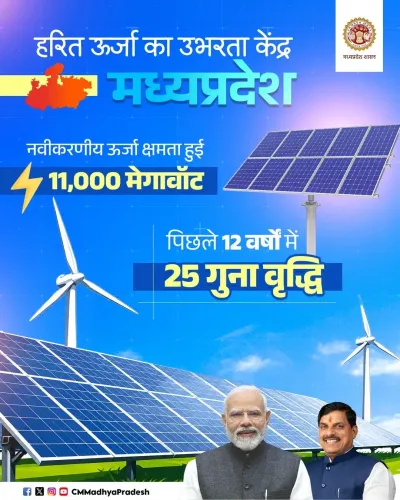
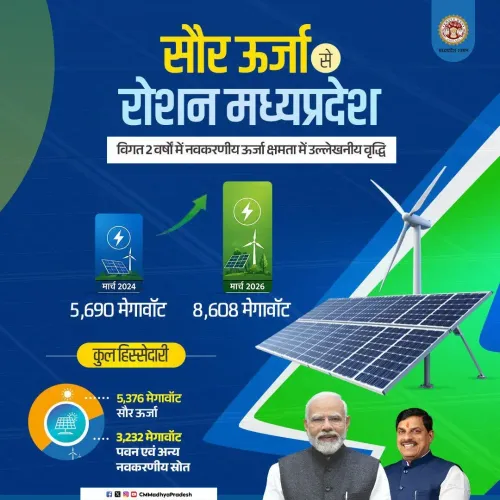
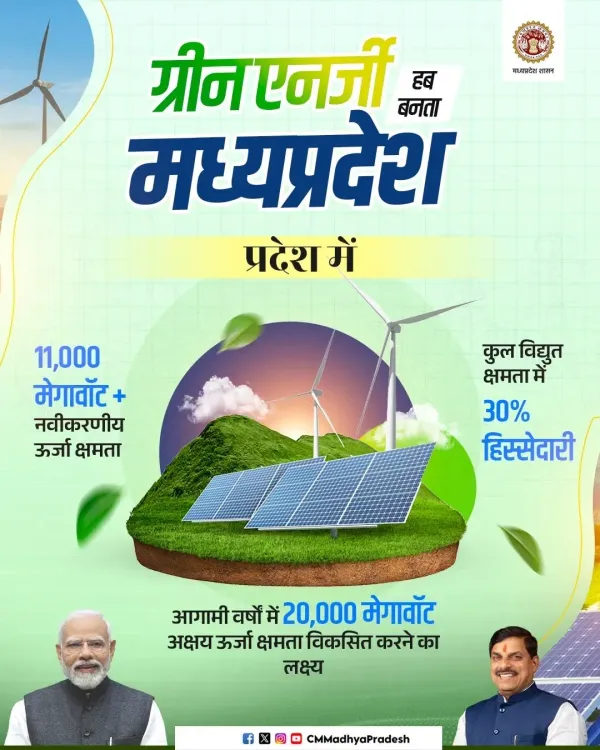
The Chief Minister's Office of Madhya Pradesh announced on Sunday, 12 July 2026 that the state has crossed 11,000 megawatts of installed renewable energy capacity, with renewables now accounting for 30 percent of the state's total power generation mix. The post, shared on the official @CMMadhyaPradesh handle, tagged Chief Minister Dr. Mohan Yadav and the state's new energy department, positioning Madhya Pradesh as an emerging 'power house of green energy.'
Context
The post declared, 'हरित ऊर्जा का पावर हाउस बन रहा है मध्यप्रदेश' ('Madhya Pradesh is becoming a power house of green energy'), citing an installed renewable capacity exceeding 11,000 MW and a 30 percent share in total electricity capacity. The announcement was made through the official CMO handle, with Dr. Mohan Yadav directly tagged, signalling the administration's intent to project this milestone as a governance achievement. Madhya Pradesh, a large landlocked state in central India, has substantial solar irradiation levels and wind corridors that have historically attracted renewable energy investment.
Policy Backdrop
India's push toward 500 GW of non-fossil fuel capacity by 2030 — a commitment made under the Paris Agreement and reinforced through national climate targets — has placed state governments at the centre of execution. The Ministry of New and Renewable Energy has facilitated this through central schemes, viability gap funding, and state-specific renewable purchase obligations. Madhya Pradesh has been an active participant in this framework, with solar parks and wind projects commissioned across several districts over the past decade. The state's renewable trajectory also draws from the legacy of India's Jawaharlal Nehru National Solar Mission, launched in 2010, which seeded the institutional and financial architecture for large-scale solar deployment across states.
Stakeholders and Impact
The primary beneficiaries of expanded renewable capacity include state power distribution companies, industrial consumers seeking stable and cleaner electricity, and renewable energy developers who have deployed capital in the state. A rising share of renewables in the generation mix can moderate fuel import costs for the state utility and reduce dependence on coal-based power during peak solar hours. For rural and peri-urban consumers, expanded grid capacity from renewable sources can translate into improved supply reliability, though distribution infrastructure quality remains a parallel determinant. The milestone also strengthens Madhya Pradesh's position in inter-state power trading markets, where surplus renewable generation can be sold to deficit states.
What's Next
Attention will now turn to whether Madhya Pradesh announces fresh capacity auctions or new power purchase agreements to sustain momentum beyond the 11,000 MW mark. State-level renewable targets for the next fiscal year, alignment with the Ministry of New and Renewable Energy's updated state-wise allocation framework, and progress on grid integration of variable renewable energy will be key indicators to watch. Dr. Mohan Yadav's government is expected to use this milestone in ongoing investor outreach, particularly ahead of any state-level investment summits. Whether the 30 percent share can be pushed higher without commensurate investment in storage and grid balancing infrastructure will define the credibility of the state's green energy ambitions in the medium term.
Point of View
Framing Madhya Pradesh as a model state within India's broader clean energy federalism. Chief Minister Dr. Mohan Yadav, who took office in December 2023, is using energy sector metrics to build a governance narrative ahead of potential investor engagement cycles. The 11,000 MW figure, if sustained by independent verification, would place MP among the more significant renewable contributors in the Hindi heartland — a region historically associated with coal dependence. The real test will be whether the state pairs this capacity headline with credible grid balancing and distribution reform, which are the unglamorous but decisive variables in India's energy transition.
NationPress
10 Oct 2026
Frequently Asked Questions
What is Madhya Pradesh's total renewable energy capacity in 2026?
The Chief Minister's Office of Madhya Pradesh stated on 12 July 2026 that the state's renewable energy capacity has crossed 11,000 megawatts, representing 30 percent of the state's total installed electricity capacity.
Who is the Chief Minister of Madhya Pradesh responsible for energy policy?
Dr. Mohan Yadav has been the Chief Minister of Madhya Pradesh since December 2023 and oversees the state's energy and development policies, including its renewable energy expansion drive.
How does Madhya Pradesh's renewable energy fit into India's 2030 target?
India aims to achieve 500 GW of non-fossil fuel capacity by 2030. Madhya Pradesh's growing renewable base, now exceeding 11,000 MW, contributes to this national goal, supported by central schemes from the Ministry of New and Renewable Energy.
What types of renewable energy does Madhya Pradesh produce?
Madhya Pradesh has developed both solar and wind energy resources, benefiting from high solar irradiation levels and wind corridors across the state, alongside hydro and other renewable sources.
What comes next for Madhya Pradesh's green energy plans?
Key developments to watch include fresh capacity auctions, new power purchase agreements, grid integration investments, and energy storage projects that will determine whether MP can push its renewable share beyond the current 30 percent.