MP CM Mohan Yadav to Set Up 4 Fast Track Courts for Exam Paper Leak Cases
Synopsis
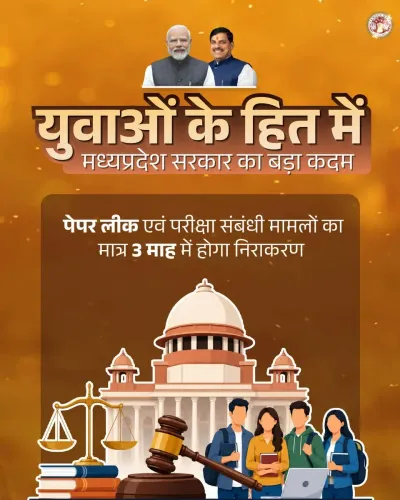
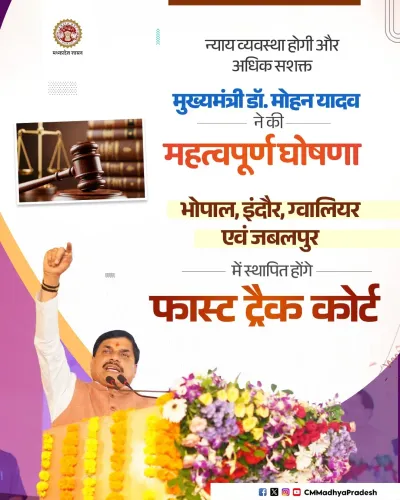
Chief Minister Dr. Mohan Yadav has announced four Fast Track Courts in Bhopal, Indore, Jabalpur, and Gwalior to resolve examination paper leak and related cases within three months, positioning Madhya Pradesh as a proactive state on educational integrity.
Key Takeaways
Four Fast Track Courts will be established in Bhopal, Indore, Jabalpur, and Gwalior in Madhya Pradesh.
These courts will resolve paper leak and examination-related cases within three months .
The announcement was made by Chief Minister Dr.
Mohan Yadav on 25 July 2026 .
The move is framed as part of Madhya Pradesh's commitment to implementing PM Narendra Modi's public-interest decisions at the state level.
The initiative directly targets issues affecting students and teachers , who the state government says it is 'completely sensitive' towards.
Fast Track Courts in India were first introduced in 2000 to provide expedited trials in priority case categories.
The Chief Minister's Office of Madhya Pradesh announced on Saturday, 25 July 2026 that Chief Minister Dr. Mohan Yadav will establish four Fast Track Courts in Bhopal, Indore, Jabalpur, and Gwalior to resolve cases related to examination paper leaks and exam-related offences within three months.
Addressing the announcement, CM Dr. Mohan Yadav stated that Madhya Pradesh has always been at the forefront of implementing every decision taken by Prime Minister Narendra Modi in the public interest and aligning state policy accordingly. He added that the state government is 'completely sensitive to all issues related to teachers and students,' and the Fast Track Courts are a direct expression of that commitment.
Context
The announcement comes amid a broader national concern over recurring incidents of examination paper leaks that have disrupted recruitment and academic tests across India. Madhya Pradesh has seen its share of examination integrity controversies in recent years, affecting aspirants for government jobs and academic admissions. The state government's move to create dedicated judicial infrastructure signals an intent to address not just the crimes themselves but the prolonged uncertainty that follows for affected candidates. The four cities chosen — Bhopal (the state capital), Indore (the commercial hub), Jabalpur (a major judicial centre), and Gwalior (a key northern MP city) — represent the state's major administrative and population centres, ensuring geographic spread of the new judicial mechanism.Policy Backdrop
Fast Track Courts as a concept are not new to India. They were first introduced nationally in 2000 under central and state funding arrangements to provide speedy trials in select categories of cases where ordinary court timelines ran into years. Over the decades, their scope has expanded to cover offences ranging from crimes against women to now, in this instance, examination fraud. Several Indian states have introduced targeted judicial mechanisms in response to high-profile paper leaks and malpractice incidents. Madhya Pradesh's decision to set a firm three-month resolution window is among the more specific time-bound commitments made by any state government in this domain. The framing of the announcement — explicitly linking the move to PM Modi's policy direction — also reflects the state government's political positioning of itself as a model implementer of central priorities in education and governance.Stakeholders and Impact
The primary beneficiaries of this initiative are students and teachers in Madhya Pradesh who have faced delays in recruitment, admissions, or professional recognition owing to examination-related legal disputes. For candidates whose futures hinge on the outcome of competitive exams, prolonged court cases compound the original harm of a leaked paper. The state education department and examination regulatory bodies will also be key stakeholders, as faster case resolution can act as a deterrent to future malpractice. Legal professionals and judges assigned to these courts will need clear operational guidelines, and the quality of outcomes will depend heavily on timely appointment of dedicated judicial officers and adequate infrastructure at each of the four court locations.What's Next
The immediate steps to watch include the formal government notification establishing the courts, the appointment of presiding judges, and the rules governing case registration and transfer of pending matters. It remains to be seen whether the three-month resolution timeline will be written into the notification as a binding target or remain an aspirational benchmark. If Madhya Pradesh operationalises these courts effectively, the model could prompt similar announcements from other states grappling with examination integrity issues, adding pressure on judicial and administrative systems to deliver time-bound outcomes for a constituency — students and job aspirants — that commands significant political attention.Point of View
The state government signals alignment with the Centre — a pattern common among BJP-governed states seeking to project unified governance. The three-month resolution window is an ambitious benchmark that, if met, could set a replicable standard for other states; if missed, it risks becoming a credibility liability. Ultimately, the initiative's real test lies in operationalisation: court notifications, judge appointments, and actual case throughput will determine whether this is durable judicial reform or a well-timed announcement.
NationPress
24 Oct 2026
Frequently Asked Questions
What are the Fast Track Courts announced by Madhya Pradesh CM Mohan Yadav?
Chief Minister Dr. Mohan Yadav has announced four Fast Track Courts — in Bhopal, Indore, Jabalpur, and Gwalior — specifically to handle examination paper leak and exam-related offence cases, with a target of resolving them within three months.
In which cities will the MP exam paper leak Fast Track Courts be set up?
The four Fast Track Courts will be established in Bhopal, Indore, Jabalpur, and Gwalior, covering Madhya Pradesh's major administrative and population centres.
How long will it take for exam paper leak cases to be resolved in these courts?
According to CM Mohan Yadav's announcement, cases related to paper leaks and examination fraud will be resolved within three months in these dedicated Fast Track Courts.
Why is Madhya Pradesh setting up Fast Track Courts for exam cases?
The state government cited its sensitivity to issues affecting students and teachers, and framed the decision as part of Madhya Pradesh's policy of implementing Prime Minister Modi's public-interest decisions at the state level.
What is the history of Fast Track Courts in India?
Fast Track Courts were first introduced in India in 2000 under central and state funding to provide speedy trials in select case categories, and their scope has since expanded to cover various priority offences including, now, examination fraud in Madhya Pradesh.