Nadda: Cabinet Approves ₹62,500 Cr Mobile Phone Scheme
Synopsis
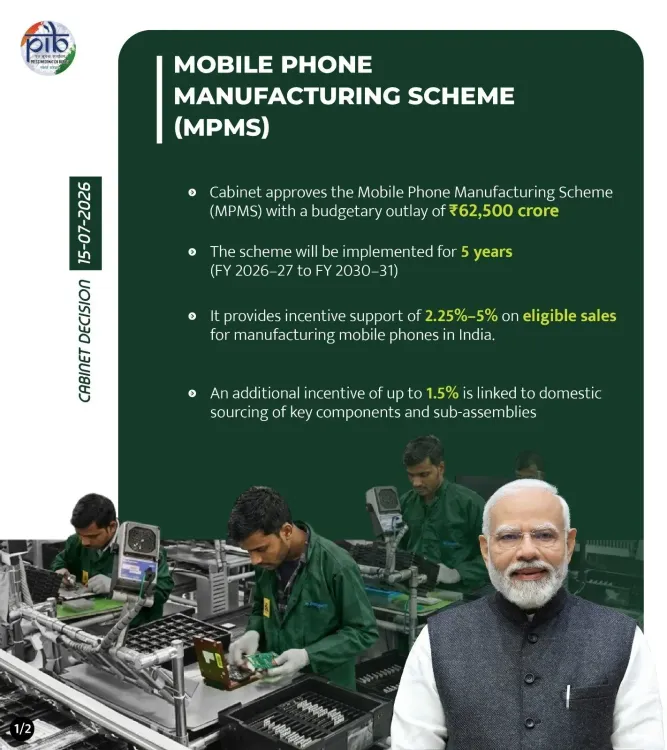
The Union Cabinet has approved the Mobile Phone Manufacturing Scheme (MPMS) with a ₹62,500 crore outlay for FY 2026-27 to FY 2030-31. The five-year scheme targets ₹39 lakh crore in production, 60,000 direct jobs, and deeper supply-chain localisation, building on the 2020 PLI for electronics.
Key Takeaways
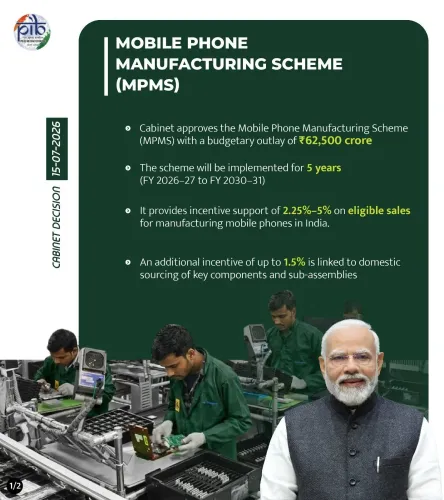
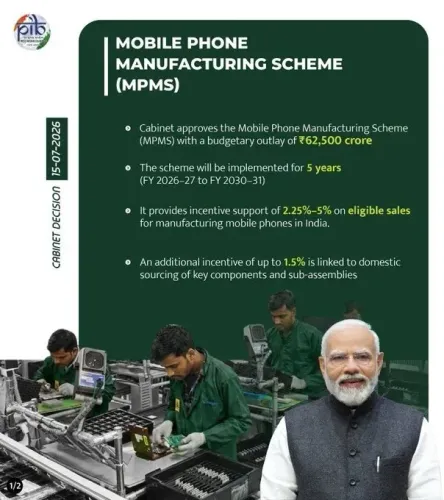
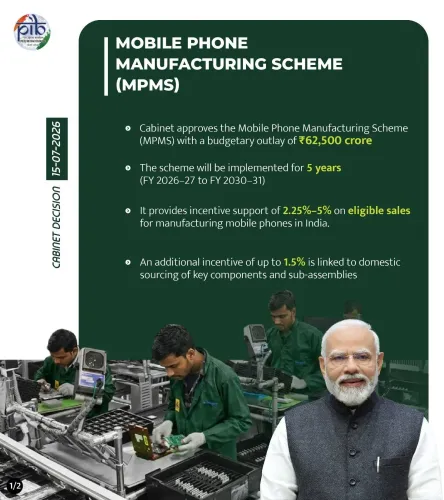
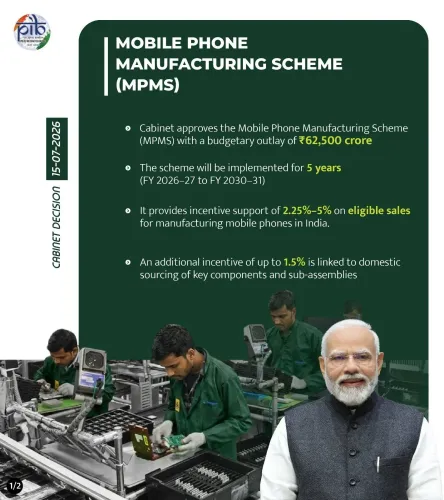
The Union Cabinet approved the Mobile Phone Manufacturing Scheme (MPMS) on 15 July 2026 with an outlay of ₹62,500 crore .
The scheme runs for five years from FY 2026-27 to FY 2030-31 .
It targets ₹39 lakh crore in cumulative mobile phone production over its tenure.
The MPMS is projected to create 60,000 direct jobs in the electronics manufacturing sector.
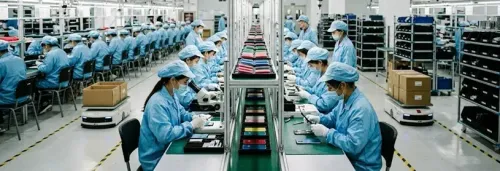
Incentives cover production, domestic sourcing, and design and R&D — extending beyond earlier PLI schemes that focused mainly on assembly.
The scheme is positioned as a pillar of the Viksit Bharat 2047 vision for a developed India.
Union Health Minister and BJP national president J. P. Nadda on Wednesday, 15 July 2026 announced that the Union Cabinet, chaired by Prime Minister Narendra Modi, has approved the Mobile Phone Manufacturing Scheme (MPMS) with a total outlay of ₹62,500 crore to accelerate India's electronics manufacturing ambitions.
Context
The MPMS is a five-year scheme running from FY 2026-27 to FY 2030-31. Announcing the Cabinet decision, Nadda said the scheme will 'boost mobile phone manufacturing, domestic value addition, supply chains, and Indian brands through incentives for production, domestic sourcing, and design and R&D.' The scheme targets ₹39 lakh crore in cumulative mobile phone production and the creation of 60,000 direct jobs over its tenure.
Nadda framed the approval as a direct extension of PM Modi's Make in India vision, noting that India today 'not only meets its domestic mobile phone requirements but also caters to growing global demand.'
Policy Backdrop
The MPMS builds on the Production Linked Incentive (PLI) Scheme for Large Scale Electronics Manufacturing, first notified in 2020, which drew global contract manufacturers to India and raised domestic value addition in handset assembly. That earlier scheme is widely credited with transforming India from a net importer of mobile phones to a significant exporter.
Successive iterations of production-linked incentives have progressively deepened supply-chain localisation — from final assembly toward components and sub-assemblies. The MPMS extends this logic by explicitly including design and R&D incentives, signalling an ambition to move up the value chain beyond contract manufacturing toward home-grown product development.
The broader policy context is the government's Viksit Bharat 2047 framework, which envisions India as a fully developed economy by the centenary of its independence. Electronics manufacturing, particularly mobile phones, has been identified as a key pillar of that roadmap.
Stakeholders and Impact
The primary beneficiaries of the MPMS are expected to be electronics manufacturers — both established global players with India operations and emerging domestic brands seeking scale. Incentives for 'domestic sourcing' are specifically designed to pull component suppliers deeper into the local ecosystem, reducing dependence on imports from China and other markets.
For mobile industry workers, the stated target of 60,000 direct jobs represents a significant formal-employment commitment. Indirect employment across logistics, retail, and component supply chains is expected to be a multiple of that figure, though the government has not specified an indirect-jobs estimate in this announcement.
Indian brands stand to benefit from the design and R&D incentive component, which could help domestic labels compete more credibly against established global names in premium and mid-range segments.
What's Next
The Cabinet approval marks the policy decision; detailed operational guidelines, incentive disbursement mechanisms, and first-year production targets are expected to be notified separately after the scheme is formally gazetted in 2026. Industry bodies and prospective applicants will watch closely for eligibility criteria, especially the thresholds for 'domestic value addition' that will determine who qualifies for the higher incentive tiers.
With the scheme window opening in FY 2026-27, India's stated goal of cementing its position as a global mobile manufacturing and export hub will face its first real test in how quickly manufacturers commit fresh capital and begin scaling production under the new framework.
Point of View
With design and R&D incentives marking a qualitative departure from the 2020 PLI's assembly-first logic. The scale of the stated production target — ₹39 lakh crore over five years — is an aggressive number that will test whether India's component ecosystem can mature fast enough to support genuine value addition rather than final-stage assembly. Announcing the scheme through the Health Minister, who also heads the ruling party, underscores the political salience the government attaches to manufacturing milestones ahead of state electoral cycles. The real measure of the policy's success will come when detailed guidelines reveal how stringently 'domestic value addition' thresholds are set and enforced.
NationPress
15 Jul 2026
Frequently Asked Questions
What is the Mobile Phone Manufacturing Scheme (MPMS)?
The MPMS is a five-year government scheme approved by the Union Cabinet on 15 July 2026 with an outlay of ₹62,500 crore to boost mobile phone manufacturing, domestic value addition, supply chains, and Indian brands through incentives for production, domestic sourcing, and design and R&D.
How much money has the government allocated for the Mobile Phone Manufacturing Scheme?
The Cabinet has approved an outlay of ₹62,500 crore for the MPMS, covering the period from FY 2026-27 to FY 2030-31.
How many jobs will the Mobile Phone Manufacturing Scheme create?
The scheme is expected to create 60,000 direct jobs in India's mobile phone manufacturing sector over its five-year tenure.
How is MPMS different from the earlier PLI scheme for electronics?
While the 2020 PLI for Large Scale Electronics Manufacturing focused primarily on attracting investment in mobile phone assembly, the MPMS explicitly includes incentives for design and R&D, signalling an intent to move India up the electronics value chain toward product development.
What is the production target under the Mobile Phone Manufacturing Scheme?
The MPMS targets ₹39 lakh crore in cumulative mobile phone production over its five-year period from FY 2026-27 to FY 2030-31.