Nadda dedicates ₹172 cr JIPMER upgrades in Puducherry

Synopsis
Union Health Minister J. P. Nadda dedicated seven healthcare and infrastructure initiatives worth ₹172.27 crore at JIPMER, Puducherry, on 21 November 2026, covering precision oncology, cardiac care, diagnostics, affordable medicines, biomedical research, and student facilities.
Key Takeaways
₹172.27 crore worth of healthcare and infrastructure initiatives dedicated at JIPMER, Puducherry on 21 November 2026 .
Seven distinct projects span precision cancer treatment, advanced diagnostics, cardiac care, affordable medicines, biomedical research , and student facilities.
JIPMER holds the status of an Institution of National Importance under a 2008 Act of Parliament, enabling large-scale super-specialty expansion.
The investment follows a central government pattern of upgrading existing premier public institutions rather than building new ones, consistent with the PMSSY framework.
JIPMER serves patients not just from Puducherry but from across southern India, giving the investment a wide regional impact.
The move is framed as part of the Viksit Bharat agenda of accessible and quality public healthcare under PM Narendra Modi .
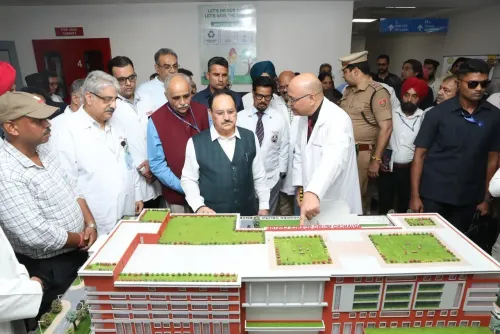
Seven new healthcare and infrastructure projects — covering precision cancer treatment, advanced diagnostics, cardiac care expansion, affordable medicines, biomedical research, and student facilities — landed at Jawaharlal Institute of Postgraduate Medical Education and Research (JIPMER), Puducherry, on Saturday, 21 November 2026, as Union Health Minister J. P. Nadda dedicated initiatives worth ₹172.27 crore to the nation in a single ceremony. For one of India's most storied public hospitals, it is a significant capital push.
What ₹172.27 crore buys JIPMER
The seven initiatives span the full arc of modern hospital capability. Precision oncology infrastructure and advanced diagnostics address the growing burden of cancer and complex disease among patients who travel from across southern India — and beyond — to reach JIPMER's gates. Expanded cardiac care capacity targets one of the country's leading causes of hospitalisation, while a Jan Aushadhi-linked affordable medicines component keeps costs within reach for economically vulnerable patients. Biomedical research facilities and upgraded student amenities round out a package designed to reinforce JIPMER's dual identity as both a teaching institution and a tertiary-care referral centre.
Nadda, posting on X, described the bundle as 'a major boost to advanced healthcare at JIPMER' and said the initiatives 'will further strengthen JIPMER's role as a premier healthcare institution serving patients from Puducherry and across the country.' He credited the direction of Prime Minister Narendra Modi and framed the investment inside the government's larger Viksit Bharat vision of accessible, quality public healthcare.
JIPMER's standing as an Institution of National Importance
JIPMER was granted the status of an Institution of National Importance by an Act of Parliament in 2008, giving it the administrative autonomy needed to pursue super-specialty expansion at scale. That legislative foundation has underpinned successive rounds of capital investment, allowing the Puducherry campus to grow into a tertiary-care destination for patients from Tamil Nadu, Andhra Pradesh, Kerala, and the wider region who might otherwise have no access to advanced procedures.
Saturday's package fits a recognisable pattern in central health policy: rather than announcing new greenfield hospitals, the government has concentrated capital on strengthening existing Institutes of National Importance with cutting-edge equipment and infrastructure. This approach aligns with the Pradhan Mantri Swasthya Suraksha Yojana (PMSSY) framework, which prioritises tertiary-care capacity-building in government institutions over the medium term.
Puducherry as a southern healthcare hub
Puducherry's unique position — a Union Territory bordered by Tamil Nadu — makes JIPMER one of the few publicly funded super-specialty centres accessible to a population that spans multiple states and income levels. Investments in oncology and cardiac infrastructure here do not serve one city; they serve a catchment of millions. That geographic logic gives the ₹172.27 crore figure a multiplier effect that straightforward per-capita arithmetic would miss.
What to watch next: the Health Ministry's detailed project documentation for the seven initiatives and whether similar capital packages are announced for other Institutions of National Importance in the coming budget cycle. The pattern, if it holds, signals a systematic upgrade rather than a one-off headline.
JIPMER's next chapter has been funded. The question now is how quickly bricks, scanners, and research benches translate into outcomes for the patients waiting at its doors.
Point of View
Trading optics for operational depth. The ₹172.27 crore package — spanning oncology, cardiology, diagnostics, and research — signals that JIPMER is being positioned as a southern anchor of India's public super-specialty network, not merely a regional facility. For Nadda, who wears both the Health Ministry and BJP presidency hats, the Puducherry visit also carries quiet political utility in a Union Territory that sits outside the BJP's traditional strongholds. The larger question is whether this round of investment triggers matching allocations at AIIMS campuses and other INIs before the next Union Budget, completing what would amount to a nationwide tertiary-care upgrade cycle.
NationPress
21 Nov 2026
Frequently Asked Questions
What projects were inaugurated at JIPMER Puducherry in November 2026?
Union Health Minister J. P. Nadda dedicated seven healthcare and infrastructure initiatives worth ₹172.27 crore at JIPMER, Puducherry, on 21 November 2026, covering precision cancer treatment, advanced diagnostics, cardiac care expansion, affordable medicines, biomedical research facilities, and improved student amenities.
What is JIPMER and why is it significant?
JIPMER — Jawaharlal Institute of Postgraduate Medical Education and Research — is a premier public hospital and medical university in Puducherry. It was declared an Institution of National Importance by an Act of Parliament in 2008, granting it autonomy to expand super-specialty services for patients across southern India.
How much money was invested in JIPMER's new projects?
The seven new healthcare and infrastructure initiatives are collectively worth ₹172.27 crore , as stated by Union Health Minister J. P. Nadda when he dedicated them to the nation on 21 November 2026.
What is the Viksit Bharat healthcare vision Nadda referred to?
Viksit Bharat — meaning 'Developed India' — is the Modi government's overarching development framework targeting advanced, affordable, and quality healthcare, particularly through strengthening existing premier public institutions like JIPMER rather than creating new ones from scratch.
Which patients benefit from JIPMER's upgraded facilities?
JIPMER serves patients from Puducherry and across southern India, including Tamil Nadu, Andhra Pradesh, and Kerala. Its status as a nationally funded super-specialty centre means patients from multiple states rely on it for advanced treatment they may not find locally.