Nadda hails India-UK FTA as milestone for trade and industry
Synopsis
Union Health Minister and BJP chief J. P. Nadda hailed the India-UK Free Trade Agreement coming into force on 15 July 2026, saying it will boost textiles, MSMEs, IT services, and Indian talent mobility, framing the deal as a step toward Prime Minister Modi's Viksit Bharat vision.
Key Takeaways
The India-UK Free Trade Agreement came into force on 15 July 2026 , according to J.
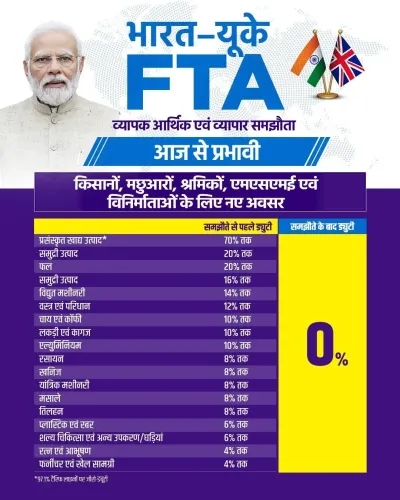
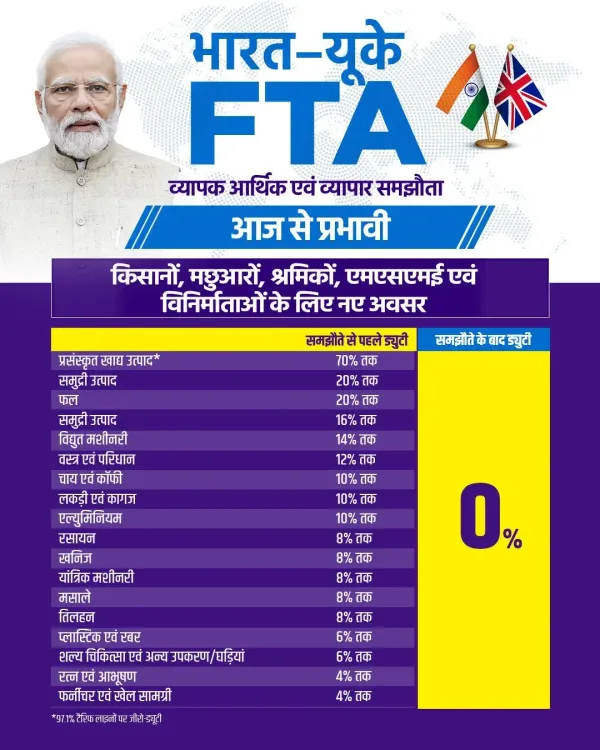
Sectors identified as direct beneficiaries include textiles, leather, gems and jewellery, engineering goods, marine products, chemicals, and processed food .
MSMEs, farmers, and manufacturers are expected to receive a boost in global competitiveness under the deal.
The agreement is also projected to open new pathways for IT, professional, financial, education, and business services exports.
Enhanced talent mobility provisions are set to benefit Indian professionals seeking opportunities in the United Kingdom .
The FTA is framed within PM Modi's 'Make In India', 'Vocal For Local', and broader Atmanirbhar Bharat policy architecture.
Union Health Minister and BJP National President J. P. Nadda on Wednesday, 15 July 2026, welcomed the entry into force of the India-UK Free Trade Agreement, calling it a landmark step toward strengthening Indian industry, commerce, and enterprise on the global stage.
Context
Posting on X, Nadda wrote — 'आज से लागू हुआ भारत और ब्रिटेन फ्री ट्रेड एग्रीमेंट उद्योग, व्यापार और व्यवसाय की सुदृढ़ता को बढ़ावा देने की दिशा में मील का पत्थर साबित होगा' ('The India-UK Free Trade Agreement, which comes into effect today, will prove to be a milestone in strengthening industry, trade, and business'). He highlighted sectors including textiles, leather, gems and jewellery, engineering goods, marine products, chemicals, and processed food as direct beneficiaries of the deal. MSMEs, farmers, and manufacturers were specifically cited as groups set to gain a global boost.
Nadda also noted that the agreement opens new avenues for IT, professional, financial, education, and business services sectors, and gives fresh momentum to mobility of Indian talent to the United Kingdom.
Policy Backdrop
India and the UK relaunched bilateral trade negotiations in January 2021 after a previous round concluded in 2006, making the eventual conclusion of the pact the result of over five years of sustained diplomacy. The deal fits into a broader pattern of India expanding its preferential trade network — the country had earlier concluded FTAs with the UAE and Australia in 2022.
These agreements complement the Atmanirbhar Bharat framework, which pairs domestic production incentives with selective tariff liberalisation to embed Indian firms in global value chains. Nadda explicitly invoked Prime Minister Narendra Modi's 'Make In India' and 'Vocal For Local' campaigns as the policy foundation enabling India to assert itself in global supply chains.
Stakeholders and Impact
The minister's post singles out textile exporters and leather goods manufacturers — sectors where India holds established competitive strength — as among the primary gainers from preferential access to the UK market. The inclusion of processed food and marine products signals potential relief for coastal and agricultural communities dependent on export earnings.
For the services economy, the FTA's provisions on professional and financial services and talent mobility could benefit a large segment of India's skilled workforce seeking opportunities in the United Kingdom. MSMEs, which form the backbone of India's manufacturing and export ecosystem, are expected to find reduced tariff barriers lowering the cost of market entry abroad.
What's Next
Attention will now turn to the publication of detailed tariff reduction schedules and rules-of-origin provisions, which will determine the practical extent of benefits for each sector. Industry bodies are expected to file submissions on utilisation rates once the agreement's notification is formally gazetted.
As India advances its 'Viksit Bharat' (Developed India) vision, the India-UK FTA is positioned as a vehicle for translating domestic manufacturing ambition into durable export growth — with the quality and scale of implementation in the coming months serving as the real test of the deal's promise.
Point of View
Anchoring it firmly within the Modi government's economic nationalism narrative. By invoking 'Make In India' and 'Vocal For Local' alongside a bilateral liberalisation agreement, the BJP is threading a careful needle — presenting export-oriented opening as consistent with, rather than contradictory to, self-reliance doctrine. The breadth of sectors cited — from farm produce to fintech — suggests the party is positioning the FTA as a broad-based electoral asset ahead of future state polls. The real measure will be whether tariff concessions translate into verifiable export upticks for MSMEs and farmers, the two constituencies most prominently named.
NationPress
15 Jul 2026
Frequently Asked Questions
What is the India-UK Free Trade Agreement?
The India-UK Free Trade Agreement is a bilateral deal between India and the United Kingdom covering goods, services, and investment. It aims to reduce tariffs and open markets across sectors such as textiles, IT services, and financial services, and includes provisions on the mobility of skilled professionals.
When did the India-UK FTA come into force?
According to J. P. Nadda's post on X, the India-UK FTA came into force on 15 July 2026 .
Which Indian sectors benefit most from the India-UK FTA?
Sectors highlighted as key beneficiaries include textiles, leather, gems and jewellery, engineering goods, marine products, chemicals, processed food, IT, professional services, financial services, and education services , along with MSMEs and farmers .
How does the India-UK FTA relate to Make in India?
The government has framed the India-UK FTA as an extension of the 'Make In India' and 'Vocal For Local' campaigns, arguing that improved export access reinforces domestic manufacturing growth and India's integration into global supply chains.
What happens next after the India-UK FTA comes into force?
The focus now shifts to the publication of detailed tariff reduction schedules and rules-of-origin provisions , which will define the practical benefits for each sector. Industry bodies are expected to assess utilisation rates once the agreement is formally notified.