Nadda hails Tejaswin Shankar's historic CWG Decathlon Bronze
Synopsis
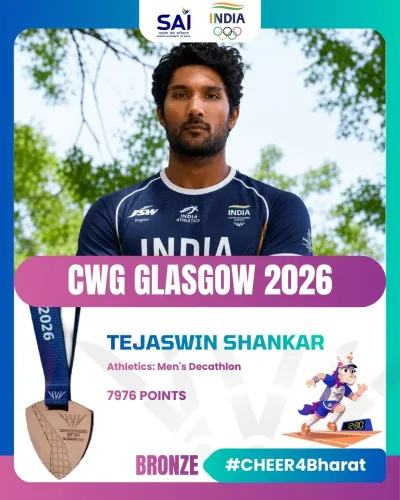
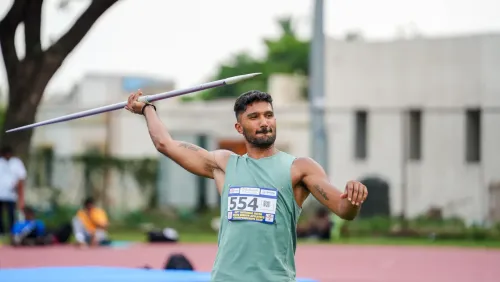
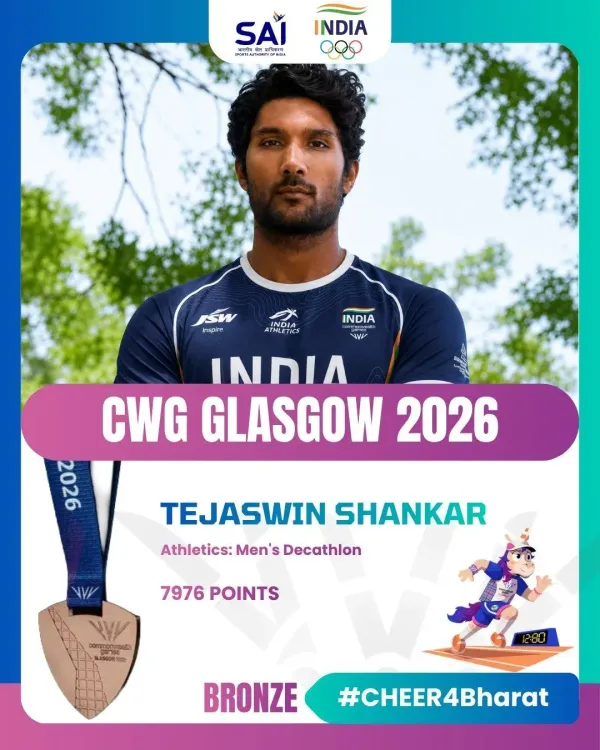
Tejaswin Shankar has made history as India's first-ever Commonwealth Games medallist in the Men's Decathlon, winning a record-breaking Bronze at Glasgow 2026. Union Health Minister J. P. Nadda celebrated the landmark achievement on X, calling it a moment that has 'scripted history' for Indian athletics.
Key Takeaways
Tejaswin Shankar won a Bronze Medal in the Men's Decathlon at the Glasgow Commonwealth Games 2026 .
This is India's first-ever Commonwealth Games medal in the Men's Decathlon.
The performance is described as record-breaking by Union Health Minister J.
Glasgow previously hosted the Commonwealth Games in 2014 , making 2026 its second edition.
The decathlon spans ten track and field disciplines across two days and is among athletics' most demanding events.
Nadda posted his congratulations on Saturday, August 1, 2026 .
India has a new chapter in its Commonwealth Games story. Tejaswin Shankar has become the country's first-ever medallist in the Men's Decathlon at a Commonwealth Games, claiming a record-breaking Bronze Medal at the Glasgow Commonwealth Games 2026 — a milestone that drew an immediate, warm response from Union Health Minister J. P. Nadda on Saturday, August 1, 2026.
Shankar's ten-discipline breakthrough at Glasgow
The decathlon — ten gruelling track and field disciplines spread across two days — has long been one of athletics' most demanding tests. No Indian athlete had ever stood on a Commonwealth Games podium in the event. Tejaswin Shankar changed that in Glasgow, producing a performance described as record-breaking, etching his name into Indian athletics history at a city that last hosted the Games in 2014.
Nadda's post on X captured the moment plainly: 'Our athlete, Tejaswin Shankar, has scripted history by becoming India's first-ever Commonwealth Games medallist in the Men's Decathlon, winning a record-breaking Bronze Medal at the Glasgow Commonwealth Games 2026!'
Why this bronze carries more weight than most
India's Commonwealth Games medal haul has historically been dominated by shooting, wrestling, weightlifting, and boxing. A podium finish in the decathlon — the so-called 'King of Athletics' — signals a broadening of India's athletic range. For a country that has invested heavily in track and field development over the past decade, Shankar's bronze is a proof-of-concept moment. It is not just a medal; it is a first.
Shankar had previously made headlines as a high jumper before transitioning focus toward the multi-event discipline, a path that demands versatility across sprints, jumps, throws, and middle-distance running. That pivot, it turns out, has paid off on the biggest stage the Commonwealth offers.
A minister's congratulations and what it signals
Senior ministers routinely acknowledge Indian sporting achievements on social media, but Nadda's framing — 'scripted history' — underscores the genuinely unprecedented nature of this result. His closing wish, that Shankar 'continue to make India proud with many more milestones in the years ahead,' points toward what Indian athletics will be watching: whether this bronze becomes the foundation of a sustained multi-event programme rather than a one-off peak.
For now, Tejaswin Shankar owns a record no one can take away. India's first. Glasgow, 2026.
Point of View
Not just a sentimental one — it signals that India's athletic development pipeline is finally producing competitive multi-event performers, a category the country had never cracked at the Commonwealth level. For the BJP government, which has championed the Khelo India framework and Target Olympic Podium Scheme, a first-ever podium in the decathlon offers a tangible, apolitical proof point. The congratulatory post from a senior cabinet minister also reflects a broader strategy of keeping India's sporting wins visible at the highest political level. The real question this medal raises is whether Indian athletics federations will now build a structured decathlon pathway around Shankar's breakthrough.
NationPress
1 Aug 2026
Frequently Asked Questions
Who is Tejaswin Shankar?
Tejaswin Shankar is an Indian track and field athlete who competes in the decathlon. He made history at the Glasgow Commonwealth Games 2026 by becoming India's first-ever Commonwealth Games medallist in the Men's Decathlon, winning a Bronze Medal.
What did Tejaswin Shankar win at CWG 2026?
Tejaswin Shankar won a record-breaking Bronze Medal in the Men's Decathlon at the Glasgow Commonwealth Games 2026, making him India's first-ever Commonwealth Games medallist in that event.
Where are the Commonwealth Games 2026 being held?
The 2026 Commonwealth Games are being held in Glasgow, Scotland. Glasgow previously hosted the Commonwealth Games in 2014.
What is the decathlon in athletics?
The decathlon is a combined track and field event comprising ten disciplines — sprints, middle-distance running, hurdles, jumps, and throws — contested over two days. It is widely regarded as one of the most demanding events in athletics.
Why did JP Nadda post about Tejaswin Shankar?
Union Health Minister J. P. Nadda posted on X to congratulate Tejaswin Shankar on winning India's first-ever Commonwealth Games Bronze Medal in the Men's Decathlon at Glasgow 2026, calling it a historic moment for Indian athletics.