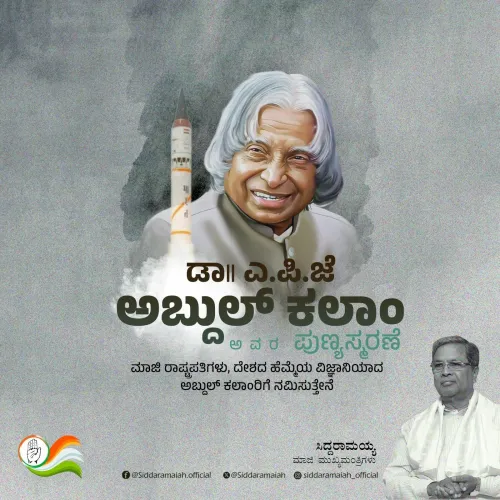
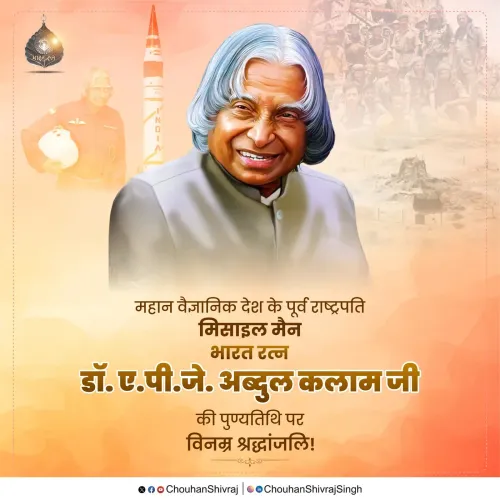
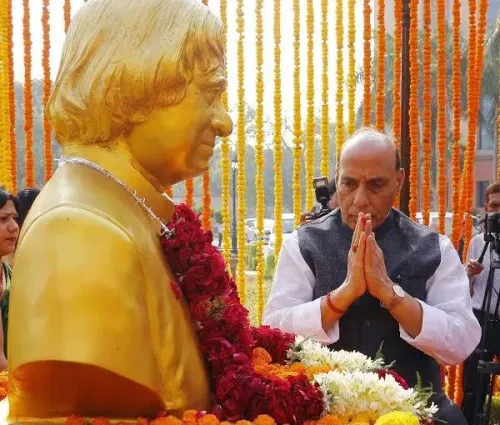
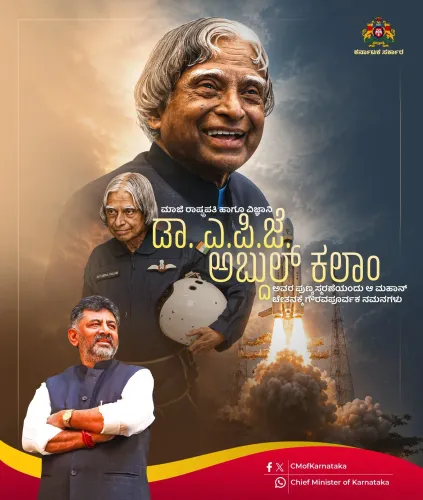
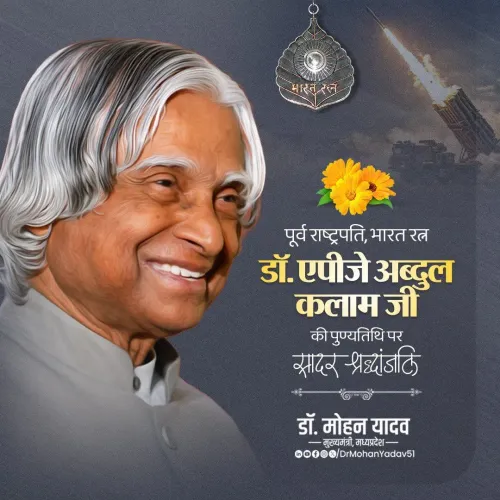
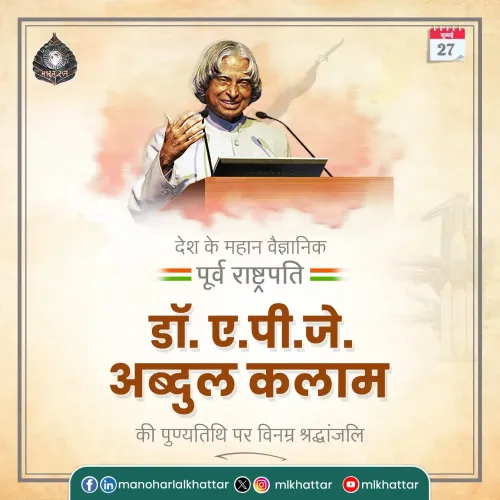
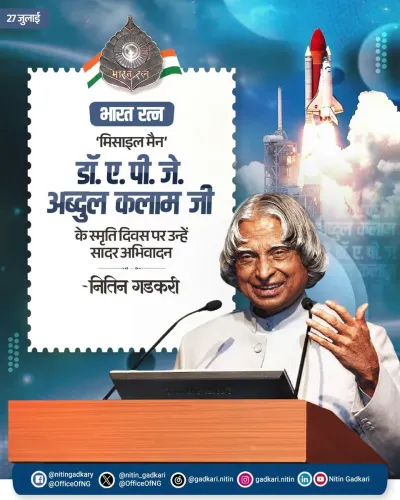
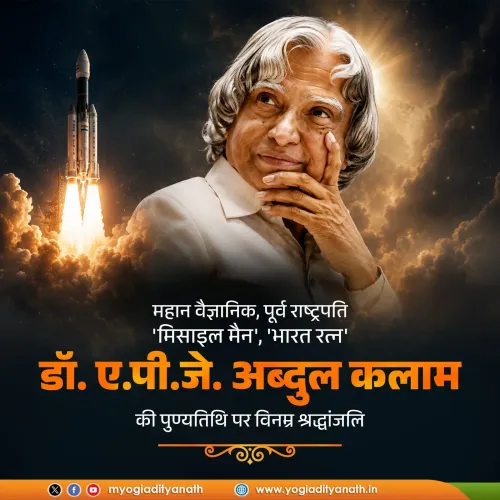
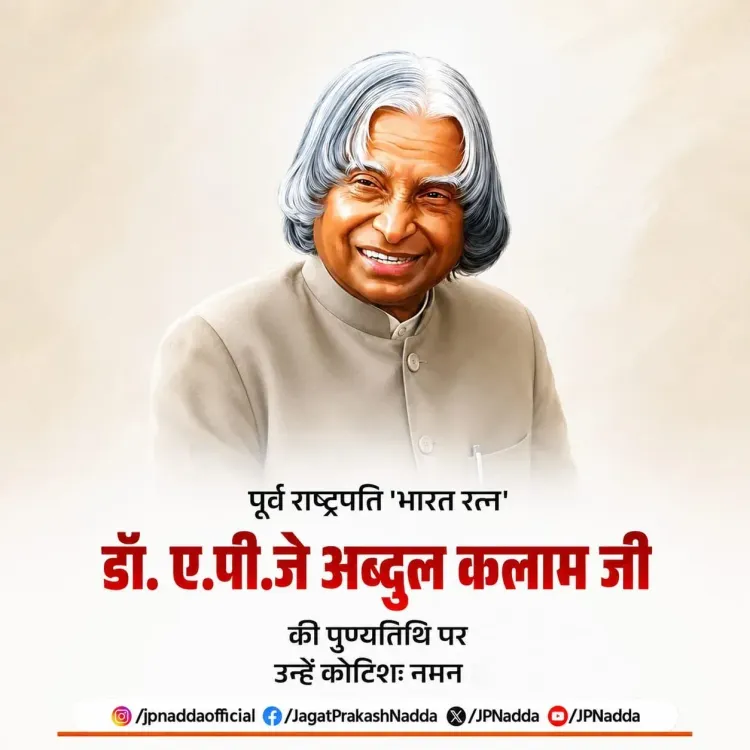
Nadda Pays Tribute to APJ Abdul Kalam on Death Anniversary
Synopsis
Union Health Minister J. P. Nadda on 27 July honoured former President and 'Bharat Ratna' awardee Dr. A. P. J. Abdul Kalam on his death anniversary, citing his landmark contributions to the Agni and Prithvi missile programmes, SLV-3, the Rohini satellite launch, and the Pokhran-II nuclear tests as pillars of India's strategic strength.
Key Takeaways
Nadda , Union Health Minister and BJP national president, paid tribute to Dr.
Abdul Kalam on his death anniversary, 27 July .
Nadda specifically cited Kalam's contributions to the Agni and Prithvi missile programmes under the IGMDP , launched in 1983 .
Kalam led the SLV-3 project at ISRO, enabling the successful launch of the Rohini satellite in July 1980 .
His documented scientific role in the Pokhran-II nuclear tests of May 1998 cemented India's status as a nuclear-capable state.
Kalam served as 11th President of India from 2002 to 2007 and received the Bharat Ratna in 1997 .
Nadda described Kalam's legacy as a lasting source of inspiration for Indian youth in nation-building and social service.
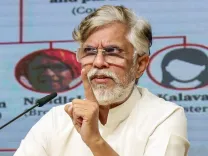
Union Health Minister J. P. Nadda on Monday, 27 July paid homage to former President and scientist Dr. A. P. J. Abdul Kalam on his death anniversary, honouring his contributions to India's strategic and nuclear deterrence capabilities. Nadda, who also serves as BJP national president, credited Kalam with elevating India's scientific and strategic strength to new heights through decades of pioneering work in defence and space research.
Context
Posting in Hindi on 27 July, Nadda wrote: 'भारत को सामरिक एवं परमाणु प्रतिरोधक क्षमता के क्षेत्र में सशक्त बनाने में बहुमूल्य योगदान देने वाले महान वैज्ञानिक' ['the great scientist who made invaluable contributions to strengthening India in the field of strategic and nuclear deterrence']. He offered 'countless salutations' (kotishaः naman) to Kalam, describing his thoughts, visionary leadership, and exemplary life as an enduring source of inspiration for Indian youth in nation-building and social service.
Dr. Kalam passed away on 27 July 2015 while delivering a lecture in Shillong. Each year, the anniversary draws tributes from across the political spectrum, underscoring the non-partisan regard in which he is held as a symbol of India's self-reliance in science and technology.
Policy Backdrop
Nadda's post specifically cited Kalam's role in the Agni and Prithvi missile programmes, the development of the SLV-3 satellite launch vehicle, the successful launch of the Rohini satellite, and India's Pokhran-II nuclear tests. These milestones form the bedrock of India's current strategic posture. The SLV-3 mission in July 1980 made India one of the few nations capable of indigenous satellite launches, while the Pokhran-II tests of May 1998 confirmed India's status as a nuclear-capable state.
Kalam served as Project Director of SLV-3 at ISRO before moving to DRDO, where he led the Integrated Guided Missile Development Programme (IGMDP) launched in 1983. Under the IGMDP, the Agni and Prithvi systems were developed as part of India's push for indigenous ballistic missile capability. He later served as Principal Scientific Adviser to the Government before being elected the 11th President of India, serving from 2002 to 2007.
Stakeholders and Impact
Kalam's legacy resonates most directly with India's defence science community — scientists at DRDO and ISRO who continue to build on the institutional frameworks he helped establish. His Bharat Ratna, awarded in 1997, recognised contributions that cut across party lines and government tenures, lending his memory a unifying quality rare in Indian public life.
For Indian youth, Kalam remains a touchstone figure. His books, public lectures, and the 'Missile Man of India' identity have made him a fixture in school curricula and motivational discourse. Annual commemorations reinforce the government's emphasis on indigenous technological advancement as a cornerstone of national security and economic development.
What's Next
Tributes on Kalam's death anniversary typically coincide with renewed public attention on DRDO and ISRO milestones, including upcoming missile induction timelines and planned satellite launch schedules. Parliamentary discussions during the ongoing monsoon session may also reference Kalam-inspired education and innovation initiatives. As India continues to expand its indigenous defence manufacturing base under the Aatmanirbhar Bharat framework, Kalam's vision of self-reliant strategic capability remains a guiding reference point for policymakers and scientists alike.
Point of View
Prithvi, SLV-3, Pokhran-II — the post goes beyond ceremonial remembrance and implicitly frames current strategic programmes as continuations of Kalam's vision. The tribute also carries a youth-outreach dimension, consistent with BJP's sustained effort to position Kalam as a non-partisan inspirational figure that appeals across demographic lines. Politically, honouring a former President who served under a Congress-led government allows the ruling dispensation to claim a broader national legacy narrative.
NationPress
27 Jul 2026
Frequently Asked Questions
When did APJ Abdul Kalam pass away?
Dr. A. P. J. Abdul Kalam passed away on 27 July 2015 while delivering a lecture at the Indian Institute of Management in Shillong , Meghalaya.
What is APJ Abdul Kalam famous for in India's defence programme?
Kalam is best known for his leadership of the Integrated Guided Missile Development Programme (IGMDP) , under which the Agni and Prithvi missile systems were developed, and for his scientific role in the Pokhran-II nuclear tests of 1998 , earning him the title 'Missile Man of India'.
What was Kalam's role in India's space programme?
Kalam served as Project Director of SLV-3 at ISRO , India's first indigenous satellite launch vehicle, which successfully placed the Rohini satellite into orbit in July 1980 , marking a landmark in India's space self-reliance.
When did APJ Abdul Kalam receive the Bharat Ratna?
Dr. A. P. J. Abdul Kalam was awarded the Bharat Ratna , India's highest civilian honour, in 1997 , recognising his contributions to science, defence, and national development.
Why did J. P. Nadda pay tribute to APJ Abdul Kalam?
J. P. Nadda , Union Health Minister and BJP national president, paid tribute on 27 July — Kalam's death anniversary — honouring his scientific legacy in missile development, space research, and nuclear deterrence, and describing him as an enduring inspiration for Indian youth.