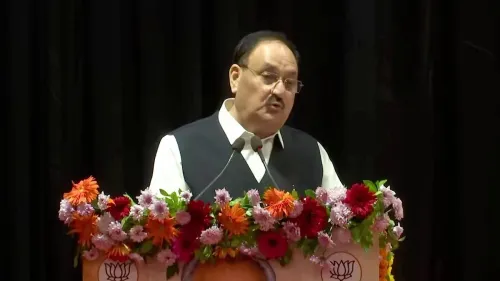
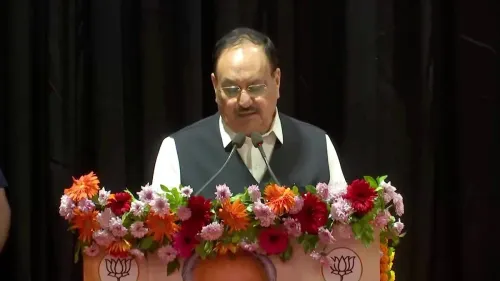
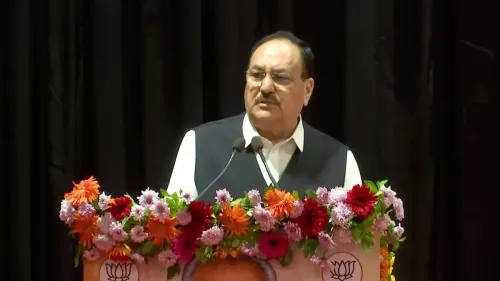
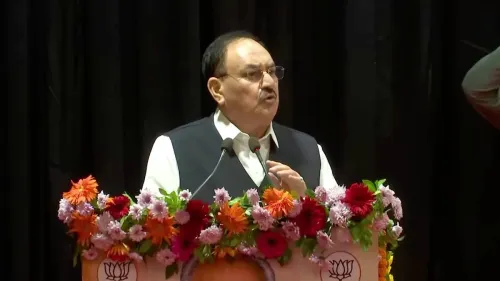
Nadda pays tribute to Kedarnath Sahni on his 100th birth anniversary
Synopsis
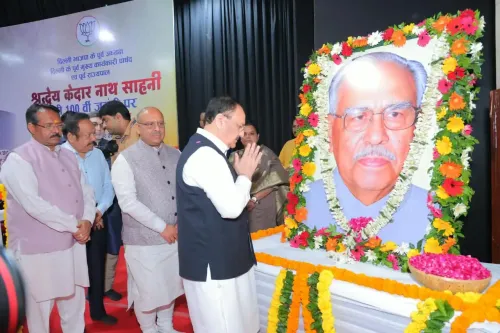
Union Health Minister J. P. Nadda attended a New Delhi event on 24 October 2026 to mark the 100th birth anniversary of late Kedarnath Sahni, honouring the former Delhi BJP president's role in building the party from Jan Sangh roots, protecting the organisation during the Emergency, and rehabilitating displaced persons.
Key Takeaways
Nadda paid tribute to late Kedarnath Sahni at a centenary event in New Delhi on 24 October 2026 .
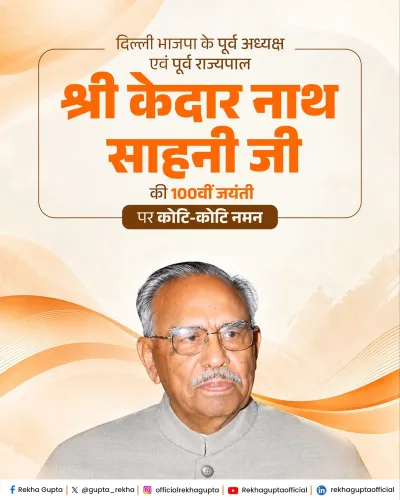
Sahni served as former Delhi BJP president and former governor , with roots in the Jan Sangh founded in 1951 .
Nadda credited Sahni with protecting the party organisation during the Emergency of 1975–77 and rehabilitating displaced persons.
Nadda recalled personally working under Sahni's leadership from Himachal Pradesh to Delhi .
The tribute linked Sahni's sacrifices to the BJP's current global standing and India's rising prestige under PM Narendra Modi .
Nadda closed with a call to treat politics as a medium of 'social service and nation-building,' not a pursuit of power.
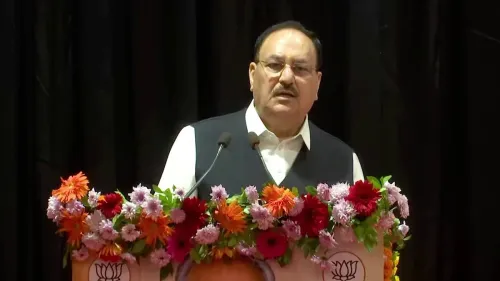
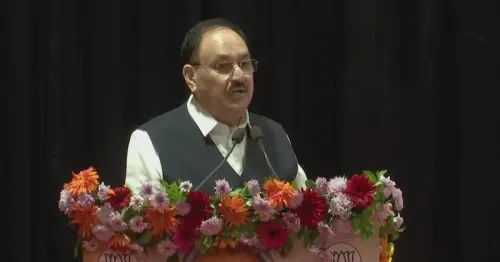
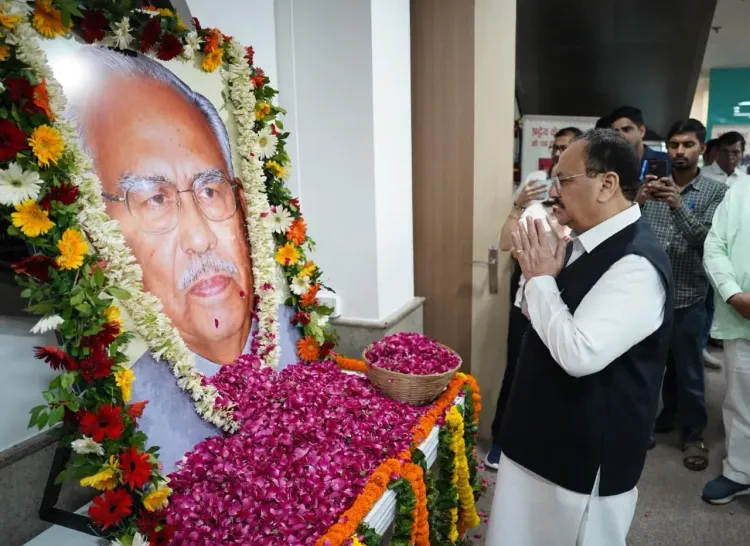
A century after the birth of one of the BJP's foundational architects, Union Health Minister J. P. Nadda stood in New Delhi on Saturday, 24 October 2026 to pay homage to the late Kedarnath Sahni — former Delhi BJP president, former governor, and a man whose decades of quiet sacrifice helped build the party from the ground up.
Posting in Hindi on X, Nadda wrote that Sahni's life 'inspires through struggle, service, and dedication to the organisation.' He added: 'His contribution to strengthening the organisation from Jan Sangh to BJP, to the rehabilitation of displaced persons, and to protecting the organisation during the Emergency will always be remembered.'
From Jan Sangh to BJP: the organisational thread Sahni helped weave
Kedarnath Sahni was among the cadre who carried the Jan Sangh's ideological flame through some of Indian politics' most turbulent decades. The Jan Sangh, founded in 1951, was the ideological predecessor to the Bharatiya Janata Party, which was formally constituted in 1980 after the Janata Party experiment dissolved. Workers like Sahni bridged that transition — holding the organisation together through the merger and then the re-founding.
Perhaps the most testing chapter was the Emergency of 1975–77, when the government of the day suspended civil liberties and cracked down on opposition parties. Jan Sangh and later BJP accounts consistently describe underground organising during this period as the crucible that forged a generation of leaders. Sahni's role in that resistance is among the contributions Nadda specifically acknowledged.
Nadda's personal connection — from Himachal Pradesh to Delhi
The tribute carried an unmistakably personal register. Nadda noted that he himself had the 'good fortune' of working under Sahni's leadership, from Himachal Pradesh all the way to Delhi — a detail that grounds the commemoration in lived political apprenticeship rather than ceremonial distance. Nadda began his own political career in Himachal Pradesh before rising through the national BJP structure to become party president and, later, a senior cabinet minister.
He also linked Sahni's sacrifices to the BJP's present-day stature, writing that 'behind the BJP's global identity and India's growing prestige under Prime Minister Narendra Modi's leadership lies the sacrifice and dedication of ascetics like Sahni.' The framing is a familiar BJP rhetorical arc — connecting the hardships of the Jan Sangh era to the party's current electoral and international standing.
The vow Nadda closed with
Nadda ended his post with what read as an organisational credo: 'Our resolve should be to make politics not a means of power, but a medium of social service and nation-building.' The line, offered at a centenary tribute, doubles as a statement of intent — the kind of closing a party president frames for internal consumption as much as public record.
The BJP regularly marks centenary and death-anniversary milestones for its early leaders, using such occasions to reinforce a sense of ideological continuity from the Jan Sangh's founding generation through to the present dispensation. Sahni's 100th birth anniversary fits squarely within that commemorative tradition — but Nadda's personal testimony lifts it beyond routine tribute.
For a party that stakes much of its identity on organisational discipline and historical memory, the men and women who kept the structure alive through the Emergency remain the closest thing the BJP has to founding saints. Kedarnath Sahni, a century on, is being firmly placed in that canon.
Point of View
Such centenary moments also serve as internal cohesion exercises, reminding workers of the party's founding ethos of service over power.
NationPress
25 Oct 2026
Frequently Asked Questions
Who was Kedarnath Sahni?
Kedarnath Sahni was a veteran BJP leader who served as former Delhi BJP president and former governor. He began his political career in the Jan Sangh, contributed to party-building through to the formation of the BJP in 1980, worked to rehabilitate displaced persons, and is credited with protecting the organisation during the Emergency of 1975–77.
Why is Kedarnath Sahni's 100th birth anniversary being celebrated in 2026?
The event marks the centenary of Sahni's birth, a milestone the BJP is commemorating with a formal tribute programme in New Delhi to honour his contributions to the party's organisational history.
What was Kedarnath Sahni's role during the Emergency?
According to J. P. Nadda's tribute, Sahni played a key role in protecting the Jan Sangh and BJP organisation during the Emergency of 1975–77, a period when opposition parties faced severe restrictions and many leaders engaged in underground organising.
What is the connection between Jan Sangh and BJP?
The Jan Sangh, founded in 1951, was the ideological predecessor to the Bharatiya Janata Party. After the Jan Sangh merged into the Janata Party in 1977, former Jan Sangh members re-established the BJP in 1980, carrying forward the same organisational lineage.
What did JP Nadda say at the Kedarnath Sahni centenary event?
Nadda said Sahni's life inspires through struggle, service, and dedication to the organisation. He recalled working under Sahni from Himachal Pradesh to Delhi, credited Sahni's sacrifices as part of the foundation of the BJP's current global standing, and called on political workers to treat politics as a medium of social service and nation-building rather than a pursuit of power.