Nadda pays tribute to RSS chief Balasaheb Deoras on punyatithi
Synopsis
BJP national president and Union Health Minister J. P. Nadda on 17 June 2026 paid tribute to Balasaheb Deoras, the RSS's third Sarsanghchalak, on his death anniversary, honouring his legacy of social harmony and service to the marginalised.
Key Takeaways
Nadda , Union Health Minister and BJP national president, paid tribute to Balasaheb Deoras on his death anniversary on 17 June 2026 .
Balasaheb Deoras was the third Sarsanghchalak of the RSS , serving from 1973 to 1994 .
Nadda described Deoras's life as devoted to 'national worship, social harmony, and the upliftment of the marginalised.' Deoras passed away in 1996 ; his death anniversary has been observed by RSS and BJP leaders every year since.
The tribute underscores the continuing ideological interface between the RSS and the BJP , with themes of social cohesion central to both organisations.
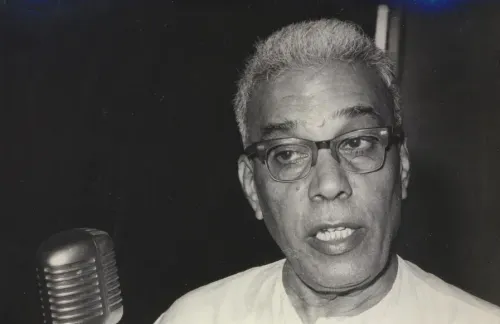
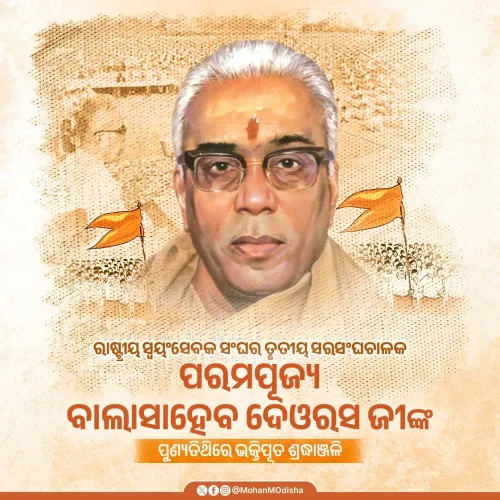
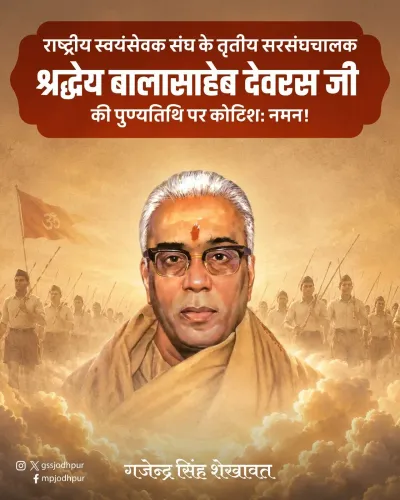
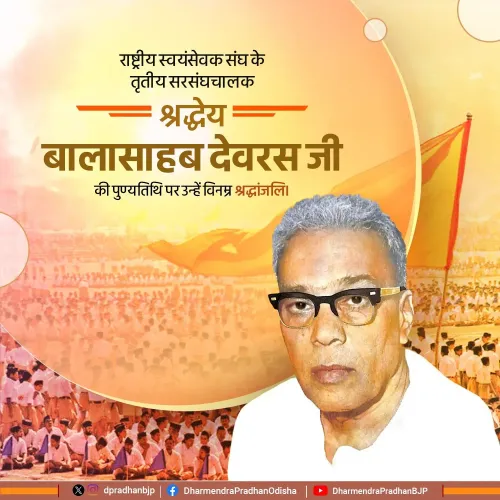
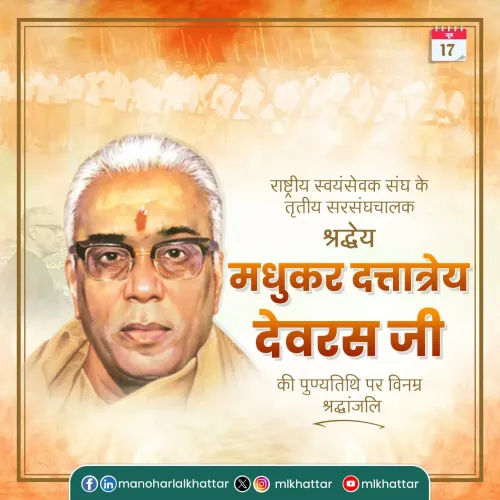
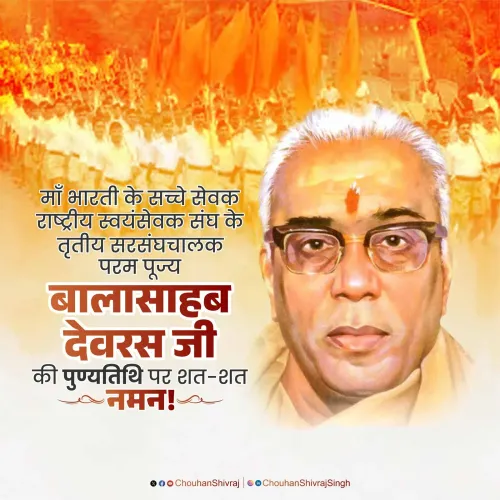
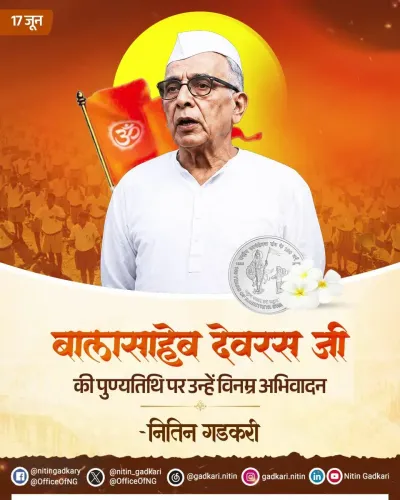
Union Health Minister and BJP national president J. P. Nadda on Wednesday, 17 June 2026, paid tribute to Madhukr Dattatreya Deoras, popularly known as Balasaheb Deoras, the third Sarsanghchalak of the Rashtriya Swayamsevak Sangh (RSS), on his death anniversary. Nadda described Deoras as a lifelong servant of the nation whose work remains an inspiration for all patriots.
Context
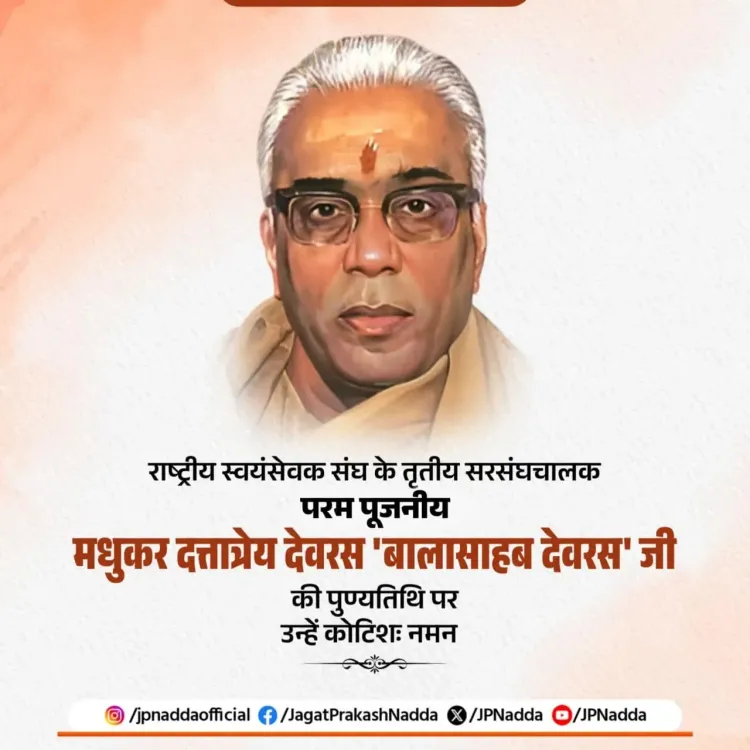
Posting in Hindi on his official X account, Nadda wrote: 'राष्ट्रीय स्वयंसेवक संघ के तृतीय सरसंघचालक परम पूजनीय मधुकर दत्तात्रेय देवरस बालासाहब देवरस जी की पुण्यतिथि पर कोटिशः नमन करता हूँ' — 'I bow in reverence a crore times on the death anniversary of the third Sarsanghchalak of the RSS, the most revered Madhukar Dattatreya Deoras, Balasaheb Deoras.' He further noted that Deoras's entire life was devoted to 'national worship, social harmony, the upliftment of the marginalised, and the establishment of the glory of Mother India.'
Nadda concluded by calling Deoras's 'luminous personality' and his nation-first work 'a source of inspiration for all who love the nation.'
Policy Backdrop
Balasaheb Deoras served as the RSS's Sarsanghchalak from 1973 to 1994, a period that saw the Sangh expand its network of social service activities and sharpen its emphasis on reaching marginalised communities. His tenure coincided with significant political upheavals in India, including the Emergency of 1975–77, during which the RSS was banned. After the ban was lifted, Deoras oversaw a period of organisational consolidation that many analysts credit with strengthening the ideological bridge between the RSS and what would become the BJP.
The RSS, founded in 1925, is a volunteer-based organisation that maintains close ideological ties with the BJP. Annual observances of Deoras's death anniversary on 17 June have been a consistent feature of the RSS–BJP calendar since his passing in 1996.
Stakeholders and Impact
The tribute carries significance for the RSS's vast volunteer network and for BJP functionaries who draw on the Sangh's ideological lineage. Themes of social harmony and service to the marginalised that Nadda invoked are also central to several government welfare programmes, making such commemorations a point of convergence between organisational memory and current policy rhetoric.
Senior BJP leaders regularly issue public homages to past RSS chiefs on their punyatithis, reinforcing the party's public acknowledgement of its ideological roots. Nadda, as both a cabinet minister and the BJP's national president, occupies a unique dual position that gives such tributes added institutional weight.
What's Next
Similar commemorative statements from other senior BJP and RSS functionaries are expected around 17 June each year, continuing the established pattern of public remembrance. Observers will watch whether references to Deoras-era social service programmes surface in upcoming government welfare scheme announcements, as the government has previously drawn rhetorical continuity between Sangh-inspired volunteerism and state-led outreach initiatives.
Point of View
The message also allows the party to frame Sangh-inspired volunteerism as a precursor to its own welfare governance. As both cabinet minister and party president, Nadda's dual role amplifies the institutional resonance of such statements beyond mere ceremonial gesture. The consistency of these annual tributes signals that the BJP-RSS ideological compact remains a deliberate, managed public narrative rather than an incidental one.
NationPress
15 Sept 2026
Frequently Asked Questions
Who was Balasaheb Deoras?
Balasaheb Deoras, full name Madhukar Dattatreya Deoras, was the third Sarsanghchalak of the Rashtriya Swayamsevak Sangh, serving from 1973 to 1994. He is remembered for expanding the RSS's social service network and emphasising outreach to marginalised communities.
When did Balasaheb Deoras die?
Balasaheb Deoras passed away in 1996. His death anniversary falls on 17 June and is observed annually by RSS and BJP leaders.
Why did JP Nadda pay tribute to Balasaheb Deoras?
J. P. Nadda paid tribute on the occasion of Deoras's punyatithi (death anniversary) on 17 June 2026, continuing a long-standing BJP practice of publicly honouring past RSS chiefs to acknowledge the party's ideological roots.
What is the RSS Sarsanghchalak?
The Sarsanghchalak is the supreme head of the Rashtriya Swayamsevak Sangh. Balasaheb Deoras was the third person to hold this position, succeeding M. S. Golwalkar.
What themes did JP Nadda highlight in his tribute to Deoras?
Nadda highlighted Deoras's commitment to national service, social harmony, upliftment of marginalised communities, and the glory of the nation, describing his personality as a source of inspiration for patriots.