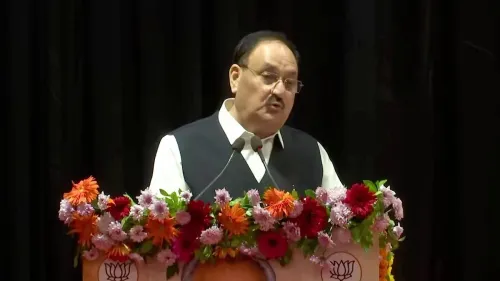
Nadda recalls Sahni ji's patient diplomacy in ABVP days
Synopsis
Union Health Minister J. P. Nadda honours Sahni ji, a mentor from his ABVP years, recalling how his patient diplomacy resolved tensions between ABVP and Janata Vidyarthi Morcha — and the lesson it left: thorough discussion beats haste in any agreement.
Key Takeaways
Union Health Minister J.
Nadda posted a personal tribute to Sahni ji on 24 October 2026 , recalling their shared years in ABVP .
Nadda describes Sahni ji as a mediator who patiently heard all sides when ABVP and the Janata Vidyarthi Morcha clashed on campuses.
Sahni ji's guiding principle, as Nadda recalls it: detailed discussion and sound counsel — not haste — underpin lasting settlements.
The tribute reflects on a formative era of campus politics in the late 1970s and early 1980s , following the Emergency and the Janata Party interlude.
BJP leaders who came of age in ABVP frequently cite that period as the crucible of their political temperament and networks.
Long before cabinet portfolios and party presidencies, Union Health Minister J. P. Nadda was a campus activist learning the craft of negotiation — and he credits a man named Sahni ji with teaching him that patience, not speed, is the true engine of lasting agreements. In a tribute posted on Saturday, 24 October 2026, Nadda shared a memory from his Akhil Bharatiya Vidyarthi Parishad (ABVP) years that speaks directly to how India's most contentious political skills are often forged on university grounds.
Posting in Hindi, Nadda wrote: 'मेरा उनसे विद्यार्थी परिषद के दिनों से संबंध रहा' — 'My connection with him goes back to the days of the Vidyarthi Parishad.' He recalled that the defining tension of that era was the friction between ABVP and the Janata Vidyarthi Morcha, the student wing aligned with the Janata Party. Campus politics in that period — the late 1970s and early 1980s — was no genteel debating society. It was combative, ideologically charged, and occasionally volatile in the aftermath of the Emergency.The man who chose dialogue over confrontation
It was in that charged atmosphere that Sahni ji stood apart. Nadda describes him as someone who would 'patiently listen to all sides' when tensions threatened to boil over, then methodically work toward a resolution. His philosophy, as Nadda recalls it, was clear: 'जल्दबाजी नहीं, बल्कि विस्तृत चर्चा और सही सुझाव ही सफल समझौते का आधार बनते हैं' — 'Not haste, but detailed discussion and the right counsel form the foundation of a successful agreement.'
That instinct — to de-escalate through process rather than posture — left a deep impression on a young Nadda. The tribute is as much a window into the making of a senior BJP leader as it is a farewell to a mentor.
ABVP's campus battles and the Janata interlude
ABVP, the RSS-affiliated student organisation, and the Janata Vidyarthi Morcha operated in an era of unusual political flux. The Janata Party's brief national government (1977–1979) gave its student wing a platform to challenge ABVP's dominance on campuses across north India, creating a rivalry that produced both sharp confrontations and, occasionally, negotiated coexistence. Senior BJP figures who came of age in this period frequently recall it as formative — not just ideologically, but in the practical arts of political management.
Nadda himself rose through ABVP before entering electoral politics in Himachal Pradesh and eventually ascending to the BJP's national leadership. The networks and temperaments built in those student years, his tribute suggests, echo across decades.
Point of View
Nadda implicitly frames dialogue and patience as core BJP values, a message that carries weight given the party's current position as the dominant force in national politics. The tribute is light on news value as a standalone event but carries biographical texture that political historians and analysts will note as another data point in documenting how India's ruling party was shaped in the post-Emergency campus wars. What remains unverified is Sahni ji's own identity and the immediate occasion for this remembrance — details that would sharpen the tribute's significance considerably.
NationPress
24 Oct 2026
Frequently Asked Questions
Who is Sahni ji that J. P. Nadda is paying tribute to?
Nadda's post identifies Sahni ji as a figure from his ABVP student-politics days who was known for patiently mediating between rival student groups. His full identity and background cannot be independently verified from available public records.
What was ABVP's conflict with the Janata Vidyarthi Morcha about?
ABVP (Akhil Bharatiya Vidyarthi Parishad) and the Janata Vidyarthi Morcha were rival student organisations in the late 1970s and early 1980s , competing for campus dominance during the period of the Janata Party government that followed the Emergency.
What is ABVP and its connection to BJP?
ABVP , the Akhil Bharatiya Vidyarthi Parishad, is an RSS -affiliated student organisation historically linked to the BJP. It has served as a primary training ground for several senior BJP leaders, including J. P. Nadda .
Why do BJP leaders often talk about their ABVP days?
ABVP is the primary student feeder organisation for the BJP, and the networks formed during campus activism in the 1970s–1980s remain central to the party's identity. Public reminiscences reinforce a shared origin story and highlight the personal bonds that shape India's ruling party.
What lesson did J. P. Nadda draw from Sahni ji's approach to negotiations?
Nadda recalls that Sahni ji believed haste is the enemy of good agreements — that extensive discussion and the right counsel , not speed, are what make settlements durable. This philosophy clearly made a lasting impression on Nadda's own political style.