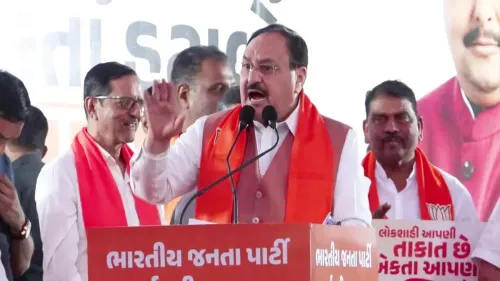
Nadda Hails EC's Last-Mile Push to Reach Every Voter
Synopsis
Union Health Minister J. P. Nadda highlighted two extraordinary feats from the 2024 Lok Sabha elections — polling officials trekking 10 km in Gir Forest and 44 km in Arunachal Pradesh to reach individual voters — as proof of the Election Commission's commitment to universal adult franchise.
Key Takeaways
Union Health Minister J.
Nadda praised the Election Commission of India's voter-outreach efforts during the 2024 general elections .
Polling officials walked 10 kilometres through Gir Forest, Gujarat to enable a single voter to cast their ballot.
A separate team covered 44 kilometres of mountain terrain in Arunachal Pradesh for one isolated voter.
The Election Commission operates under Article 324 of the Constitution and is mandated to conduct elections across all of India's diverse geographies.
The SVEEP programme , launched in 2009 , underpins the Commission's systematic push for electoral participation in remote and difficult areas.
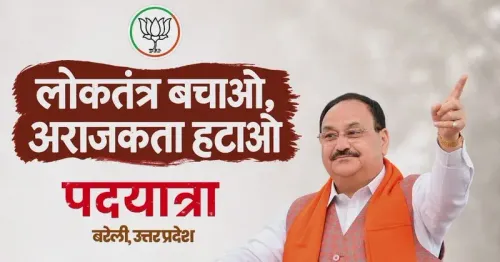
Nadda's post carried the hashtag #SaveDemocracyRemoveAnarchy , placing the tribute within an active political debate.
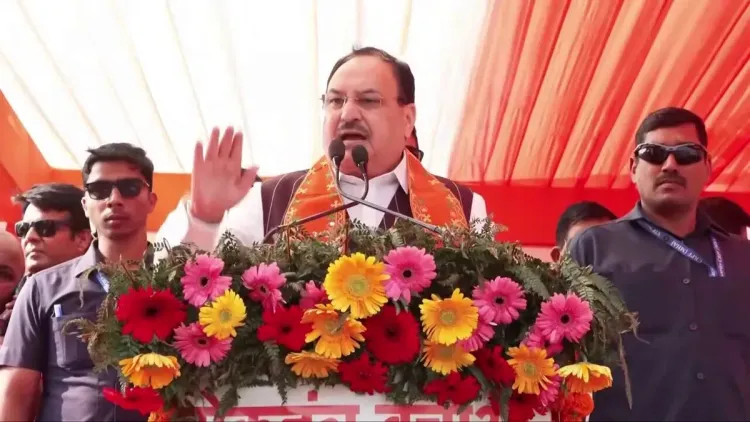
Ten officials. Ten kilometres on foot through Gir's lion-country. All to record a single vote. Union Health Minister J. P. Nadda invoked that image on Tuesday, 3 November 2026, to salute the Election Commission of India's commitment to universal franchise during the 2024 general elections — arguing that India's democracy doesn't wait for citizens to find it; it walks to their door.
Posting in Hindi with the hashtag #SaveDemocracyRemoveAnarchy, Nadda highlighted two logistical feats from the 2024 Lok Sabha polls. In Gir Forest, Gujarat, polling personnel trekked 10 kilometres on foot to enable a single voter to cast their ballot inside a protected wildlife reserve. In the mountains of Arunachal Pradesh, officials covered 44 kilometres of high-altitude terrain — again, for one solitary voter. His message: 'The voter will not come to the Election Commission's door; the Election Commission will go to the voter's door.'
Gir and Arunachal: Two Journeys, One Principle
The two examples Nadda chose are not random. Gir Forest in Gujarat is India's last refuge of the Asiatic lion — a protected area where permanent habitation is thin and access is deliberately restricted. Arunachal Pradesh, India's easternmost state, combines some of the country's most rugged mountain terrain with sparse population densities; reaching remote hamlets requires crossing ridgelines that most supply chains simply bypass. That polling officials made both journeys — for a single vote each — is a pointed illustration of what the constitutional mandate of universal adult franchise demands in practice.
The Election Commission of India, established under Article 324 of the Constitution, carries supreme authority over the conduct of elections to Parliament, state legislatures, and the offices of President and Vice-President. Its operational brief extends far beyond ballot-counting: it encompasses the logistics of setting up booths wherever a registered voter lives, however inaccessible that location may be.
The Institutional Machinery Behind Last-Mile Access
These individual journeys sit inside a broader institutional architecture. The Commission's Systematic Voters' Education and Electoral Participation (SVEEP) programme, running since 2009, was designed precisely to push electoral participation into difficult geographies — remote forests, island chains, high-altitude villages, and tribal hamlets that routine outreach doesn't naturally reach. Last-mile booth placement and dedicated polling parties for isolated voters are now a regular feature of every major election cycle.
The 2024 Lok Sabha elections, spread across seven phases from April to June, were the largest democratic exercise in human history by voter count. The logistical scale involved hundreds of thousands of polling parties fanning out across terrain as varied as Rajasthan's deserts and Meghalaya's rainforests. Within that vast operation, the Gir and Arunachal episodes Nadda highlighted represent the extreme end of the accessibility curve — places where the cost-per-vote in human effort is highest, yet the Commission deployed resources regardless.
Nadda's post arrives at a moment of political friction — the hashtag #SaveDemocracyRemoveAnarchy signals an active partisan debate — but the specific examples he cites speak to a non-partisan institutional record that spans multiple administrations and election cycles. The principle that no registered voter should be unreachable has been consistently upheld by the Commission across governments of different stripes.
As India begins looking toward the next general elections expected around 2029, the question of how the Commission deepens last-mile access — through technology, expanded SVEEP reach, or dedicated remote-area polling units — will define how well that principle holds at an even larger scale.
Point of View
As the combative hashtag signals. Yet the underlying examples are real and institutionally significant: the Election Commission's last-mile logistics represent a constitutional commitment that pre-dates and transcends any single government. The sharper political read is that by anchoring a partisan hashtag to a non-partisan institutional record, Nadda is attempting to conflate the Commission's credibility with the ruling party's democratic credentials — a fusion that critics of electoral institutions are likely to contest. What the post does objectively illuminate is the extraordinary human cost of universal franchise in a country as geographically extreme as India, and the quiet administrative machinery — SVEEP, dedicated polling parties, remote booth deployment — that makes it possible election after election.
NationPress
4 Nov 2026
Frequently Asked Questions
Why did Election Commission officials walk 10 km in Gir Forest for one voter?
During the 2024 Lok Sabha elections, polling officials trekked 10 kilometres inside Gir Forest, Gujarat — a protected wildlife reserve with limited access — to set up a booth for a single registered voter, fulfilling the constitutional obligation that every eligible citizen can cast their ballot regardless of location.
What is the SVEEP programme of the Election Commission?
The Systematic Voters' Education and Electoral Participation (SVEEP) programme was launched by the Election Commission in 2009 to boost voter awareness and turnout, with a specific focus on reaching marginalised, remote, and difficult-to-access communities across India.
What did J. P. Nadda post about the Election Commission?
Union Health Minister J. P. Nadda posted in Hindi on 3 November 2026, citing examples of polling officials walking 10 km in Gir and 44 km in Arunachal Pradesh to reach isolated voters in 2024, calling it a demonstration of the Election Commission's commitment to democracy.
What is the Election Commission of India's constitutional basis?
The Election Commission of India is established under Article 324 of the Constitution and holds supreme authority over the conduct of elections to Parliament, state legislatures, and the offices of President and Vice-President.
When were the 2024 Lok Sabha elections held?
The 2024 Lok Sabha elections were held in seven phases between April and June 2024 to constitute the 18th Lok Sabha, making them one of the largest democratic exercises in world history by total voter count.