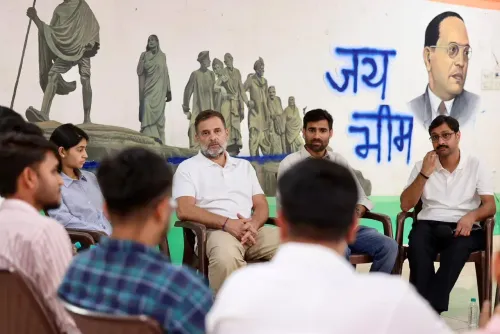
Rahul Gandhi flags Nagpur student's NEET centre allotted in Abu Dhabi

Synopsis
Congress leader Rahul Gandhi raised the case of a Nagpur student allotted Abu Dhabi as his NEET re-exam centre a day before the test. With no passport and no funds for international travel, the aspirant was forced to skip the examination, spotlighting a critical flaw in NTA's centre-allocation process.
Key Takeaways
Congress leader Rahul Gandhi posted on June 20, 2026 about a Nagpur student allotted Abu Dhabi as his NEET re-examination centre.
The student discovered the overseas allotment only when he downloaded his admit card one day before the scheduled examination.
The aspirant had no passport and his family lacked the financial means to arrange international travel on such short notice.
The student reportedly cried through the night and ultimately declined to appear for the exam.
The NTA created overseas centres including Abu Dhabi to serve NRI and diaspora students, but the allocation system does not reliably exclude domestic candidates.
The incident is expected to fuel parliamentary and judicial scrutiny of NTA's centre-assignment guidelines for re-examinations.
Congress leader Rahul Gandhi, Leader of the Opposition in the Lok Sabha, on Saturday, June 20, 2026, shared the case of a student from Nagpur who was allotted an exam centre in Abu Dhabi for the NEET re-examination — a day before the test — leaving the aspirant unable to appear due to lack of a passport and funds for international travel.
Gandhi posted in Hindi, describing the student's predicament: 'नागपुर का एक बच्चा एक महीने से NEET re-exam की तैयारी कर रहा था' ('A child from Nagpur had been preparing for the NEET re-exam for a month'). He wrote that when the student downloaded his admit card a day before the examination, his assigned centre turned out to be Abu Dhabi. With no passport, no family finances to arrange international travel, and no time left, the student 'cried through the night and is now refusing to sit the exam,' Gandhi wrote.
Context
The National Eligibility cum Entrance Test (NEET) is India's single-window undergraduate medical entrance examination, conducted by the National Testing Agency (NTA), an autonomous body set up under the Ministry of Education in 2017. The Supreme Court had mandated NEET as the sole medical entrance test nationwide in 2013, replacing a fragmented system of state-level exams. The NTA took over NEET from the CBSE starting 2019.
Overseas centres — including one in Abu Dhabi — were introduced by the NTA to allow Non-Resident Indians and Indian students abroad to appear for the examination without travelling back to India. However, critics have long argued that the centre-allocation algorithm does not adequately distinguish between domestic candidates and those genuinely based overseas.
Policy Backdrop
Centralised national examinations have drawn sustained criticism over centre allocation, logistical barriers, and perceived insensitivity to candidates from smaller cities and economically weaker backgrounds. A student in Nagpur — a Tier-2 city in Maharashtra — receiving an overseas allotment underscores a structural gap in NTA's centre-assignment process for re-examinations, where candidate pools and logistical circumstances can differ significantly from the main exam cycle.
Domestic candidates allotted overseas centres face a compounded disadvantage: they require a valid passport, international airfare, accommodation, and a visa — costs and documentation that are simply out of reach for middle-class or economically weaker families, often with less than 24 hours of notice after admit-card release.
Stakeholders and Impact
The immediate stakeholder is the student himself — a medical aspirant who had reportedly spent one month preparing specifically for the re-examination, only to find participation rendered impossible by an administrative decision. More broadly, the case represents the vulnerability of students from non-metro cities who depend on domestic centre allotments and have no fallback when the system errs.
Gandhi's post is likely to amplify calls from Opposition benches and student groups for the NTA to institute mandatory safeguards — such as confirming passport status and residential address before assigning overseas centres to candidates registered with domestic addresses. Parliamentary committees overseeing education have previously raised concerns about NTA's operational transparency.
What's Next
The incident is expected to invite parliamentary questions and possible committee scrutiny of NTA's centre-allocation guidelines, particularly for re-examinations. Petitions in courts regarding exam accessibility for economically weaker students remain a recurring recourse, and this case could add to that docket.
Unless the NTA introduces a clear policy distinguishing domestic from overseas candidates at the point of centre assignment — and provides a grievance window before admit cards are finalised — similar cases risk recurring in future re-examination cycles, deepening the trust deficit in centralised testing infrastructure.
Point of View
The episode reinforces a pattern of operational lapses that have already drawn Supreme Court attention, making a policy correction on overseas centre assignments increasingly difficult to defer. Whether the government responds with a procedural fix or dismisses it as an isolated incident will signal how seriously it treats exam-access equity as a governance priority.
NationPress
19 Sept 2026
Frequently Asked Questions
Why was a Nagpur student allotted Abu Dhabi for the NEET re-exam?
The NTA's centre-allocation system assigned the student an overseas centre in Abu Dhabi, which is designated for NRI and diaspora candidates. The exact reason a domestic candidate from Nagpur received this allotment has not been officially explained by the NTA.
What is the NEET re-exam and who is eligible for it?
The NEET re-examination is a supplementary round of the National Eligibility cum Entrance Test for undergraduate medical admissions, typically held for candidates who missed the main exam due to valid reasons or in response to administrative irregularities.
Can a student change their NEET exam centre after the admit card is issued?
Generally, the NTA does not permit centre changes after admit cards are released. Students are advised to raise centre-related grievances during the application correction window, which closes well before admit cards are generated.
What action can the Nagpur student take after being denied the chance to appear?
The student or his family can file a grievance with the NTA, approach the Ministry of Education, or seek legal remedy through a petition in the High Court or Supreme Court challenging the centre allotment and seeking a fresh opportunity to appear.
Has Rahul Gandhi raised NEET-related issues before?
Yes, Rahul Gandhi has repeatedly raised concerns about NEET in Parliament and on social media, including issues of exam irregularities, paper leaks, and the hardship the centralised system imposes on students from smaller cities and economically weaker families.