NCB releases Voluntary Code of Conduct to stop chemical diversion for drug making
Synopsis
India's top narcotics agency is asking the chemical and pharma industry to become the first line of defence against synthetic drug manufacturing. The NCB's new Voluntary Code of Conduct — launched in Ahmedabad with 250+ industry participants — extends beyond controlled substances to any chemical that could be misused, marking a significant expansion of India's counter-narcotics perimeter.
Key Takeaways
NCB Director General Anurag Garg launched the Voluntary Code of Conduct (VCC) for the chemical and pharmaceutical industry on 16 June in Ahmedabad .
The VCC aims to prevent diversion of precursor chemicals for illicit manufacture of narcotic drugs, psychotropic substances, and synthetic drugs.
More than 250 participants attended, including representatives from CHEMEXCIL , Gujarat Chemical Association , PHARMEXCIL , and other major industry bodies.
The Code covers chemicals beyond those already notified under the NDPS framework, targeting potential misuse in new psychoactive substances.
Industry stakeholders committed to strengthening compliance systems, customer verification, transaction monitoring, and suspicious-activity reporting to the NCB.
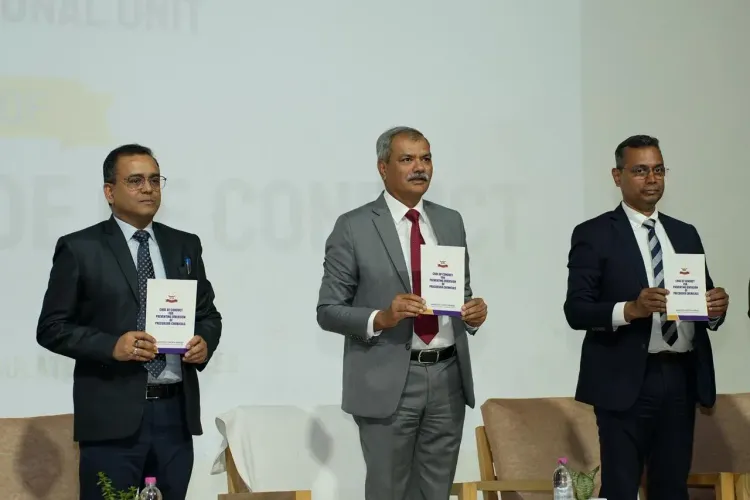
Narcotics Control Bureau (NCB) Director General Anurag Garg on Tuesday, 16 June launched a Voluntary Code of Conduct (VCC) for the chemical and pharmaceutical industry at a conference in Ahmedabad, aimed at preventing the diversion of precursor chemicals for the illicit manufacture of narcotic drugs. The move signals a deliberate shift in India's anti-drug strategy — from pure enforcement to industry co-option.
What the Voluntary Code of Conduct covers
The VCC is a guidance framework designed to promote responsible chemical stewardship, reinforce supply-chain integrity, and enable early detection and reporting of suspicious transactions. Crucially, the Code extends beyond chemicals already notified as controlled substances under the Narcotic Drugs and Psychotropic Substances (NDPS) framework — it also covers chemicals that carry potential for misuse in the manufacture of synthetic drugs and new psychoactive substances.
Garg urged manufacturers, importers, exporters, distributors, transporters, and traders to voluntarily adopt the VCC's guidance and bolster internal compliance systems, customer-verification procedures, transaction monitoring mechanisms, and record-keeping practices.
Why enforcement alone is not enough
Addressing the conference, Garg stressed that while enforcement agencies play a critical role in interdiction and investigation, the fight against synthetic drugs cannot be won through law enforcement action alone. He noted that industry participants — by virtue of their position in the supply chain — are uniquely placed to spot suspicious orders, unusual procurement patterns, abnormal consumption trends, and attempts to conceal end-use information.
NCB and Central Bureau of Narcotics (CBN) officers briefed participants on the rapidly evolving synthetic drug landscape and the increasing misuse of precursor and essential chemicals by drug trafficking syndicates. They underscored how criminal networks continuously seek alternative and substitute precursor substances to evade regulatory controls — making industry vigilance an essential pillar of India's counter-narcotics strategy.
Who attended and what they said
The conference drew more than 250 participants, including senior officers from the NCB and CBN, and representatives of major industry associations and leading chemical and pharmaceutical companies. Among those present were Satish Waman Wagh (CHEMEXCIL Chairman), Jaimin R. Vasa (Gujarat Chemical Association President), Bhalchandrasinh Raorane (Federation of Industries of India Chairman), Chanakya Contractor (Gujarat Chamber of Commerce and Industry Chemical Committee Chairman), Viranchi Shah (PHARMEXCIL Representative), and Haresh Gopalbhai Patel (Ankleshwar Industries Association Past Honorary General Secretary).
Industry representatives welcomed the initiative and shared best practices on chemical stewardship, supply-chain security, customer due diligence, and voluntary self-regulation. Participants acknowledged that safeguarding legitimate chemical supply chains is a shared responsibility and expressed commitment to supporting the Code's objectives.
What the NCB wants industry to do next
Garg specifically encouraged stakeholders to promptly share intelligence with the NCB on suspicious enquiries, unusual transactions, attempts to procure chemicals without legitimate business justification, or any activity indicating possible diversion for illicit drug manufacture. The Code also calls for a proactive approach to identifying and reporting emerging diversion risks — not merely reacting to known threats. The initiative represents one of the more structured public-private frameworks India has attempted in the precursor-chemical space, and its uptake across Gujarat's dense chemical corridor will be closely watched.
Point of View
And the real test will be adoption rates in the dense industrial clusters of Gujarat and Maharashtra where precursor chemicals move in high volumes. The NCB's explicit push to extend the Code beyond NDPS-notified substances is notable: it anticipates the next generation of synthetic drug precursors before they are formally scheduled, which is exactly the gap traffickers exploit. What is missing from this framework is any mention of an enforcement backstop or penalty structure for non-reporting — without that, the VCC risks becoming a compliance checkbox rather than a genuine intelligence pipeline.
NationPress
19 Sept 2026
Frequently Asked Questions
What is the NCB's Voluntary Code of Conduct for the chemical industry?
The Voluntary Code of Conduct (VCC) is a guidance framework released by the Narcotics Control Bureau on 16 June in Ahmedabad to help chemical and pharmaceutical companies prevent the diversion of precursor chemicals for illicit drug manufacturing. It covers supply-chain integrity, suspicious-transaction reporting, customer due diligence, and record-keeping, and extends to chemicals beyond those already controlled under the NDPS framework.
Why is the NCB involving the chemical industry in anti-drug efforts?
The NCB argues that enforcement agencies alone cannot stop the flow of precursor chemicals to illicit drug manufacturers. Industry participants — manufacturers, importers, exporters, distributors, and traders — are best placed to detect unusual procurement patterns, suspicious orders, and attempts to conceal end-use information before chemicals reach criminal networks.
Which chemicals does the Voluntary Code of Conduct apply to?
The VCC applies to chemicals already notified as controlled substances under the NDPS framework, as well as other chemicals that have the potential to be misused in the manufacture of synthetic drugs and new psychoactive substances — a broader scope than existing regulatory controls.
Who attended the NCB conference in Ahmedabad?
More than 250 participants attended, including senior NCB and Central Bureau of Narcotics officers, and representatives from major industry associations such as CHEMEXCIL, Gujarat Chemical Association, Federation of Industries of India, PHARMEXCIL, and the Ankleshwar Industries Association, among others.
What are chemical companies expected to do under this Code?
Companies are encouraged to strengthen internal compliance systems, verify customer credentials, monitor transactions for anomalies, maintain detailed records, and promptly report to the NCB any suspicious enquiries, unusual procurement requests, or activity that may indicate diversion for illicit drug manufacture.