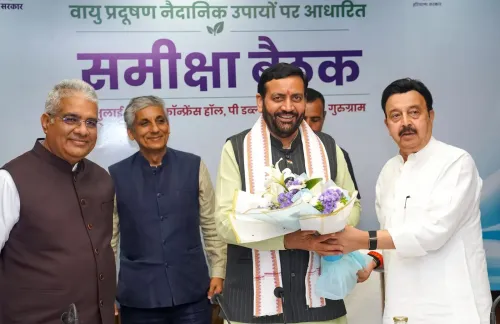
CM Saini: NCR boundary unchanged after NCRPB 42nd meet

Synopsis
Haryana Chief Minister Nayab Singh Saini announced on 16 June 2026 that the NCRPB's 42nd meeting resolved to keep the National Capital Region's boundaries unchanged, providing regulatory certainty for residents and developers across Delhi, Haryana, Uttar Pradesh, and Rajasthan.
Key Takeaways
The 42nd NCRPB meeting , held on 16 June 2026 , decided that the NCR area boundaries will remain unchanged .
Haryana CM Nayab Singh Saini announced the decision via a post on X.
The NCRPB was established under the National Capital Region Planning Board Act, 1985 to coordinate planning across Delhi , Haryana , Uttar Pradesh , and Rajasthan .
The status quo provides planning and regulatory certainty for land-use, real-estate, and infrastructure development within the existing NCR footprint.
Formal outcome notifications from the NCRPB are expected to follow the meeting.
Haryana Chief Minister Nayab Singh Saini announced on Tuesday, 16 June 2026, that the 42nd meeting of the National Capital Region Planning Board (NCRPB) resolved that no changes would be made to the boundaries of the National Capital Region (NCR).
Context
Saini posted on X, stating: 'आज राष्ट्रीय राजधानी क्षेत्र योजना बोर्ड (NCRPB) की 42वीं बैठक में यह निर्णय लिया गया कि NCR Area में कोई परिवर्तन नहीं किया जाएगा' — 'Today, at the 42nd meeting of the National Capital Region Planning Board, it was decided that no changes will be made to the NCR area.' The announcement confirms that the existing geographic extent of the NCR, which encompasses Delhi and adjoining districts of Haryana, Uttar Pradesh, and Rajasthan, will remain intact for now.
Policy Backdrop
The NCRPB was constituted under the National Capital Region Planning Board Act, 1985, to coordinate planning and development across the region. Its periodic meetings review boundary configurations, regional land-use plans, and infrastructure priorities among the participating states. Decisions on area stability carry significant weight for land-use policy, real-estate planning, and development project approvals across the region.
Haryana holds a substantial share of the NCR, with districts including Gurugram, Faridabad, Sonipat, and Panipat falling within its ambit. Any boundary revision would directly affect land classification, development norms, and state-level investment flows in these districts, making the Haryana government a key stakeholder in every NCRPB deliberation.
Stakeholders and Impact
The decision to keep the NCR area unchanged provides regulatory certainty for residents, developers, and local bodies operating within the existing NCR footprint. Urban planners and real-estate investors often factor NCR status into project feasibility, as inclusion in the region unlocks specific infrastructure funding and development norms. Districts on the periphery that had been the subject of earlier boundary-expansion discussions will continue under their current planning frameworks.
For the Haryana government, the status quo preserves existing inter-state coordination arrangements and avoids the administrative complexities that a boundary revision would entail. NCR residents across all four participating states — Delhi, Haryana, Uttar Pradesh, and Rajasthan — are the primary beneficiaries of this planning stability.
What's Next
Formal outcome notifications from the NCRPB are expected to follow the meeting, detailing any other resolutions adopted on 16 June 2026. Stakeholders will watch for updates to the regional plan and any follow-up meetings that address infrastructure investment priorities within the unchanged NCR boundary. The decision sets the baseline for upcoming land-use and development policy discussions across the region.
Point of View
CM Saini positions Haryana as a constructive participant in inter-state planning rather than a driver of boundary expansion that could complicate land-use regulations. The move also signals that any future revision to the NCR's geographic scope will require broader political and administrative consensus among the four participating states. For now, the decision defers rather than resolves the longer-term question of how the NCR framework will adapt to rapid urbanisation beyond its current limits.
NationPress
16 Sept 2026
Frequently Asked Questions
What was decided at the 42nd NCRPB meeting?
The 42nd meeting of the National Capital Region Planning Board, held on 16 June 2026, decided that no changes would be made to the boundaries of the NCR area.
What is the NCRPB and what does it do?
The NCRPB, or National Capital Region Planning Board, was established under the National Capital Region Planning Board Act, 1985. It coordinates planning and development across the NCR, which covers Delhi and adjoining districts of Haryana, Uttar Pradesh, and Rajasthan.
Which districts of Haryana fall in the NCR?
Key Haryana districts within the NCR include Gurugram, Faridabad, Sonipat, and Panipat, among others. These districts are subject to NCRPB planning norms and development guidelines.
Why does the NCR boundary matter for residents and developers?
NCR status affects land classification, development norms, and eligibility for specific infrastructure funding. A boundary change would alter planning frameworks and investment conditions for any districts added or removed.
Who announced the outcome of the 42nd NCRPB meeting?
Haryana Chief Minister Nayab Singh Saini announced the outcome on 16 June 2026 via a post on X, stating that the meeting resolved to keep the NCR area unchanged.