NK Singh calls on FM Sitharaman amid fiscal federalism focus

Synopsis
Union Finance Minister Nirmala Sitharaman met 15th Finance Commission Chairman NK Singh on June 1, 2026, in New Delhi. The courtesy call comes as the Commission's 2021–26 award period enters its final year, with attention shifting to the framework for the successor 16th Finance Commission.
Key Takeaways
NK Singh , Chairman of the 15th Finance Commission , called on Union Finance Minister Nirmala Sitharaman on June 1, 2026 .
The 15th Finance Commission was constituted in November 2017 under Article 280 to recommend devolution for 2021–2026 .
The Commission recommended a vertical devolution share of 41 per cent of the divisible pool for states.
The meeting comes as the current award period nears its end, raising questions about the 16th Finance Commission's constitution.
Primary stakeholders — state governments and local bodies — await clarity on the next devolution cycle's formula and grant structure.
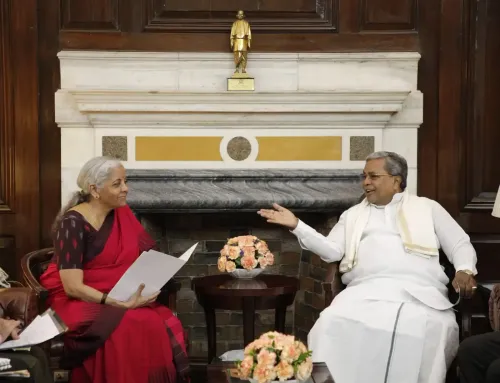
Union Finance Minister Nirmala Sitharaman received a courtesy call from NK Singh, Chairman of the 15th Finance Commission and former Rajya Sabha MP, on Monday, June 1, 2026, in New Delhi. The meeting brought together two key figures in India's fiscal architecture at a time when the country's devolution framework for the 2021–2026 cycle is in its final year.
Context
NK Singh has served as Chairman of the 15th Finance Commission since its constitution by presidential order in November 2017 under Article 280 of the Constitution. The Commission was mandated to recommend Centre-State tax devolution and grants covering the five-year period from 2021 to 2026. Singh, a seasoned bureaucrat and former member of the Planning Commission, is widely regarded as one of India's foremost authorities on fiscal federalism.
Finance Commission chairmen meeting the Union Finance Minister is a well-established constitutional practice. Such interactions typically span discussions on revenue deficit grants, performance-based incentives, and the implementation status of Commission recommendations as they feed into annual Union Budget allocations.
Policy Backdrop
The 15th Finance Commission submitted its final report covering 2021–26, recommending a vertical devolution share of 41 per cent of the divisible pool to states — a figure that has shaped every Union Budget in the current cycle. The Commission also introduced performance-linked grants for local bodies and tied portions of funding to measurable outcomes in health, education, and revenue mobilisation.
India's fiscal federalism has grown increasingly complex, with states pressing for higher devolution shares and greater flexibility in grant utilisation. The 15th Finance Commission navigated contentious debates around population criteria — balancing the interests of demographically stable southern states against those of more populous northern states — a formula that continues to influence inter-governmental fiscal relations.
Stakeholders and Impact
State governments and urban and rural local bodies are the primary stakeholders in Finance Commission recommendations, as devolution transfers constitute a significant share of sub-national revenue. Any consultations that inform the transition to the 16th Finance Commission — or adjustments within the current Budget cycle — carry direct consequences for infrastructure spending, welfare programmes, and fiscal headroom at the state level.
The meeting also holds significance for the 2026–27 Union Budget, the last to be framed under the 15th Commission's award period. Discussions between Singh and Sitharaman could inform how residual grants and performance incentives are accounted for in the forthcoming fiscal year's expenditure framework.
What's Next
With the 15th Finance Commission's mandate concluding in 2026, attention is turning to the constitution and terms of reference of the 16th Finance Commission, which will set the devolution framework for the next five-year cycle. The Finance Ministry is expected to initiate that process in the coming months, and consultations such as Monday's meeting may inform the design of the successor body's mandate.
How the government balances states' demand for a higher devolution share against central fiscal consolidation targets will be a defining question for the incoming Commission — and for Sitharaman's broader legacy on federal finance.
Point of View
Given unresolved tensions over population-based devolution criteria. The timing also matters for the 2026–27 Budget, the last framed under the current award, where residual performance grants and revenue deficit transfers will need to be cleanly accounted for. Observers of federal finance will watch for any signals on whether the next Commission's mandate broadens to include climate finance or debt sustainability benchmarks for states.
NationPress
15 Oct 2026
Frequently Asked Questions
Who is NK Singh and what is the 15th Finance Commission?
NK Singh is a former Rajya Sabha MP and senior bureaucrat who has served as Chairman of the 15th Finance Commission, the constitutional body set up in 2017 under Article 280 to recommend Centre-State tax devolution and grants for the period 2021 to 2026.
Why did NK Singh meet Nirmala Sitharaman on June 1 2026?
NK Singh called on Finance Minister Nirmala Sitharaman on June 1, 2026, in New Delhi. Such meetings between Finance Commission chairmen and the Finance Minister are a standard part of India's fiscal federalism process, typically covering devolution implementation and grant utilisation.
What does the 15th Finance Commission recommend for states?
The 15th Finance Commission recommended that states receive 41 per cent of the divisible pool of central taxes, along with performance-linked grants for local bodies tied to outcomes in health, education, and revenue mobilisation.
When will the 16th Finance Commission be constituted?
The 15th Finance Commission's mandate covers 2021 to 2026, so the government is expected to initiate the constitution of the 16th Finance Commission in the coming months to set the devolution framework for the next five-year cycle.
How does the Finance Commission affect state governments?
Finance Commission recommendations directly determine the share of central tax revenues transferred to states and local bodies, shaping their capacity to fund infrastructure, welfare schemes, and public services without relying solely on their own tax revenues.