Odisha Cabinet Approves Repeal Bill to Scrap Obsolete Laws
Synopsis
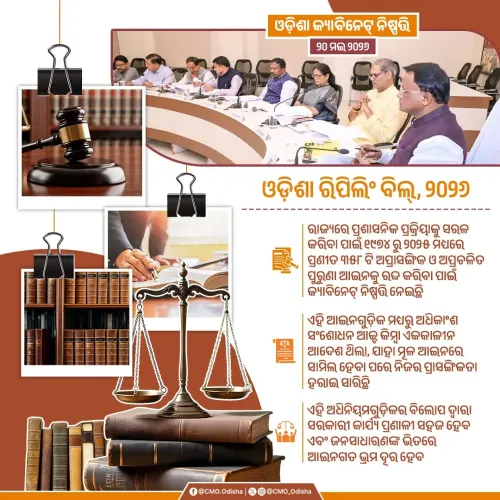
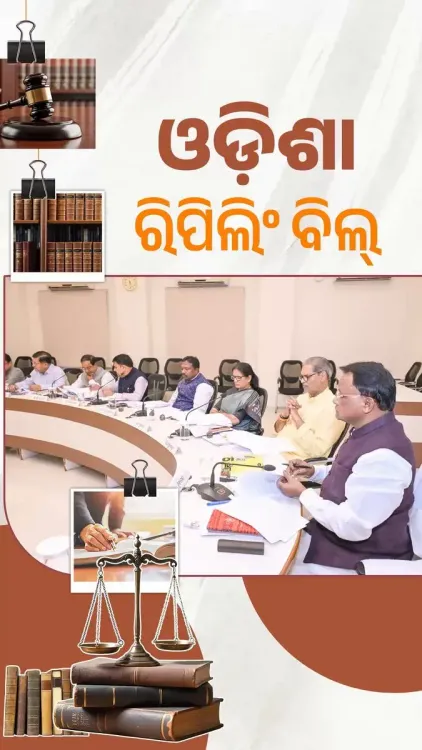
The Chief Minister's Office of Odisha announced on 30 May 2026 that the state cabinet has approved the Odisha Repealing Bill, which will scrap all outdated and irrelevant laws from the state's statute books to simplify governance and reduce public legal confusion.
Key Takeaways
The Odisha state government approved the Odisha Repealing Bill on 30 May 2026 .
The bill aims to repeal all obsolete, irrelevant, and defunct laws accumulated in Odisha's legal framework over the years.
The stated goals are a more transparent, simpler, and welfare-oriented administrative system.
The reform aligns with a national pattern in which the central government repealed over 1,000 redundant statutes between 2014 and 2022.
The bill must still be introduced and passed in the Odisha Legislative Assembly before it becomes law.
Key details — including the exact number and names of laws to be repealed — are yet to be made public.
The Chief Minister's Office of Odisha announced on Saturday, 30 May 2026 that the state government has approved the 'Odisha Repealing Bill', a legislative measure aimed at scrapping all irrelevant, outdated, and defunct laws that have accumulated in the state's legal framework over the years.
Context
The CMO's post, published in Odia, states that the bill has been approved with the goal of making Odisha's administrative system 'adhika swachha, sarala o jankalyanakaari' — 'more transparent, simpler, and welfare-oriented.' The announcement describes the bill as targeting laws that have lost their relevance over time and whose continued presence in the statute books creates unnecessary complexity, impedes administrative efficiency, and causes legal confusion among the public.
The post further notes that eliminating these redundant statutes will bring 'comprehensive simplicity to administrative processes' and remove 'all legal confusion and ambiguity in the minds of the general public.' The bill is positioned as a structural reform to make governance more dynamic and accessible.
Policy Backdrop
The Odisha move mirrors a broader national trend. The Government of India launched a systematic exercise to repeal obsolete central laws starting in 2014, eliminating over 1,000 redundant statutes by 2022 to reduce legal clutter and lower compliance burdens. Several Indian states have since undertaken parallel exercises, targeting colonial-era and post-independence laws that no longer serve a practical purpose.
These state-level repealing efforts are closely linked to ease-of-governance and ease-of-doing-business agendas, which seek to cut down on redundant litigation, administrative bottlenecks, and the scope for misuse of archaic provisions. Odisha's approval of the Repealing Bill places it within this wider reform pattern sweeping Indian states.
Stakeholders and Impact
The primary beneficiaries of the bill are Odisha's general public and its state administration. For ordinary citizens, the removal of defunct laws reduces the risk of being inadvertently caught in outdated legal provisions or facing administrative decisions anchored in irrelevant statutes. For government departments, a leaner statute book means cleaner, faster decision-making.
Businesses and investors operating in Odisha also stand to benefit, as a simplified legal environment reduces compliance uncertainty. Legal practitioners and courts in the state may see a reduction in frivolous or archaic litigation that draws on obsolete provisions.
What's Next
The Odisha Repealing Bill will now need to be introduced and passed in the Odisha Legislative Assembly before it becomes law. Observers will watch closely for the full list of specific laws proposed for repeal, which will determine the practical scope and ambition of the reform. Subsequent government notifications and implementation rules will define how the cleanup is operationalised across departments.
The bill's passage would mark a significant step in Odisha's ongoing administrative modernisation drive, and its implementation will be a test of the state government's capacity to translate legislative housekeeping into tangible improvements in public service delivery.
Point of View
But its political significance lies in the current state government's effort to signal a clean break from legacy governance structures. By aligning with the central government's decade-long push to prune India's statute books, the Odisha administration is positioning itself as a reform-oriented actor on ease-of-governance metrics. The real test will come when the specific list of laws proposed for repeal is made public — the breadth and boldness of that list will reveal whether this is substantive reform or symbolic tidying. If implemented effectively, the bill could meaningfully reduce administrative friction for citizens and businesses in one of India's larger states.
NationPress
17 Oct 2026
Frequently Asked Questions
What is the Odisha Repealing Bill?
The Odisha Repealing Bill is a legislative measure approved by the Odisha state government on 30 May 2026 to scrap all outdated, irrelevant, and defunct laws from the state's statute books in order to simplify governance and reduce legal confusion.
Why is Odisha repealing old laws?
The state government says the repeal is aimed at making the administrative system more transparent, simpler, and welfare-oriented by removing laws that have lost relevance over time and create unnecessary complexity for citizens and officials.
How many laws will the Odisha Repealing Bill scrap?
The exact number and names of laws to be repealed have not yet been officially disclosed. The full list is expected to be revealed when the bill is introduced in the Odisha Legislative Assembly.
Has the Odisha Repealing Bill been passed?
As of 30 May 2026, the bill has been approved by the state cabinet. It still needs to be introduced and passed in the Odisha Legislative Assembly before it becomes law.
Is scrapping obsolete laws a new idea in India?
No. The Government of India began a systematic repeal of redundant central laws in 2014, removing over 1,000 statutes by 2022. Several Indian states have since undertaken similar exercises, and Odisha's bill follows this established national pattern.