Odisha CM Office Launches Kanya Sumangal Yojana for Girls
Synopsis
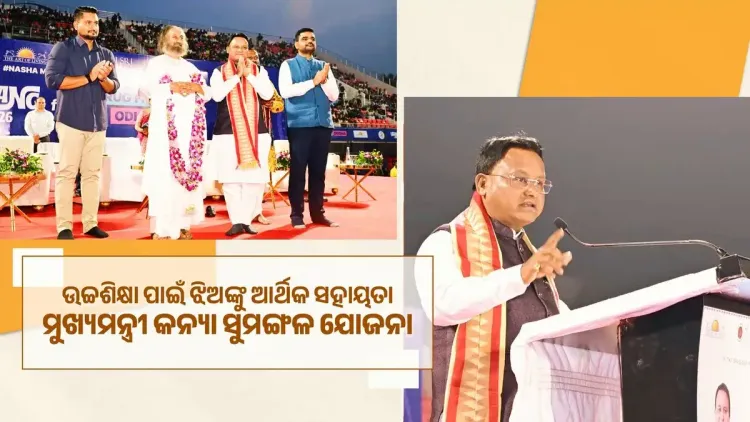
Odisha's Chief Minister's Office has launched the Mukhyamantri Kanya Sumangal Yojana, offering ₹20,000 at a girl's birth and ₹1,00,001 upon graduation. The milestone-linked cash-transfer scheme aims to close gender education gaps and build financial self-reliance among Odisha's girls.
Key Takeaways
The Mukhyamantri Kanya Sumangal Yojana was announced by the Chief Minister's Office of Odisha on 18 November 2026 .
Beneficiaries receive ₹20,000 at birth and ₹1,00,001 on completion of a graduation degree.
The scheme is designed to promote higher education for girls and encourage self-reliance.
The two-stage, milestone-linked structure is intended to keep girls enrolled through to degree completion.
The initiative aligns with the national Beti Bachao Beti Padhao campaign launched in 2015 .
Detailed eligibility norms and disbursement mechanisms are expected via Odisha's social welfare department.
A girl born in Odisha today enters a world where the state has just placed a financial promise alongside her first breath — ₹20,000 at birth, and ₹1,00,001 the day she earns her graduation degree. The Chief Minister's Office of Odisha announced the Mukhyamantri Kanya Sumangal Yojana on Wednesday, 18 November 2026, framing it as a two-stage cash-transfer lifeline designed to keep girls in school, through college, and into self-reliance.
What the scheme promises — and how it works
The CMO's announcement spells out the architecture plainly. Financial assistance of ₹20,000 is disbursed at the time of birth, giving families an immediate incentive to register the girl child and invest in her early welfare. The larger tranche — ₹1,00,001 — is unlocked only on completion of a graduation degree, directly tying the payout to educational attainment rather than mere enrolment.
That design is deliberate. By back-loading the bigger sum to graduation, the scheme nudges families to see a daughter's higher education through to its finish line rather than withdrawing her mid-way. The CMO described the initiative as helping girls 'fulfil their aspirations and move towards a self-reliant future' — ଆତ୍ମନିର୍ଭରଶୀଳ (self-reliant) being the word the official Odia text places at the centre of its vision.
Odisha's move within India's wider Beti Bachao push
The scheme slots into a well-worn national policy groove. Since the Beti Bachao Beti Padhao campaign was launched in 2015, Indian states have competed to design conditional cash-transfer programmes that address gender gaps in education and improve child sex ratios. What distinguishes the Odisha model is the size of the graduation-stage payout — ₹1,00,001 is a figure large enough to meaningfully defray post-graduation costs such as vocational training, skill certification, or seed capital for a small livelihood.
Across India, similar state-level schemes have shown that milestone-linked disbursements outperform lump-sum grants in keeping girls enrolled through secondary and higher education. Odisha's two-point structure — birth and graduation — compresses the milestone ladder while preserving the incentive logic.
Who stands to benefit, and what comes next
The immediate stakeholders are girl children and their families across Odisha, particularly in districts where female literacy rates and higher-education enrolment lag behind state averages. Detailed eligibility norms — income ceilings, domicile requirements, documentation — are expected to be formalised through the state's social welfare department. Budget provisions and the disbursement mechanism will likely be fleshed out in the next Odisha state budget cycle.
The announcement carries political weight too: Odisha's ruling dispensation has consistently positioned girl-child welfare as a signature governance priority, and a named Chief Minister scheme carries the kind of brand visibility that incentivises local administration to push enrolment numbers up.
One scheme, two cheques, and a clear bet — that if you meet a family at birth and again at graduation, you can keep a girl on the path in between.
Point of View
Odisha's scheme signals a shift from symbolic gestures toward outcome-oriented design. The political calculus is equally visible: a Chief Minister-branded welfare scheme for girl children is high-visibility social policy that travels well electorally in rural Odisha, where female education gaps remain acute. The real test will come when eligibility criteria and disbursement timelines are notified — that is where such schemes have historically faltered on exclusion errors and bureaucratic delays.
NationPress
18 Nov 2026
Frequently Asked Questions
What is Mukhyamantri Kanya Sumangal Yojana?
It is an Odisha government welfare scheme that provides financial assistance of ₹20,000 to girl children at birth and ₹1,00,001 upon completion of graduation, aimed at supporting girls' education and self-reliance.
How much money does Odisha's Kanya Sumangal Yojana give?
The scheme provides ₹20,000 at the time of a girl's birth and ₹1,00,001 when she completes her graduation degree.
Who is eligible for Mukhyamantri Kanya Sumangal Yojana in Odisha?
The scheme targets girl children and their families in Odisha. Detailed eligibility norms including income and domicile criteria are expected to be notified by the state social welfare department.
How is Odisha's Kanya Sumangal Yojana different from other girl child schemes?
Its two-stage milestone design — birth and graduation — concentrates incentives at the two most critical dropout points, with the larger ₹1,00,001 payout reserved for degree completion to encourage families to invest in full higher education.
Is Kanya Sumangal Yojana related to Beti Bachao Beti Padhao?
Yes, the scheme aligns with the national Beti Bachao Beti Padhao campaign launched in 2015, which encouraged states to design programmes improving child sex ratios and female educational attainment.