Yadav at COP31: Carbon Budget Equity Non-Negotiable for India
Synopsis
Union Environment Minister Bhupender Yadav delivered India's National Statement at COP31 in Antalya, declaring equitable carbon budget access non-negotiable, rejecting archaic cooperation frameworks, and announcing new NDCs aligned with the Viksit Bharat 2047 vision under PM Modi's leadership.
Key Takeaways
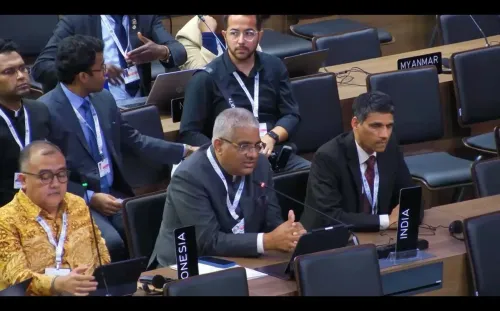
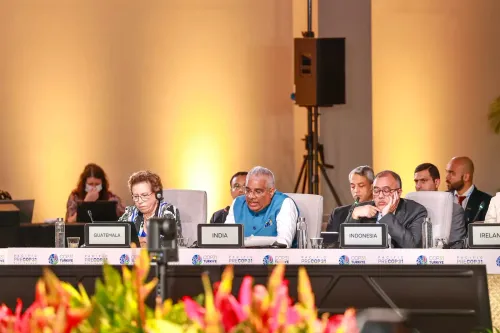
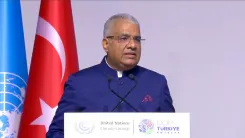
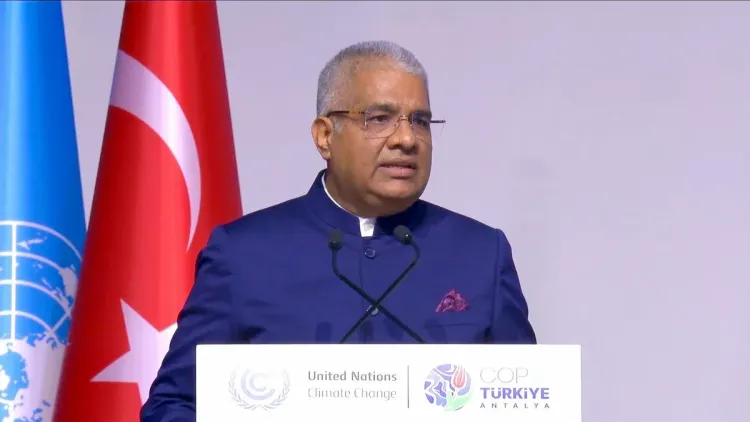
Bhupender Yadav delivered India's National Statement at COP31 in Antalya, Türkiye on 18 November 2026 .
India declared that equitable access to the remaining, depleted carbon budget is 'non-negotiable' for developing countries.
India announced its next NDCs under the Paris Agreement, aligned with the Viksit Bharat goal of becoming a developed nation by 2047 .
Yadav argued that developing countries cannot be forced to choose between climate action and rights to development, health, and education.
India framed its economic growth as a 'rising tide' capable of lifting other Global South nations.
The minister called for modernising international cooperation frameworks, rejecting mechanisms divorced from contemporary geopolitical realities.
At the global climate table in Antalya, Türkiye, Union Environment Minister Bhupender Yadav drew a line in the sand on Wednesday, 18 November 2026: developing nations will not be forced to choose between cutting emissions and securing the right to grow. Delivering India's National Statement at the 31st Conference of the Parties (COP31), Yadav framed equitable access to the remaining carbon budget not as a demand but as a civilisational non-negotiable.
India's core argument: growth and climate are not a trade-off
Yadav's statement cut to the heart of a tension that has defined UNFCCC negotiations for decades. 'Developing countries cannot be asked to choose between climate action and the legitimate right to development, to decent living standards, health and education,' he said. The logic is direct: nations that have contributed least to the accumulated carbon in the atmosphere have the most to lose — and the least fiscal room to absorb the transition costs that richer economies can spread across deeper tax bases and capital markets.
The minister was equally pointed about the architecture of international cooperation, warning that it 'can neither be based on archaic mechanisms nor be divorced from the broader environment in which countries engage with one another.' That is diplomatic shorthand for a demand long voiced by the Global South: legacy finance pledges, technology-transfer barriers, and conditionality-laden climate funds are relics of a world that no longer exists.
New NDCs tied to 'Viksit Bharat 2047'
India's headline announcement at COP31 was the declaration of its next Nationally Determined Contributions (NDCs) under the Paris Agreement, explicitly aligned with the national vision of Viksit Bharat — a developed India by 2047, the centenary of independence. Yadav attributed the milestone directly to the leadership of Prime Minister Narendra Modi, framing sustainable development not as a Western prescription but as an indigenous political project.
The linkage matters. By anchoring new climate targets to a domestic development timeline rather than to pressure from wealthy-nation negotiating blocs, India signals that its ambition is self-generated and sovereign — but it also raises the stakes for the financial commitments it expects in return. India's trajectory at past COPs tells the story: at COP26 in Glasgow in 2021, PM Modi announced the Panchamrit five-point strategy and a net-zero target by 2070; updated NDCs submitted in 2022 strengthened renewable energy and emissions-intensity goals. Each iteration has pushed ambition while insisting that the burden-sharing calculus remain fair.
India as a rising tide for the Global South
Perhaps the most geopolitically resonant line in Yadav's statement was the framing of India's growth as 'a rising tide that can also lift other developing countries.' It is a deliberate recast of a classic development metaphor — and a direct pitch to the Global South that India's economic trajectory is a shared asset, not a solo sprint. India's International Solar Alliance, launched in 2015, already operationalises this idea, pooling solar deployment support across developing nations.
The remark also carries weight in a COP negotiating room where developing countries often enter fragmented. India positioning itself as an anchor voice for equitable carbon-budget distribution strengthens the collective bargaining power of nations that need climate finance most urgently.
What hinges on the COP31 outcome
The specifics of India's newly declared NDCs — their sectoral targets, timelines, and integration into national planning — remain to be detailed in formal submissions. The broader COP31 negotiation outcomes on climate finance, adaptation funding, and the mechanics of a fair carbon budget split will determine how much of Yadav's Antalya statement translates from principle to enforceable commitment.
What is already clear is the posture India has staked out: ambitious on domestic climate action, immovable on the right to develop, and determined to reshape the terms of international cooperation to reflect present realities rather than post-colonial financial hierarchies. The world is listening — and the Global South is watching to see whether that posture holds through the final hours of the negotiations.
Point of View
The Modi government is domesticating climate ambition as a national development project rather than an externally imposed obligation, which insulates it from political criticism at home. The 'rising tide' framing is a soft-power play to consolidate India's voice as the anchor of Global South climate diplomacy, particularly as fragmentation among developing nations has historically weakened collective bargaining at UNFCCC talks. How Yadav's Antalya statement translates into the fine print of negotiated text on finance and carbon budgets will be the real test of whether principle becomes architecture.
NationPress
18 Nov 2026
Frequently Asked Questions
What did India say at COP31 in Antalya?
Union Environment Minister Bhupender Yadav delivered India's National Statement at COP31 in Antalya, Türkiye on 18 November 2026, declaring equitable access to the remaining carbon budget non-negotiable and announcing new NDCs aligned with the Viksit Bharat 2047 vision.
What are India's new NDCs announced at COP31?
India declared its next Nationally Determined Contributions at COP31, explicitly aligned with the goal of achieving Viksit Bharat — a fully developed India by 2047 — in a sustainable manner. The detailed sectoral targets are yet to be formally submitted.
What is Viksit Bharat and how does it relate to climate policy?
Viksit Bharat is India's national goal to become a developed economy by 2047, the centenary of independence. India has linked its new climate NDCs to this domestic development vision, framing sustainable growth as an indigenous priority rather than an externally mandated target.
What is India's position on the carbon budget at UNFCCC talks?
India argues that developing countries have an equitable right to the remaining global carbon budget, since historically industrialised nations have consumed the bulk of permissible emissions. Yadav described this equitable access as 'non-negotiable' at COP31.
Where is COP31 being held?
COP31, the 31st Conference of the Parties to the UNFCCC, is being held in Antalya, Türkiye.