Odisha CMO: Farmer empowerment top priority under double-engine govt
Synopsis
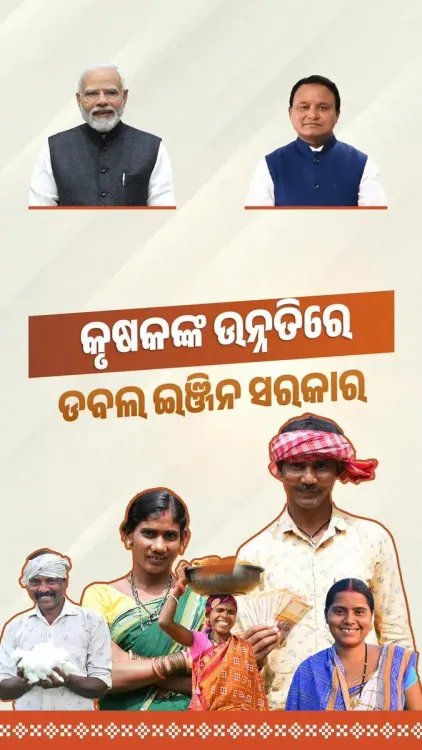
The Chief Minister's Office of Odisha affirmed on 25 September 2026 that farmer empowerment and agricultural prosperity are the state's top priority, citing the BJP double-engine government's continuous work on input support and fair crop pricing.
Key Takeaways
Farmer empowerment declared the primary focus of the Odisha government in a post dated 25 September 2026 .
The double-engine government framework — coordinated BJP rule in Odisha and at the Centre since the 2024 assembly elections — is cited as the delivery mechanism.
The government's stated goals span the full agricultural chain: input support, productivity, and fair prices for produce .
PM-KISAN , the central scheme providing annual income support to farmer families since 2019 , forms part of the national baseline the state aims to build upon.
Odisha's kharif paddy procurement cycle is a key near-term test of how these commitments translate into practice.
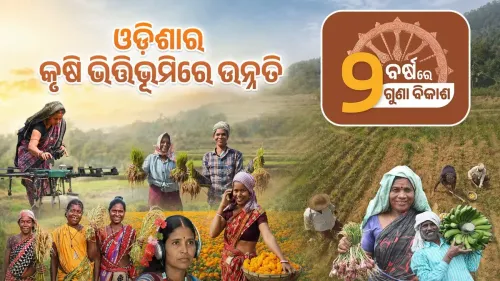
From ensuring inputs reach the field to guaranteeing a fair price for every harvested crop, the Chief Minister's Office of Odisha has declared farmer empowerment and agricultural prosperity the defining priority of the state government — and it is betting on the 'double-engine' coordination between Bhubaneswar and New Delhi to deliver it. The message, posted on Friday, 25 September 2026, frames the pledge not as a promise but as a work already in motion.
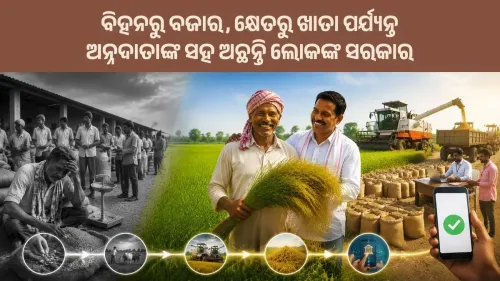
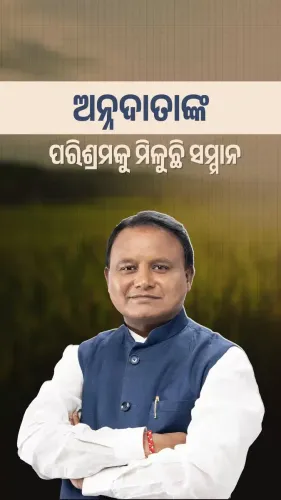
The post, written in Odia, reads: 'Empowerment of farmers and the prosperity of agriculture is the priority of the people's government. From providing the necessary support for agricultural work to ensuring fair prices for farmers' produce, the double-engine government is continuously working in the interest of farmers. It is the government's resolve to bring positive change in farmers' income and lives by making agriculture more empowered, productive and prosperous.'What 'double-engine' means for Odisha's farms
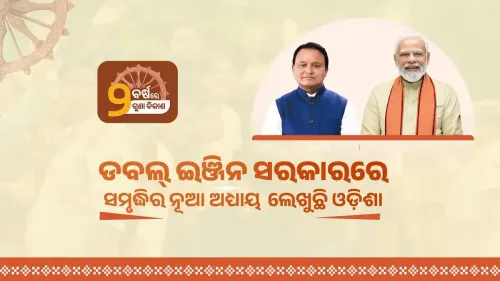
The phrase double-engine government — shorthand for simultaneous BJP-led administrations at the state and central levels — became operational in Odisha after the 2024 assembly elections, when the party ended a long stretch of opposition at the state level. The political argument is simple: when both engines pull in the same direction, central schemes and state delivery systems no longer work at cross-purposes. For farmers, that is supposed to translate into faster disbursal, fewer bureaucratic gaps, and tighter integration between procurement and income-support programmes.
The nationally-run PM-KISAN scheme, launched in 2019, provides direct annual income support to landholding farmer families and remains a cornerstone of the central government's agricultural safety net. Under a coordinated framework, Odisha's own state-level input subsidies and crop procurement mechanisms are meant to layer on top of — rather than duplicate or clash with — that national baseline.
Fair price and the procurement challenge
The explicit reference to 'fair prices for farmers' produce' points to the perennial pressure point: minimum support price realisation. Odisha's agricultural calendar is anchored by the kharif paddy harvest — the state is one of India's significant rice-producing states — and every procurement season tests how well the delivery machinery actually performs. The government's stated resolve is to close the gap between what farmers grow and what they earn.
Analysts watching Odisha's farm policy will be tracking state budget allocations for the upcoming kharif and rabi procurement cycles, as well as any new announcements in the next assembly session that integrate central and state support more tightly. The political stakes are equally concrete: Odisha's rural voter base is large, and delivering visible change in farm incomes is a central test of the double-engine promise.
The government's language — 'sakaratmaka paribarttana' (positive change) in farmers' income and lives — sets a benchmark that will ultimately be judged at the mandi gate and in household accounts, not in a social-media post.
Point of View
The statement anchors the double-engine narrative to a measurable outcome that voters understand viscerally. The real political risk, however, lies in execution — Odisha's paddy procurement machinery has faced perennial capacity and timing pressures, and the gap between official resolve and mandi-level reality remains the sharpest test of the government's credibility with its rural base. Upcoming state budget sessions and kharif procurement outcomes will signal whether the coordination dividend is real or rhetorical.
NationPress
25 Sept 2026
Frequently Asked Questions
What is the double-engine government in Odisha?
The double-engine government refers to simultaneous BJP-led administrations in Odisha and at the Centre, a situation that came into effect after the 2024 Odisha assembly elections . The idea is that policy coordination between both levels reduces bureaucratic delays in delivering schemes to farmers and other beneficiaries.
What is PM-KISAN and how does it help Odisha farmers?
PM-KISAN is a central government scheme launched in 2019 that provides direct annual income support to landholding farmer families across India, including in Odisha. It serves as a financial safety net alongside state-level input subsidies and procurement support.
What does the Odisha government mean by fair prices for farmers' produce?
It refers to ensuring farmers receive at least the minimum support price (MSP) for their crops — particularly paddy, Odisha's dominant kharif crop — through effective government procurement rather than distress sales to private buyers at lower rates.
When did the Odisha CMO make this farmer welfare statement?
The Chief Minister's Office of Odisha posted the statement on Friday, 25 September 2026 on its official X (formerly Twitter) account, reaffirming the government's agricultural priorities.
What should I watch for next in Odisha farm policy?
Key signals include state budget allocations for kharif and rabi procurement, new schemes announced in upcoming assembly sessions, and actual paddy procurement figures — these will indicate whether the double-engine coordination is delivering measurable income gains for Odisha's farmers.