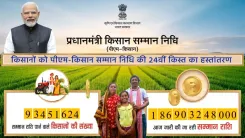
Odisha CMO Spotlights PM-KISAN's ₹6,000 Lifeline for Farmers

Synopsis
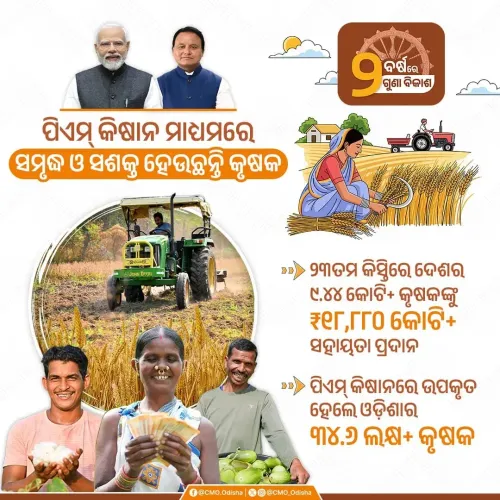
The Chief Minister's Office of Odisha highlighted PM-KISAN on 30 October 2026, stressing how its ₹6,000 annual direct cash transfer in three instalments helps farmers afford seeds, fertilisers, and pesticides at the most critical point of the crop cycle.
Key Takeaways
PM-KISAN provides eligible farmer families ₹6,000 per year in three equal instalments of ₹2,000 each .
Payments are transferred directly to Aadhaar-linked bank accounts , eliminating intermediaries.
The scheme was launched in February 2019 under Prime Minister Narendra Modi's government as a central sector initiative.
The support is specifically intended to cover essential inputs: seeds, fertilisers, and pesticides .
The Odisha CMO's post underscores ongoing state-level outreach to drive enrollment and awareness among eligible beneficiaries.
PM-KISAN operates within India's broader Direct Benefit Transfer framework, coordinated between the Union Ministry of Agriculture and state governments.
Every season, millions of Indian farmers face a brutal cash crunch before the first seeds even touch the soil. The Chief Minister's Office of Odisha used its platform on Friday, 30 October 2026 to spotlight a scheme designed to break that cycle — the Pradhan Mantri Kisan Samman Nidhi (PM-KISAN) Yojana — calling it a 'visionary initiative aimed at strengthening farmers financially and providing timely support for agricultural activities.'
₹6,000 a Year, Directly in the Bank
The mechanics are deliberately simple. Eligible landholding farmer families receive ₹6,000 annually, split into three equal instalments of ₹2,000, transferred directly into Aadhaar-linked bank accounts — no middlemen, no queues. The CMO's post, written in Odia alongside an English caption, underlines that this support helps farmers meet the cost of seeds, fertilisers, and pesticides at precisely the moment those inputs are needed most: before planting begins.
The Odisha government's amplification of the scheme signals continued state-level engagement with a programme that relies on Union-state coordination for beneficiary verification and outreach.
PM-KISAN's Place in India's Direct-Benefit Architecture
PM-KISAN was launched in February 2019 by the government of Prime Minister Narendra Modi as a central sector scheme to supplement farmer incomes. It sits at the core of India's Direct Benefit Transfer framework — a nationwide effort to reduce leakages by routing welfare payments through verified bank accounts rather than intermediaries. The scheme runs alongside complementary measures including crop insurance programmes and input subsidies, forming a layered safety net for agricultural households.
For a largely agrarian state like Odisha, where farming communities depend on seasonal income and are vulnerable to weather shocks, schemes that guarantee predictable cash flows carry outsized significance. The emphasis on seeds, fertilisers, and pesticides in the post is not incidental — these are the earliest and often most financially stressful expenditures of any crop cycle.
What the Odisha Highlight Signals
State governments periodically amplify central welfare schemes to drive enrollment, dispel misinformation, and remind eligible beneficiaries to keep their Aadhaar-bank linkages current — a prerequisite for receiving transfers. The CMO's post fits that pattern and points toward what farmers and policy-watchers should track next: the timing of the upcoming PM-KISAN instalment release and any state-specific top-up measures Odisha may announce to complement the central allocation.
A scheme that began as a pre-election promise in 2019 has since become a permanent fixture of rural financial planning. When a state capital reaffirms it, the message to farmers is clear — the money is coming, and the pipeline stays open.
Point of View
Championing a flagship Modi scheme also serves a dual purpose: it aligns state messaging with the Centre's farmer-welfare narrative while signalling administrative seriousness to a predominantly rural electorate. The post's bilingual Odia-English framing is noteworthy — it reaches both grassroots beneficiaries and English-language policy audiences in a single communication. Longer term, how actively states like Odisha layer their own top-ups onto PM-KISAN will determine whether the scheme evolves from a floor to a genuine income stabiliser for smallholders.
NationPress
30 Oct 2026
Frequently Asked Questions
What is PM-KISAN and how much money do farmers get?
PM-KISAN (Pradhan Mantri Kisan Samman Nidhi) is a central government scheme that gives eligible farmer families ₹6,000 per year in three instalments of ₹2,000 each, transferred directly to their Aadhaar-linked bank accounts.
Who is eligible for PM-KISAN in Odisha?
All landholding farmer families in Odisha who meet the central government's eligibility criteria — including valid land records and an Aadhaar-linked bank account — can receive PM-KISAN benefits. Certain categories such as institutional landholders and high-income taxpayers are excluded.
When was PM-KISAN launched and by whom?
PM-KISAN was launched in February 2019 by the government of Prime Minister Narendra Modi as a central sector scheme to provide direct income support to farmer families.
How do I check my PM-KISAN instalment status?
Farmers can check their PM-KISAN payment status on the official PM-KISAN portal using their Aadhaar number or registered mobile number to track instalment disbursements.
Why is the Odisha government highlighting PM-KISAN now?
State governments periodically promote PM-KISAN to ensure eligible farmers are enrolled, keep their Aadhaar-bank linkages current, and are aware of upcoming instalment releases — all of which are necessary to receive the direct cash transfers.