Odisha CMO Launches 'Jnanodaya' Free KG-to-PG Scheme
Synopsis
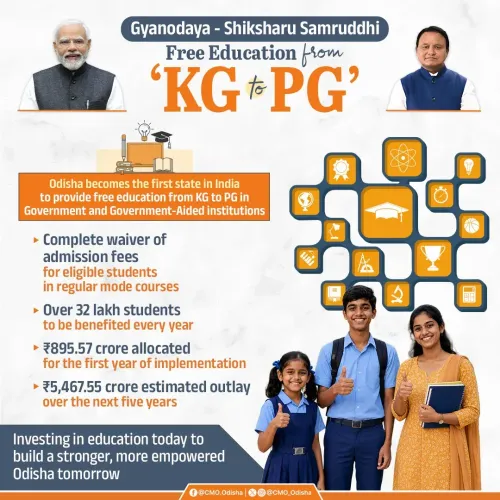
The Chief Minister's Office of Odisha launched 'Jnanodaya – Shiksha ru Samruddhi' on 4 July 2026, a scheme guaranteeing free education from KG to postgraduate level in government and aided institutions. More than 32 lakh students are expected to benefit each year, marking a significant step in the state's human-development agenda.
Key Takeaways
The Chief Minister's Office of Odisha announced the 'Jnanodaya – Shiksha ru Samruddhi' scheme on 4 July 2026 .
The scheme provides free education from KG to postgraduate (PG) level in eligible government and government-aided institutions.
More than 32 lakh students are projected to benefit from the scheme every year.
The initiative aims to ensure that every meritorious student's aspirations are realised regardless of financial background.
The scheme is framed as a historic step toward building a knowledge-empowered youth and a prosperous Odisha .
Detailed implementation guidelines, budget allocations, and phased rollout schedules are awaited from the state government.
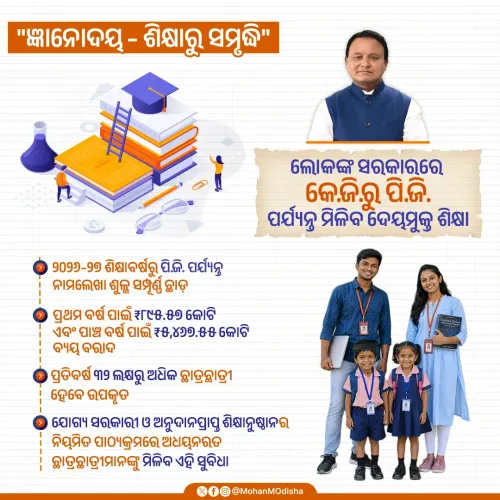
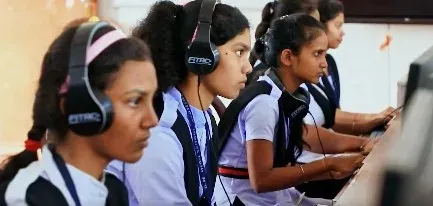
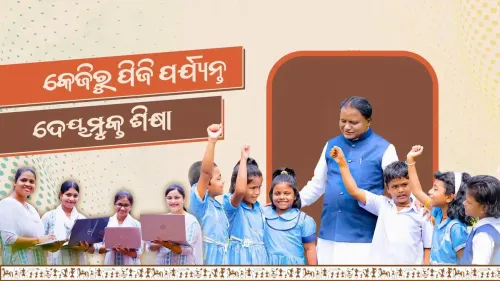
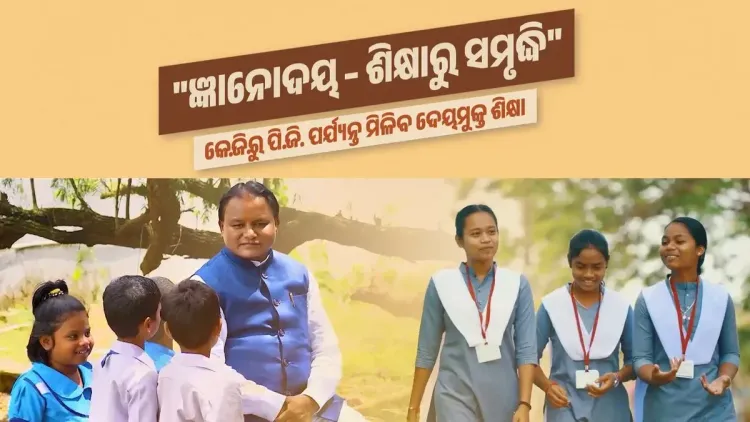
The Chief Minister's Office of Odisha announced on Saturday, 4 July 2026, the launch of 'Jnanodaya – Shiksha ru Samruddhi' (ଜ୍ଞାନୋଦୟ – ଶିକ୍ଷାରୁ ସମୃଦ୍ଧି), a flagship scheme promising free education from kindergarten through postgraduate level in eligible government and government-aided institutions across Odisha. The scheme is projected to benefit more than 32 lakh students every year.
Context
The post, shared from the official CMO Odisha account, states in Odia: 'ଶିକ୍ଷା ହେଉଛି ସମୃଦ୍ଧ ଓଡ଼ିଶାର ସବୁଠୁ ବଡ଼ ଶକ୍ତି' — 'Education is the greatest strength of a prosperous Odisha.' Anchoring the scheme in that conviction, the state government has positioned Jnanodaya as a historic step toward building a knowledge-empowered generation. The initiative covers the full educational continuum, ensuring that financial barriers do not interrupt a student's journey from early childhood through higher education.
The scheme targets eligible government and aided educational institutions, making fee-free enrolment the default rather than the exception. By guaranteeing that every meritorious student's aspirations can be realised, the government frames the scheme as both a welfare measure and a long-term investment in human capital.
Policy Backdrop
Odisha has steadily expanded access to school and higher education through successive state budgets and within the national Right to Education framework since 2010. The state has consistently ranked education spending as a priority in its annual budgets, reflecting a policy consensus that educational attainment is directly linked to reduced poverty and out-migration from the state.
Across India, several states have introduced fee-waiver programmes spanning school to postgraduate levels to raise enrolment ratios and build a skilled workforce. Jnanodaya follows this broader pattern but distinguishes itself by explicitly covering the entire KG-to-PG spectrum under a single unified scheme, rather than addressing individual stages through separate programmes.
Stakeholders and Impact
The most direct beneficiaries are students enrolled in or seeking admission to government and aided institutions across Odisha. With more than 32 lakh students expected to benefit annually, the scheme's scale places it among the largest state-level education-access initiatives in eastern India. Families in rural and semi-urban areas, where private schooling costs are a significant financial burden, stand to gain the most.
Beyond individual households, the scheme carries implications for Odisha's youth demographic as a whole. Higher enrolment and retention rates at the postgraduate level could strengthen the state's talent pipeline, potentially reducing the brain drain that has historically seen skilled graduates migrate to other states for employment.
What's Next
The immediate focus will be on the release of detailed implementation guidelines, including eligibility criteria for institutions and students, the mechanism for fee reimbursement or waiver, and the phased rollout schedule. Observers will watch the next Odisha state assembly session and annual budget presentation for specific allocations tied to Jnanodaya.
The scheme's long-term success will hinge on administrative capacity at the district level and the ability of aided institutions to absorb the transition without disruption to quality. If implementation proceeds as announced, Jnanodaya – Shiksha ru Samruddhi could become a reference model for other states seeking to bridge the gap between school access and higher-education attainment.
Point of View
Named scheme, the administration gains a sharper narrative asset — one that is easy to communicate to voters across rural and urban constituencies alike. The 32-lakh annual beneficiary figure, if borne out in implementation, would represent a substantial expansion of the state's direct-benefit footprint in the education sector. The real test, however, will be whether aided institutions receive adequate compensatory funding, since underfunded mandates have historically been the Achilles heel of similar state-level free-education drives across India.
NationPress
4 Jul 2026
Frequently Asked Questions
What is the Jnanodaya – Shiksha ru Samruddhi scheme in Odisha?
Jnanodaya – Shiksha ru Samruddhi is a scheme launched by the Government of Odisha that guarantees free education from kindergarten (KG) to postgraduate (PG) level in eligible government and government-aided institutions across the state.
How many students will benefit from the Jnanodaya scheme every year?
According to the Chief Minister's Office of Odisha, more than 32 lakh students are expected to benefit from the Jnanodaya scheme annually.
When was the Jnanodaya scheme launched in Odisha?
The scheme was announced by the Chief Minister's Office of Odisha on 4 July 2026 .
Which institutions are covered under the Jnanodaya free education scheme?
The scheme covers eligible government and government-aided educational institutions in Odisha, spanning the full range from early childhood education through postgraduate studies.
What is the goal of the Jnanodaya – Shiksha ru Samruddhi scheme?
The scheme aims to remove financial barriers to education so that every meritorious student in Odisha can pursue their aspirations, ultimately building a knowledge-empowered youth and contributing to the state's long-term economic prosperity.