CM Majhi: Odisha Farmers Get ₹10,000/yr via Dual KISAN Schemes
Synopsis
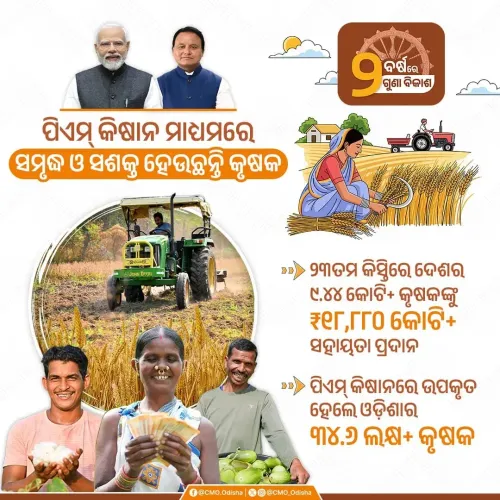
Odisha Chief Minister Mohan Charan Majhi announced that eligible farmers in the state receive a combined ₹10,000 annually — ₹6,000 from the central PM-KISAN scheme and ₹4,000 from the state's CM-KISAN scheme — framing the dual support as a pillar of farmer financial self-reliance.
Key Takeaways
Eligible Odisha farmers receive a combined ₹10,000 per year in direct income support.
The PM-KISAN central scheme contributes ₹6,000 annually , launched by the Government of India in February 2019 .
The Odisha state's CM-KISAN scheme adds a further ₹4,000 annually on top of the central benefit.
Chief Minister Mohan Charan Majhi has been in office since June 2024 , with farmer welfare a stated priority.
The stacked central-plus-state model mirrors a broader pattern adopted by BJP-governed states to deepen farmer income support.
Key policy watch points include state budget revisions to CM-KISAN allocations and scheme enrollment and disbursement data.
Every farmer in Odisha is an Annadāta — a provider of life — and Odisha Chief Minister Mohan Charan Majhi is putting numbers to that reverence: eligible farmers in the state now receive a combined ₹10,000 annually, drawn from two stacked direct-benefit schemes that together form one of the more generous farmer-support frameworks in eastern India.
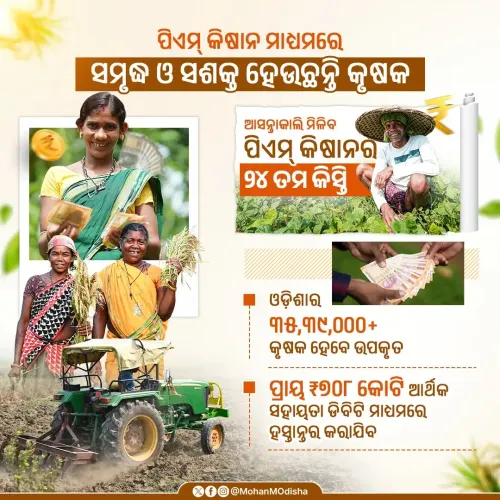
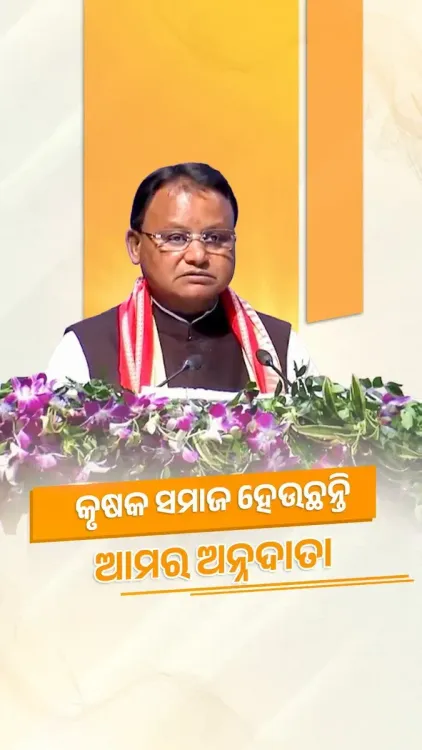
Writing in Odia on Friday, 30 October 2026, Chief Minister Majhi laid out the arithmetic plainly. The Central government's PM-KISAN scheme contributes ₹6,000 per year, while the Odisha state government's own CM-KISAN scheme adds a further ₹4,000 per year — bringing total annual income support to ₹10,000 for qualifying farm families. 'Farmers are not just cultivators, they are our Annadatas,' he wrote, framing the dual-scheme support as a step toward making them 'financially self-reliant.'
How PM-KISAN and CM-KISAN Fit Together
PM-KISAN — launched by the Government of India in February 2019 — was designed as a national floor for farmer income, channelling ₹6,000 a year in three equal instalments directly into the bank accounts of land-holding farmer families through direct benefit transfer. It set a nationwide baseline but left headroom for states to supplement.
That headroom is exactly what CM-KISAN fills. The Odisha state scheme layers an additional ₹4,000 annually on top of the central support — a model that has become a recognisable pattern across BJP-governed states, which have increasingly used state-funded top-ups to deepen the reach of the central framework and address farmer income volatility between harvest cycles.
Odisha's Agricultural Stakes
Odisha is an eastern Indian state where agriculture underpins a substantial share of livelihoods. Since the BJP came to power in the state in June 2024, with Majhi assuming the Chief Minister's office, the government has signalled farmer welfare as a priority pillar — and the dual-KISAN messaging is a recurring feature of that positioning.
The stacking model matters because farm income in Odisha remains vulnerable to monsoon irregularities and commodity price swings. A predictable annual cash transfer of ₹10,000 — modest in absolute terms but guaranteed — can smooth input costs for small and marginal farmers who might otherwise resort to high-interest credit at critical sowing or harvesting moments.
What Farmers and Policymakers Will Watch Next
The real test of any income-support scheme lies in enrollment breadth and disbursement regularity — how many eligible farmers are actually registered, and whether instalments arrive on schedule. State budget announcements carry the next data points: any revision to CM-KISAN allocations or expansion of eligibility criteria will signal how far the government intends to stretch this combined safety net.
For now, Majhi's post plants a clear political and policy marker — a ₹10,000 annual promise to the people whose labour fills every plate.
Point of View
000 floor that the dual PM-KISAN/CM-KISAN architecture already provides. The political calculus is straightforward: by visibly 'owning' the central scheme alongside the state top-up, the BJP government in Odisha seeks credit for the full ₹10,000 figure rather than just its ₹4,000 contribution. This stacking model has become a template across BJP-ruled states, suggesting a deliberate federal welfare-delivery strategy that leverages central transfers as a base and uses state budgets to differentiate. The durability of CM-KISAN's ₹4,000 component will ultimately depend on Odisha's fiscal headroom — making future budget cycles the real political and policy test.
NationPress
30 Oct 2026
Frequently Asked Questions
What is the CM-KISAN scheme in Odisha?
CM-KISAN is an Odisha state government scheme that provides eligible farmers with an additional ₹4,000 per year in direct income support, supplementing the ₹6,000 annual benefit from the central PM-KISAN scheme for a combined total of ₹10,000.
How much money do Odisha farmers get under PM-KISAN and CM-KISAN together?
Eligible farmers in Odisha receive a combined ₹10,000 per year — ₹6,000 from the central PM-KISAN scheme and ₹4,000 from the state's CM-KISAN scheme.
When was PM-KISAN launched?
PM-KISAN was launched by the Government of India in February 2019 as a direct benefit transfer programme providing ₹6,000 annually to eligible land-holding farmer families.
Who is Mohan Charan Majhi?
Mohan Charan Majhi is a BJP leader who has served as Chief Minister of Odisha since June 2024.
Do other states also top up PM-KISAN with state funds?
Yes. Several Indian states, particularly those governed by the BJP, have introduced state-funded top-up schemes that stack additional annual payments onto the central PM-KISAN baseline to raise total farmer income support.