CM Majhi Backs Parbati Giri Mega Lift Irrigation Scheme
Synopsis
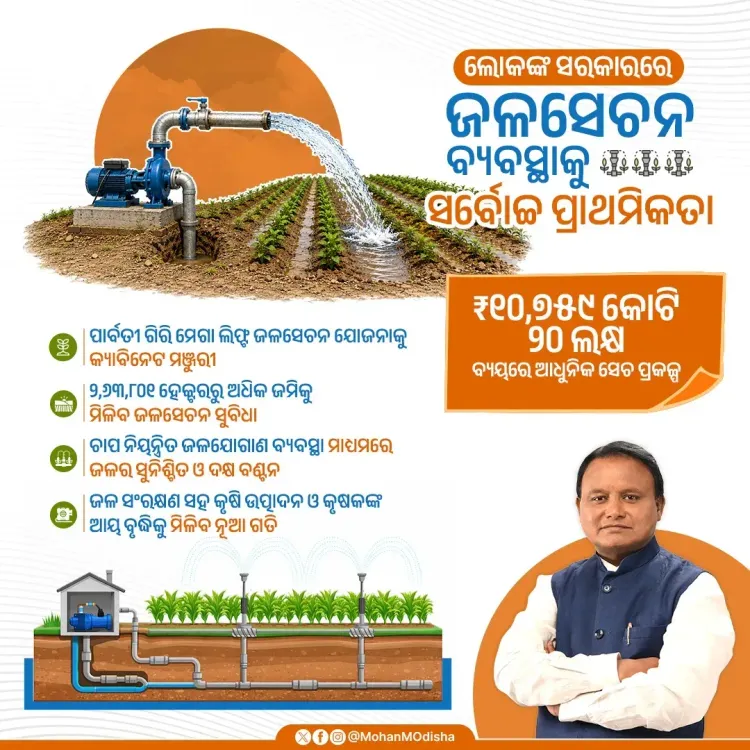
The Odisha Cabinet has approved the Parbati Giri Mega Lift Irrigation Scheme, CM Mohan Charan Majhi announced on 17 July 2026. The project will use pressurised water supply to irrigate lakhs of hectares of farmland, advancing the government's 'prosperous farmer, prosperous Odisha' agenda.
Key Takeaways
The Odisha Cabinet has approved the Parbati Giri Mega Lift Irrigation Scheme on 17 July 2026 .
CM Mohan Charan Majhi announced the approval via X, framing it as a major boost to modern irrigation infrastructure.
The scheme will use a pressure-regulated water supply system for assured and systematic distribution of irrigation water.
Lakhs of hectares of agricultural land are expected to benefit from the project.
The initiative is linked to the government's stated goal of water conservation and raising farmer incomes in Odisha.
Specific project cost, district coverage, and implementation timelines are yet to be publicly notified.
Odisha Chief Minister Mohan Charan Majhi announced on Friday, 17 July 2026 that the Odisha Cabinet has approved the Parbati Giri Mega Lift Irrigation Scheme, a major infrastructure push aimed at strengthening the state's agricultural water supply through pressurised distribution systems. The scheme is intended to bring irrigation access to lakhs of hectares of farmland across the state.
Context
Writing in Odia on X, CM Majhi stated that under the 'people's government' (lokanka sarkar), irrigation infrastructure is being made more robust. He said the cabinet approval for the Parbati Giri Mega Lift Irrigation Scheme marks a 'big boost' to modern irrigation infrastructure in the state. The scheme, he noted, will ensure 'assured and systematic distribution of water' through a pressure-regulated supply system, enabling lakhs of hectares of agricultural land to receive irrigation benefits.
The Chief Minister framed the initiative as central to his government's vision of a 'prosperous farmer, prosperous Odisha' (samruddha krishak, samruddha Odisha), describing it as a demonstration of the government's firm commitment to water conservation and raising farmer incomes.
Policy Backdrop
Odisha has pursued lift irrigation expansion since the 2010s, particularly to address the needs of rainfed districts where monsoon dependence leads to recurring crop losses. Earlier efforts under the Accelerated Irrigation Benefits Programme laid the groundwork for larger, pressurised mega-lift systems now being pursued by the state.
The Parbati Giri scheme fits a broader pattern of state-level infrastructure approvals designed to modernise water delivery and improve agricultural productivity. The central government's Pradhan Mantri Krishi Sinchayee Yojana has also provided a policy and funding framework that state-level mega lift projects have historically sought to align with.
Stakeholders and Impact
The primary beneficiaries of the scheme are Odisha's farming communities, particularly those in rainfed agricultural districts that have historically lacked reliable irrigation. Pressurised water supply systems are designed to reduce water wastage compared to conventional canal-based delivery, potentially improving both water-use efficiency and crop yields.
If implemented as envisaged, the scheme could reduce dependence on monsoon rainfall for a significant share of the state's cultivated area, offering farmers greater predictability in planning crop cycles and potentially supporting higher-value agriculture.
What's Next
The cabinet approval marks the formal go-ahead for the project, but the implementation timeline, district-wise coverage, and detailed funding arrangements are yet to be publicly notified. Watchers will look for the government to specify which districts fall under the scheme's first phase and whether central scheme funding will be leveraged to supplement state expenditure.
With CM Majhi's government having taken office in June 2024, the approval signals an intent to deliver visible agricultural infrastructure outcomes ahead of the mid-term mark of the current administration.
Point of View
Less than two years into its tenure, to demonstrate delivery on agricultural promises to Odisha's large farming electorate. Lift irrigation mega-projects have historically served as flagship rural infrastructure markers for state governments seeking to differentiate their development record. By anchoring the announcement in the 'samruddha krishak, samruddha Odisha' slogan, the BJP-led administration is building a consistent messaging arc around farmer welfare that mirrors the central government's own agrarian outreach. The critical test will be whether implementation details — district coverage, funding, and timelines — follow swiftly enough to convert the cabinet approval into on-ground credibility before the next electoral cycle.
NationPress
16 Oct 2026
Frequently Asked Questions
What is the Parbati Giri Mega Lift Irrigation Scheme?
The Parbati Giri Mega Lift Irrigation Scheme is a state-level irrigation project approved by the Odisha Cabinet that will use a pressurised water supply system to deliver reliable irrigation to lakhs of hectares of agricultural land across Odisha.
Which districts will benefit from the Parbati Giri irrigation scheme?
The specific districts to be covered under the scheme have not yet been publicly notified as part of the cabinet approval announcement. Official implementation details are awaited.
What did CM Mohan Charan Majhi say about the irrigation scheme?
CM Majhi stated that the cabinet approval marks a big boost to modern irrigation infrastructure in Odisha, promising assured and systematic water distribution through a pressure-regulated system, and connecting the project to his government's 'prosperous farmer, prosperous Odisha' vision.
How does Odisha's lift irrigation policy work?
Odisha has developed lift irrigation schemes since the 2010s to serve rainfed districts where canal-based systems are not viable. Mega lift schemes pump water from rivers or reservoirs and distribute it through pressurised pipelines to farmland, improving efficiency and coverage.
Is the Parbati Giri scheme linked to the central government's Pradhan Mantri Krishi Sinchayee Yojana?
The cabinet approval announcement did not specify a formal funding linkage with the Pradhan Mantri Krishi Sinchayee Yojana, though Odisha's past lift irrigation projects have sought alignment with central irrigation schemes. Funding details are yet to be confirmed.