Odisha Revives 64 Original Place Names, Drops Colonial Spellings
Synopsis
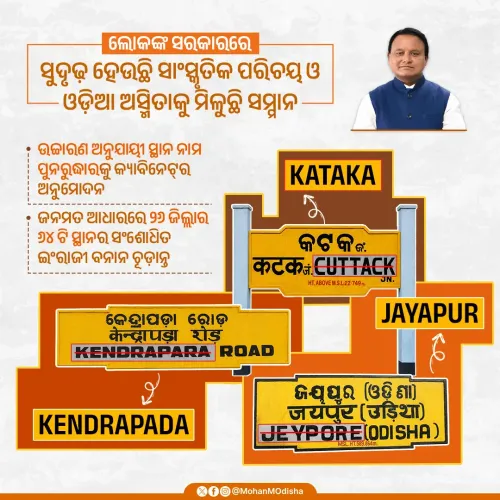
The Chief Minister's Office of Odisha announced the revision of English spellings for 64 places across the state, replacing colonial-era transliterations with authentic Odia forms. The most prominent change sees Cuttack officially become Kataka, continuing the linguistic self-assertion that began with the state's own renaming in 2011.
Key Takeaways
The Chief Minister's Office of Odisha announced revised English spellings for 64 places across the state on 23 June 2026 .
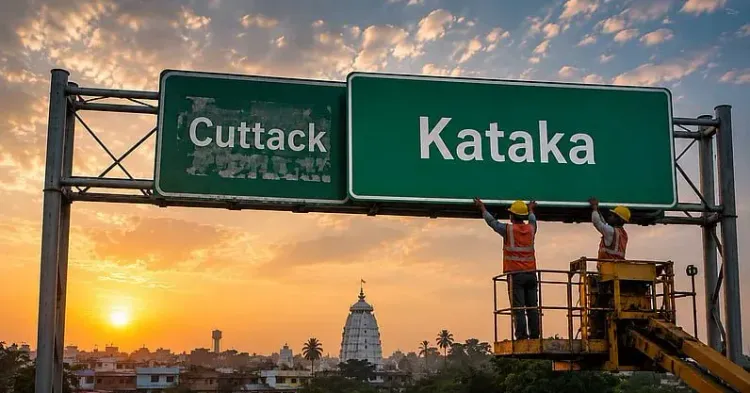
Cuttack , Odisha's historic former capital, will now be officially spelled Kataka in English records.
The move follows the 2011 Orissa (Alteration of Name) Act , which renamed the state itself from 'Orissa' to 'Odisha'.
Gazette notifications, updated maps, postal records, and central-government documentation will all require revision.
The exercise is part of a broader national pattern of replacing colonial anglicisations with indigenous place-name forms.
Coordination with central agencies including Survey of India and the Ministry of Home Affairs will be required for full implementation.
The Chief Minister's Office of Odisha announced on Tuesday, 23 June 2026 that the state government has officially revised the English spellings of 64 places across Odisha, replacing colonial-era transliterations with forms that reflect authentic Odia pronunciation. The move marks one of the most sweeping place-name reforms the state has undertaken since it secured its own renamed identity over a decade ago.
Context
The most prominent change under the new order is the renaming of Cuttack — Odisha's historic former capital — to Kataka, the form long used in Odia script and speech. The colonial spelling 'Cuttack' was a phonetic approximation introduced by British administrators and has persisted in official English records for nearly two centuries. The state government's announcement signals that such approximations will no longer be treated as authoritative.
The Chief Minister's Office shared the update on X (formerly Twitter), framing the revision as a restoration of original identity rather than a renaming exercise. The post linked to detailed coverage of the full list of affected places, spanning cities, towns, and localities across the state.
Policy Backdrop
This decision is the latest step in a long arc of linguistic self-assertion by Odisha. In 2011, Parliament passed the Orissa (Alteration of Name) Act, formally changing the state's English name from 'Orissa' to 'Odisha' to align with Odia pronunciation — a change Odia speakers had sought for decades. That precedent established both the legal mechanism and the political will for further corrections.
India's broader pattern of place-name revision dates to the 1950s linguistic reorganisation of states and has accelerated since 2010, with several states replacing colonial or anglicised names with indigenous forms. Odisha's current exercise of 64 simultaneous revisions is notable in scale, applying the corrective logic of the 2011 state-name change to dozens of localities at once.
The administrative implications are significant. Gazette notifications will need to be issued, and official maps, railway signboards, postal addresses, and national-level databases will require updating. Where place names appear in inter-state or central-government documentation, coordination with New Delhi may be required before changes take full legal effect.
Stakeholders and Impact
For Odia speakers — who number over 3.5 crore across the state — the revision is primarily a matter of cultural recognition. The old spellings, while administratively entrenched, never reflected how residents actually pronounced or wrote their home towns in their own language. Residents of Kataka in particular have long regarded the 'Cuttack' spelling as an outsider's imposition.
Practical disruption is expected during the transition period. Residents, businesses, educational institutions, and government agencies will need to update addresses, certificates, and records. The state government is expected to issue a phased compliance timeline to manage the changeover without invalidating existing documentation.
What's Next
The immediate next steps involve gazette notification of the revised spellings and communication to central agencies including Survey of India, India Post, and the Ministry of Home Affairs, which maintains the official list of place names for national purposes. State departments handling land records, transport, and education will also need to align their systems.
The revision sets a precedent that other Odia towns with distorted colonial spellings may follow in future rounds. Odisha's move is likely to renew debate in other states about the pace and scope of similar corrections, positioning linguistic authenticity as an ongoing governance priority rather than a one-time symbolic gesture.
Point of View
The state government signals that cultural identity, not bureaucratic inertia, will drive official nomenclature going forward. The scale of the revision — and the high-profile example of Cuttack becoming Kataka — gives the move political salience beyond Odisha, inviting other states to audit their own inherited colonial spellings. The real test will be implementation: whether central agencies and national databases follow suit swiftly, or whether the old spellings linger in parallel systems for years.
NationPress
23 Jun 2026
Frequently Asked Questions
Why is Cuttack being renamed to Kataka?
'Cuttack' is a colonial-era phonetic approximation of the Odia name 'Kataka'. The Odisha government is replacing such distorted spellings with forms that accurately reflect Odia pronunciation, as part of a revision covering 64 places across the state.
How many places has Odisha renamed in 2026?
The Odisha government has revised the English spellings of 64 places in the state, replacing colonial transliterations with authentic Odia forms.
Is this the first time Odisha has changed a place name?
No. In 2011 , Parliament passed the Orissa (Alteration of Name) Act, officially changing the state's English name from 'Orissa' to 'Odisha'. The current exercise extends that same corrective logic to 64 localities.
Will the Cuttack name change affect addresses and official documents?
Yes. Residents, businesses, and government agencies in affected areas will need to update addresses, certificates, and records. The state is expected to issue a phased compliance timeline, and central agencies such as India Post and Survey of India will also need to align their systems.
Does the central government need to approve Odisha's place name changes?
For changes to inter-state or national-level documentation, coordination with central agencies including the Ministry of Home Affairs and Survey of India is typically required before revisions take full legal effect across all official records.