Operation Sindoor at 1: Kumaraswamy, Pralhad Joshi vow India will never bow to terror
Synopsis
One year after Operation Sindoor reshaped India's counter-terror doctrine in response to the Pahalgam attack that killed 26 civilians, Union Ministers Kumaraswamy and Pralhad Joshi led tributes in Bengaluru — turning the anniversary into a unified political statement that New India acts swiftly and decisively against terrorism.
Key Takeaways
Union Ministers H.D.
Kumaraswamy and Pralhad Joshi marked one year of Operation Sindoor in Bengaluru on 7 May 2025 .
Operation Sindoor was launched in response to the Pahalgam terror attack that claimed 26 innocent lives .
Karnataka BJP President B.Y.
Vijayendra reaffirmed India's zero-tolerance policy against terrorism under PM Modi.
Leader of the Opposition R.
Ashoka said India "no longer waits; India acts," signalling cross-party endorsement of the operation's legacy.
Leaders across the board described the operation as a symbol of India's unity, military precision, and unwavering national resolve.
Union Ministers H.D. Kumaraswamy and Pralhad Joshi, along with senior Bharatiya Janata Party (BJP) leaders in Karnataka, on 7 May 2025 marked one year of Operation Sindoor, reaffirming that India will never yield to terrorism or intimidation. The commemorations in Bengaluru drew pointed tributes to the armed forces and strong endorsements of Prime Minister Narendra Modi's zero-tolerance stance on cross-border terror.
Kumaraswamy: A Symbol of Unity and Courage
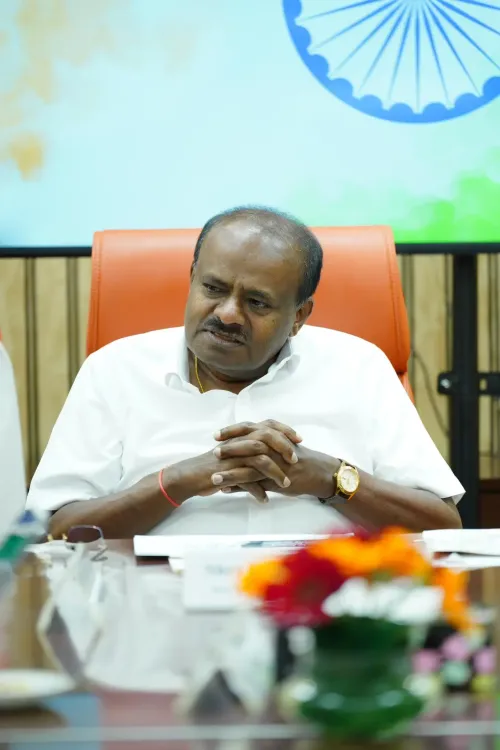
Union Minister for Heavy Industries and Steel H.D. Kumaraswamy described Operation Sindoor as "not merely a military exercise but a symbol of the country's unity, courage, and determination in the face of challenges." He said the operation reflected the resolve of a civilisation that stands united during difficult times and highlighted the bravery of the armed forces who place the nation above self.
Praising Prime Minister Modi's leadership, Kumaraswamy noted that India had sent a "clear and unequivocal message to the world that its patience should never be mistaken for weakness." He added that every sacrifice made for the Tiranga (Tricolour) would be honoured with strength, unity, and unwavering national resolve. "India stands strong. India stands united. India stands resolute," he declared.
Pralhad Joshi: New India Will Not Stay Silent
Union Minister for Food, Public Distribution and Consumer Affairs Pralhad Joshi said, "Operation Sindoor sent a strong and uncompromising message to the forces of terror — New India will never stay silent in the face of cowardly attacks." He credited the armed forces with showcasing "exceptional valour, strategic excellence and an unwavering commitment to national security" under Modi's leadership.
Joshi emphasised that India's message was unambiguous: "Every attack on our sovereignty will be crushed and every enemy of peace will be answered with strength." This comes amid a broader political consensus in Karnataka's BJP ranks that Operation Sindoor marked a turning point in India's counter-terror posture.
Karnataka BJP Leaders Echo the Resolve
Karnataka BJP President and MLA B.Y. Vijayendra recalled that Operation Sindoor was launched in direct response to the Pahalgam terror attack that claimed 26 innocent lives. He said the operation "showcased the strength, coordination and resolve of India's armed forces — from land to air to sea." Vijayendra added that under Modi's leadership, India has adopted a zero-tolerance policy against terrorism, and that "every attack on India will be met with strength, precision and unflinching national resolve."
Karnataka's Leader of the Opposition R. Ashoka also joined the chorus, saying: "One year since Operation Sindoor, and the message to the world remains crystal clear — do not mistake our patience for weakness. India no longer waits; India acts." Ashoka described the nation as "united by purpose and steeled by resolve," adding that from national security to territorial integrity, India's commitment is "absolute and our honour non-negotiable."
Background: What Operation Sindoor Was
Operation Sindoor, launched one year ago, was India's military response to a devastating terror attack in Pahalgam that killed 26 civilians. The operation involved coordinated action across land, air, and sea, and was widely seen as a significant escalation in India's counter-terror doctrine — moving from strategic restraint to direct, precision-led military action. Notably, the operation drew near-unanimous political support across party lines at the time of its execution.
What This Signals Going Forward
The first anniversary commemorations underscore that Operation Sindoor has become a defining political and strategic reference point for the BJP, particularly in Karnataka ahead of future electoral cycles. The unified messaging from Union ministers, state party leadership, and the Leader of the Opposition signals that India's hardened counter-terror posture enjoys broad cross-party endorsement in the state. Analysts note that the political framing of the operation — as proof of a "New India" that acts rather than waits — is likely to remain a centrepiece of national security discourse in the months ahead.
Point of View
Suggesting the operation has achieved rare bipartisan legitimacy. The risk, however, is that the anniversary becomes a political ritual rather than an occasion to assess strategic outcomes: Were the operation's objectives verifiably achieved? Has cross-border terror infrastructure been durably degraded? Those questions remain largely unasked in the public discourse, even as the messaging of 'New India acts' hardens into electoral doctrine.
NationPress
21 Sept 2026
Frequently Asked Questions
What was Operation Sindoor?
Operation Sindoor was a coordinated Indian military operation launched one year ago in response to the Pahalgam terror attack that killed 26 civilians. It involved action across land, air, and sea, and marked a significant shift in India's counter-terror doctrine toward direct, precision-led military engagement.
Why are Union Ministers commemorating Operation Sindoor on 7 May 2025?
7 May 2025 marks the first anniversary of Operation Sindoor. Union Ministers H.D. Kumaraswamy and Pralhad Joshi, along with Karnataka BJP leaders, held commemorations in Bengaluru to honour the armed forces and reaffirm India's zero-tolerance stance on terrorism.
What did H.D. Kumaraswamy say about Operation Sindoor?
Kumaraswamy described Operation Sindoor as not merely a military exercise but a symbol of India's unity, courage, and determination. He said India had sent a clear message that its patience should never be mistaken for weakness, and paid tribute to the sacrifices of the armed forces.
What was the Pahalgam terror attack that triggered Operation Sindoor?
The Pahalgam terror attack was a terrorist strike that claimed 26 innocent lives, according to BJP leader B.Y. Vijayendra. It served as the direct trigger for the launch of Operation Sindoor, which was India's military response to the attack.
Who else spoke at the Operation Sindoor anniversary events in Karnataka?
Karnataka BJP President and MLA B.Y. Vijayendra and Leader of the Opposition R. Ashoka also spoke at the commemorations. Ashoka notably said 'India no longer waits; India acts,' reflecting broad cross-party support for the operation's legacy.