Owaisi: India-China ties can't be on Beijing's terms alone

Synopsis
AIMIM president Asaduddin Owaisi on June 24, 2026, stated that India-China normalisation cannot happen solely on Beijing's terms, insisting Indian interests must remain paramount and warning that abandoning this consistent policy would be a disaster.
Key Takeaways
Asaduddin Owaisi stated on June 24, 2026 that India-China ties cannot be normalised solely on Chinese terms .
He described placing Indian interests as paramount as India's 'consistent policy' and warned that changing it 'will be a disaster.' The June 2020 Galwan Valley clash killed 20 Indian soldiers and set the current framework: complete disengagement before normalisation.
India's position since 2020 has been that border tranquility along the LAC is a precondition for normal bilateral relations.
Cross-party political consensus in India has broadly supported prioritising sovereignty over premature normalisation with Beijing .
Future SCO and BRICS sideline meetings and corps commander talks will be key indicators of how the relationship evolves.
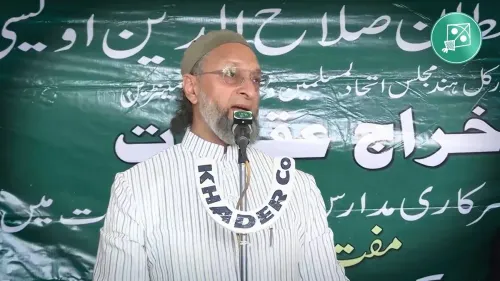
AIMIM president Asaduddin Owaisi on Wednesday, June 24, 2026, weighed in on the state of India-China bilateral relations, asserting that while every Indian citizen desires normal and peaceful ties with China, such normalisation cannot come at the cost of Indian interests. Responding to a post on X, Owaisi warned that any deviation from this consistent national policy 'will be a disaster.'
Context
Owaisi, replying on X, stated: 'Every Indian citizen wants normal and peaceful ties with China, but these can't be solely on Chinese terms. Indian interests have to be paramount and cannot be discarded in this pursuit of normalcy with China.' He described this as India's 'consistent policy' and cautioned against changing it. The Hyderabad MP's remarks come amid ongoing diplomatic and military-level engagement between New Delhi and Beijing to manage tensions along the Line of Actual Control (LAC).
Policy Backdrop
The friction in India-China ties has its most recent and defining flashpoint in the June 2020 Galwan Valley clash, which killed 20 Indian soldiers and triggered prolonged military disengagement negotiations. Following the clash, India formally stated that normalisation of bilateral ties would require complete disengagement and restoration of the pre-April 2020 status quo along the LAC. This position — that border tranquility is a precondition for normal relations — has been maintained consistently across political formations.
The roots of structured India-China diplomacy trace back to the 1954 Panchsheel Agreement, which outlined five principles of peaceful coexistence. The 1993 Agreement on Maintenance of Peace and Tranquility along the LAC subsequently established mechanisms to manage border differences. Despite these frameworks, the LAC — an undefined de facto border between the two countries — has remained a persistent source of tension since the 1962 war.
Stakeholders and Impact
The debate over the terms of engagement with China directly affects Indian border communities, the armed forces deployed along the LAC, and the broader civilian population whose economic and security interests are intertwined with the bilateral relationship. Cross-party political voices in India have largely converged on the principle that sovereignty and territorial integrity must not be compromised in any diplomatic outreach to Beijing. Owaisi's statement reflects this wider parliamentary consensus, even as it signals vigilance against any perceived softening of New Delhi's stance.
At the strategic level, the India-China relationship sits within a broader Indo-Pacific competition, where India has sought to balance economic interdependence with assertive defence of its territorial claims. Any recalibration of policy — whether perceived or real — carries implications for India's alignments with partners in the region and beyond.
What's Next
Future rounds of corps commander-level talks and any high-level bilateral meetings on the sidelines of multilateral forums such as the SCO or BRICS summits will be closely watched as indicators of whether the disengagement process along the LAC is advancing. Parliamentary debates on the border situation may also surface if any policy recalibration is under consideration by the government. Owaisi's intervention signals that opposition voices will continue to hold the executive to account on the terms under which any normalisation with China is pursued.
Point of View
' he is effectively holding the government to its own stated doctrine, making any quiet diplomatic concession politically costly. The intervention reflects a broader pattern in which opposition MPs use foreign policy moments to signal national-security credibility. The real test will come when the details of any new disengagement or diplomatic normalisation package become public, at which point this stated benchmark will be used to evaluate whether Indian interests were, in fact, protected.
NationPress
22 Sept 2026
Frequently Asked Questions
What did Asaduddin Owaisi say about India-China relations?
Owaisi said that while every Indian citizen wants normal and peaceful ties with China, normalisation cannot happen solely on Chinese terms and that Indian interests must be paramount. He called this India's consistent policy and warned that changing it would be a disaster.
What is the Line of Actual Control (LAC)?
The Line of Actual Control is the undefined de facto border between India and China where military tensions have persisted since the 1962 war, most recently escalating in the deadly June 2020 Galwan Valley clash.
What happened in the Galwan Valley clash?
In June 2020, Indian and Chinese troops clashed in the Galwan Valley along the LAC, resulting in the deaths of 20 Indian soldiers. The incident triggered prolonged military disengagement negotiations and prompted India to link normalisation of ties to full disengagement.
What is India's official policy on normalising ties with China?
India has stated since 2020 that normalisation of bilateral ties with China requires complete disengagement and restoration of the pre-April 2020 status quo along the LAC, prioritising sovereignty and territorial integrity.
Why is Owaisi commenting on India-China foreign policy?
As AIMIM president and a Lok Sabha MP from Hyderabad since 2004, Owaisi regularly comments on national security and foreign policy issues. His statement reflects a broader cross-party consensus in India that security interests must not be compromised in diplomatic engagement with Beijing.