Owaisi flags Article 28 after students told to stand for Vedic chants
Synopsis
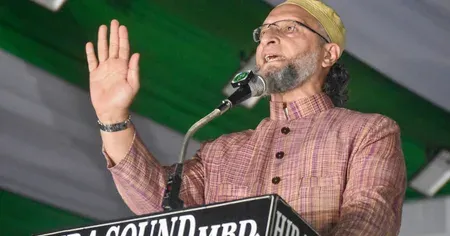
AIMIM president Asaduddin Owaisi has invoked Article 28 and Article 51A(H) of the Constitution after a report that students in state-funded schools were directed to stand during Vedic chants, calling it a violation of constitutional secularism and the duty to foster scientific temper.
Key Takeaways
Owaisi cited a report that students were 'told to stand up during the Vedic chants' at what is implied to be a state-funded educational institution.
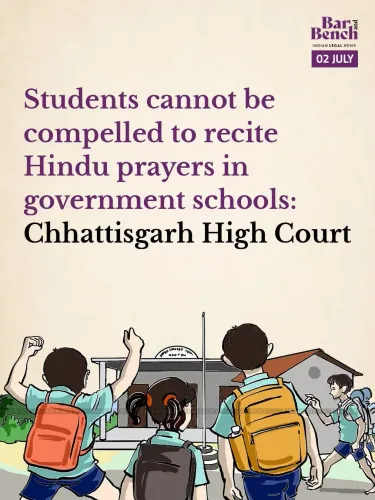
Article 28 of the Indian Constitution prohibits religious instruction in institutions wholly maintained out of state funds.
Article 51A(H) , inserted by the 42nd Constitutional Amendment of 1976 , makes it a fundamental duty to cultivate scientific temper, humanism, and the spirit of inquiry.
Owaisi directed his post at Prime Minister Narendra Modi , asserting that 'National Interest means Questioning the Government.' The issue is part of a long-running constitutional debate over the boundary between state neutrality and religious practice in Indian public schools.
A reported directive asking schoolchildren to stand during Vedic chants has drawn a sharp constitutional challenge from AIMIM president Asaduddin Owaisi, who invoked two separate articles of the Indian Constitution on Saturday, 8 August 2026 to argue that the practice violates the foundational compact between the state and its citizens.
Owaisi quoted a report stating that students 'have been told to stand up during the Vedic chants,' then trained his fire on two constitutional provisions in quick succession. First, Article 51A(H) — the fundamental duty inserted by the 42nd Constitutional Amendment of 1976 — which obliges every citizen to develop 'scientific temper, humanism and the spirit of inquiry and reform.' That duty, he wrote, 'has been thrown into a Dust Bin.' Second, and more specifically, Article 28, which prohibits religious instruction in educational institutions 'wholly maintained out of state funds.'
What Article 28 actually says — and why it matters here
Article 28 draws a clear line: a school running entirely on state money cannot conduct religious instruction. The provision was designed to protect students of every background from state-sponsored religious exposure in classrooms funded by public taxes. If the institution in question is wholly state-funded, any compulsory religious ritual — including being made to stand during sacred chants — would fall squarely within the ambit of this prohibition.
The distinction matters. Article 28 does permit religious instruction in institutions that receive state aid but are not wholly state-run, and it carves out institutions established under an endowment or trust requiring religious instruction. Critics of practices like mandatory standing during Vedic recitations argue that the line between 'instruction' and 'participation' is being deliberately blurred.
A recurring fault-line in Indian public education
This is not a new fight. Successive governments at the centre and in states have introduced elements of traditional knowledge, yoga, Sanskrit recitation, and ritual observance into school routines. Opposition voices and minority representatives have consistently cited Article 28 and the broader principle of state neutrality on religion. The exchange follows a well-worn pattern — a reported practice, a constitutional citation, a political flashpoint — but the constitutional text Owaisi cites is unambiguous, and the legal question it raises is real.
Owaisi closed with a pointed reminder directed at Prime Minister Narendra Modi and, implicitly, at students themselves: 'National Interest means Questioning the Government.' It is a line that reframes the act of constitutional scrutiny not as dissent, but as civic duty.
Whether the reported directive leads to a formal legal challenge under Article 28, a parliamentary question, or a Ministry of Education response will determine how far this moment travels beyond the political timeline.
Point of View
He forces the debate away from tradition versus modernity and onto the state's explicit obligations under its own founding document. The move reflects a broader opposition strategy of using the Constitution as both shield and sword against practices that blur the line between state and religion in public institutions. If a formal legal challenge follows, courts would have to revisit the precise definition of 'religious instruction' under Article 28 — a determination with nationwide implications for school routines across every state. The closing line about national interest and questioning government signals that AIMIM intends this as a civic-education argument, not merely a minority-rights one.
NationPress
22 Sept 2026
Frequently Asked Questions
What does Article 28 of the Indian Constitution say?
Article 28 prohibits religious instruction in educational institutions wholly maintained out of state funds. It also bars students in state-aided institutions from being compelled to attend religious instruction or worship without consent.
Why is Owaisi objecting to students standing during Vedic chants?
Owaisi argues that directing students to stand during Vedic chants in a state-funded school amounts to compulsory participation in a religious practice, which he says violates Article 28's prohibition on religious instruction in wholly state-funded institutions.
What is Article 51A(H) and what does it require?
Article 51A(H) is a fundamental duty inserted by the 42nd Constitutional Amendment of 1976. It requires every Indian citizen to develop scientific temper, humanism, and the spirit of inquiry and reform.
Can state-funded schools in India conduct religious activities?
Under Article 28, institutions wholly maintained by state funds cannot provide religious instruction. Institutions that receive state aid but are not wholly state-run, or those established under a religious trust, have more latitude, but students cannot be compelled to participate.
What could happen next after Owaisi's post on Vedic chants in schools?
Possible follow-ups include a formal response from the Ministry of Education, parliamentary questions during the next session, or a legal petition invoking Article 28 before a High Court or the Supreme Court.