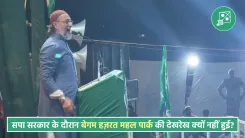
Owaisi pays tribute to Kairana's freedom fighters

Synopsis
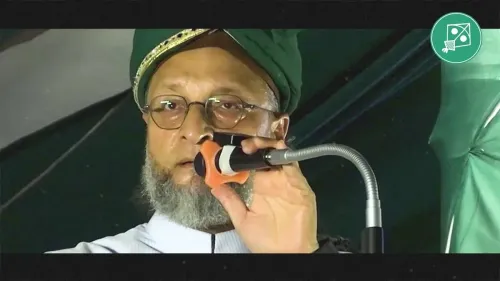
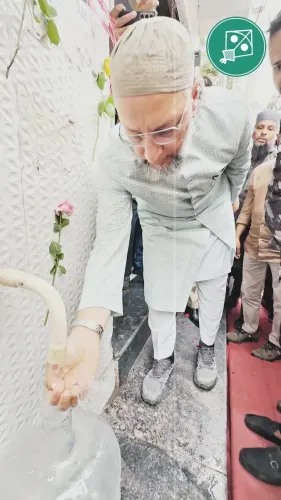
AIMIM president Asaduddin Owaisi paid tribute to Kairana's freedom fighters on 27 October 2026, invoking the term 'mujahideen-e-azadi' — part of a sustained effort to foreground Muslim contributions to India's independence struggle in public memory.
Key Takeaways
AIMIM president Asaduddin Owaisi posted a tribute on X on 27 October 2026 honouring the freedom fighters of Kairana , Uttar Pradesh.
He used the Urdu phrase mujahideen-e-azadi — 'soldiers of freedom' — to describe the town's independence-era contributors.
Kairana is located in Shamli district, Uttar Pradesh , and is associated in regional history with resistance to colonial rule.
The tribute aligns with AIMIM's broader pattern of highlighting Muslim participation in India's freedom struggle through public statements and commemorations.
Owaisi regularly invokes historical figures and places to argue that Muslim contributions to the independence movement deserve greater acknowledgement in national memory.
From the soil of Kairana came men and women who gave everything for a nation not yet born — and on Tuesday, 27 October 2026, AIMIM president Asaduddin Owaisi paused to honour them, paying homage to the town's mujahideen-e-azadi (freedom fighters) in a post on X.
Writing in Urdu, Owaisi said: 'मैं कैराना की सरज़मीन के मुजाहिदीन-ए-आज़ादी को ख़िराज-ए-अक़ीदत पेश करता हूँ' — 'I offer my respectful tribute to the freedom fighters of the land of Kairana.'
Kairana's place in the independence narrative
Kairana, a town in Shamli district, Uttar Pradesh, carries a layered history that local historians associate with early resistance to colonial rule. The use of the term mujahideen-e-azadi — literally 'soldiers of freedom' — is a specific, historically charged phrase that foregrounds the Muslim contribution to India's independence movement, a thread Owaisi has pulled at consistently in public discourse.
The tribute fits a deliberate pattern. AIMIM has long used historical commemorations to argue that Muslim participation in the freedom struggle is under-acknowledged in mainstream national memory. By naming Kairana specifically, rather than gesturing at a broad community, Owaisi grounds the tribute in regional identity — a town, a soil, a specific sacrifice.
A recurring voice on Muslim historical memory
This is not an isolated gesture. Owaisi has periodically invoked figures and places from the independence era to make a pointed political-cultural argument: that the freedom struggle was plural, and that erasing any strand of it diminishes the whole. The framing resonates with his constituency while also entering a wider national conversation about whose history gets told — and how.
Whether the post prompts responses from Uttar Pradesh political figures or local historians remains to be watched. But the message itself is clear: Kairana's fighters deserve to be remembered by name, not footnote.
Point of View
Long-run counter-narrative strategy by AIMIM: using historical commemoration as political assertion. By anchoring the tribute to a specific town rather than an abstraction, Owaisi makes the argument harder to dismiss as identity politics alone — it becomes a claim about documented local history. In the current climate of contested national memory in Uttar Pradesh and beyond, such posts function as both homage and provocation, inviting a conversation that mainstream political discourse has often preferred to sidestep. The frequency of these gestures signals that AIMIM views historical framing as electoral and cultural terrain worth contesting consistently.
NationPress
27 Oct 2026
Frequently Asked Questions
Why did Owaisi pay tribute to Kairana's freedom fighters?
Owaisi paid tribute to honour the role of Kairana's residents in India's independence movement, using the term 'mujahideen-e-azadi' to specifically recognise their contributions — part of AIMIM's broader effort to highlight Muslim participation in the freedom struggle.
What does 'mujahideen-e-azadi' mean?
'Mujahideen-e-azadi' is an Urdu phrase meaning 'soldiers of freedom' or 'freedom fighters,' used to refer to those who fought against British colonial rule during India's independence movement.
Where is Kairana located?
Kairana is a town in Shamli district, Uttar Pradesh, India. It has regional historical associations with participants in the struggle for Indian independence.
What is AIMIM's stance on Muslim contributions to India's freedom struggle?
AIMIM and its president Asaduddin Owaisi have consistently argued that Muslim contributions to India's independence movement are under-acknowledged in mainstream national memory, and regularly issue tributes and statements to highlight specific figures, places, and events from that history.
Who is Asaduddin Owaisi?
Asaduddin Owaisi is the president of the All India Majlis-e-Ittehadul Muslimeen (AIMIM) and serves as a Lok Sabha Member of Parliament from Hyderabad, Telangana. He is known for his advocacy on issues related to Muslim communities and minority rights in India.