Giriraj Singh adds women, textile questions to ASUSE survey
Synopsis
Union Textiles Minister Giriraj Singh announced that ASUSE will include dedicated questions for women entrepreneurs and specific questions for handloom, powerloom and handicraft sectors, aiming to build targeted policies for India's informal textile workforce.
Key Takeaways
ASUSE , conducted by the National Statistical Office, will now carry dedicated questions for women entrepreneurs in the unincorporated sector.
Sector-specific questions covering handloom, powerloom and handicraft businesses will be added to the survey for the first time.
The move is designed to generate gender-disaggregated, sector-level data to support targeted policy and scheme design by the Ministry of Textiles .
Earlier NSS rounds — the 67th and 73rd — provided MSME baselines but lacked the granularity needed for women-led micro-enterprise policy in traditional crafts.
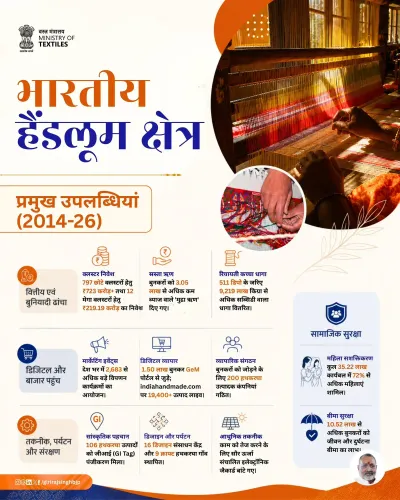
The National Handloom Development Programme , restructured in 2015-16 , has focused on weaver welfare and cluster development — data from the revised ASUSE could sharpen its targeting.
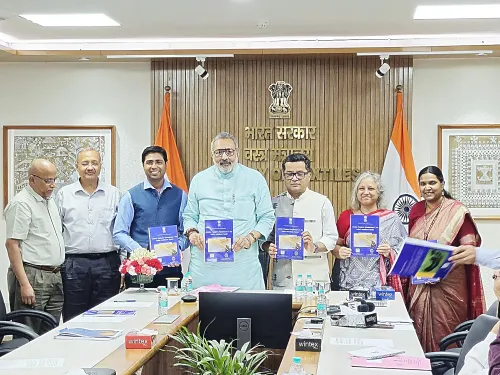
A quiet but consequential data reform is under way in India's informal economy. Union Textiles Minister Giriraj Singh announced on Tuesday, 27 October 2026 that the Annual Survey of Unincorporated Sector Enterprises (ASUSE) will now include dedicated questions for women entrepreneurs — and, for the first time, sector-specific questions covering handloom, powerloom and handicraft businesses.
Writing on X in Hindi, the minister said the move marks 'mahtvapurn pahal' — 'an important initiative' — toward understanding the challenges faced by women entrepreneurs and building effective policies for them. The survey will carry special questions related to women business owners as well as specific questions tailored to the needs of the handloom, powerloom and handicraft sectors, he noted, adding that this will help 'better understand the needs of these sectors, design targeted policies, and accelerate development.'
Why ASUSE data matters for India's 'invisible' textile workforce
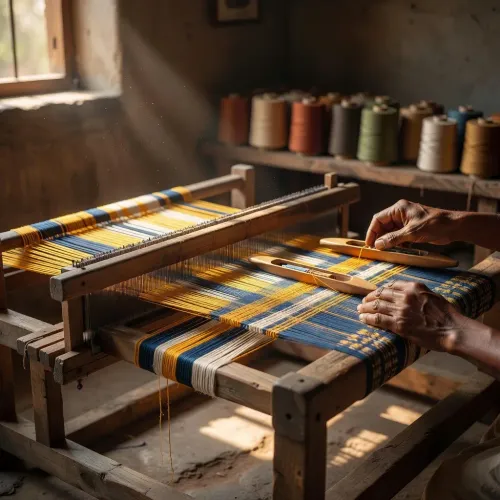
The ASUSE, conducted by the National Statistical Office, is the primary government tool for tracking the informal economy — the vast, largely uncounted universe of unregistered, household-level businesses that form the backbone of India's traditional crafts and textiles. Previous major rounds — notably the 67th and 73rd NSS rounds — gave planners the baseline data needed to design MSME interventions stretching back more than a decade. But those surveys were not built with gender-disaggregated or sector-specific lenses sharp enough to capture what is happening inside handloom clusters in Varanasi or handicraft workshops in Kutch.
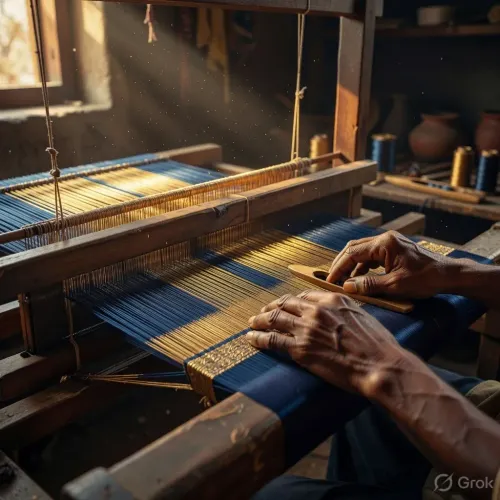
That gap matters enormously. Women make up a disproportionately large share of handloom and handicraft labour in India — often as home-based workers or micro-entrepreneurs who do not show up cleanly in standard enterprise data. Without precise data on their access to credit, technology and markets, even well-funded schemes can miss their intended beneficiaries entirely.
From the National Handloom Development Programme to a data-first approach
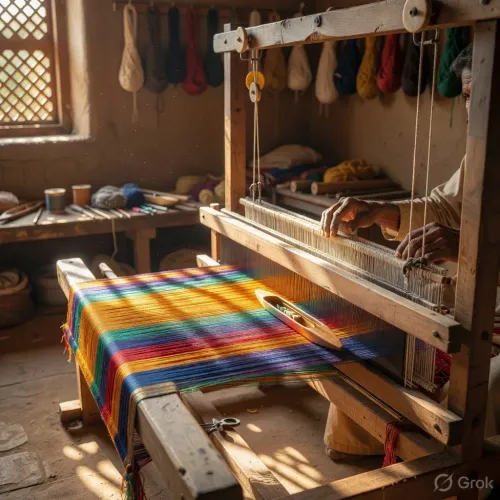
The Ministry of Textiles restructured the National Handloom Development Programme in 2015-16 to focus on weaver welfare and cluster development. The programme has channelled resources into training, yarn subsidies and market linkages. What has been harder to do is calibrate those interventions precisely — matching the right support to the right weaver in the right cluster — because aggregate survey data cannot capture the differential barriers women-led micro-enterprises face compared with male-owned ones.
Adding gender-specific and sector-specific modules to ASUSE is a structural fix to that problem. Granular data on female entrepreneurship in powerloom towns or handicraft belts can directly inform credit-access policies, cluster-level skilling programmes and direct-benefit transfer eligibility criteria.
What follows the announcement
The precise questionnaire additions and the implementation timeline for the referenced ASUSE round have not yet been published in official records. The real test of the initiative will come when the survey results are released and the Ministry of Textiles converts the new data into concrete scheme guidelines for women entrepreneurs in handloom and handicraft clusters across India.
Data without follow-through is just data. The sector is watching to see whether this survey redesign becomes the scaffolding for a genuine policy overhaul — or remains a well-intentioned footnote.
Point of View
Group-level diagnostics that can be translated directly into scheme eligibility and credit frameworks. For the Ministry of Textiles, this is particularly consequential: handloom and handicraft are among the most feminised segments of India's labour-intensive economy, yet they remain among the hardest to reach through standard enterprise surveys. If the new questionnaire design is followed by timely publication of results and concrete scheme revisions, it could set a replicable template for other ministries seeking to disaggregate informal-sector data by gender. The credibility of the initiative, however, will ultimately rest not on the announcement but on the survey's execution and the policy action that follows.
NationPress
27 Oct 2026
Frequently Asked Questions
What is the ASUSE survey in India?
ASUSE stands for the Annual Survey of Unincorporated Sector Enterprises. It is conducted by the National Statistical Office to collect data on informal-sector businesses — small, unregistered enterprises that are not captured by corporate filings — and is used to design policies for India's vast informal economy.
What changes is Giriraj Singh making to the ASUSE survey?
Union Textiles Minister Giriraj Singh announced that the ASUSE will now include dedicated questions for women entrepreneurs as well as sector-specific questions for handloom, powerloom and handicraft businesses, with the aim of enabling more targeted policy support for these groups.
Why are gender-specific questions important in enterprise surveys like ASUSE?
Women-led micro-enterprises in sectors like handloom and handicraft often face distinct barriers — including limited access to credit, technology and formal markets — that do not show up in aggregate data. Gender-disaggregated questions allow policymakers to design interventions that precisely address these differential challenges.
What is the National Handloom Development Programme?
The National Handloom Development Programme is a central government scheme run by the Ministry of Textiles, restructured in 2015-16, that focuses on weaver welfare, cluster development, yarn subsidies, training and market linkages for India's handloom sector.
When will the updated ASUSE results be available?
The exact questionnaire changes and the release timeline for the updated ASUSE round have not yet been published in official records. The Ministry of Textiles is expected to announce follow-up guidelines once the survey results are available.