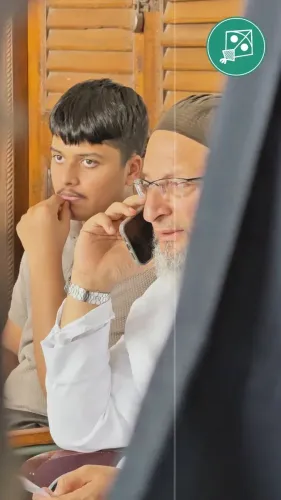
Owaisi tells PM Modi, not Pradhan, to answer youth
Synopsis
AIMIM president Asaduddin Owaisi on July 23, 2026, challenged Prime Minister Narendra Modi directly — not Education Minister Dharmendra Pradhan — to answer India's youth, using a wordplay on both leaders' shared title 'Pradhan' and Modi's self-described 'non-biological' identity.
Key Takeaways
AIMIM president Asaduddin Owaisi posted on July 23, 2026 , demanding PM Narendra Modi answer India's youth on education.
Owaisi pointedly bypassed Union Education Minister Dharmendra Pradhan , directing accountability to the Prime Minister.
The phrase 'non-biological Pradhan Sevak' fuses two recurring opposition jabs at Modi — his self-styled title and a controversial remark about his birth.
The post follows a broader opposition pattern since 2014 of elevating education and employment accountability to the head of government.
NEP 2020 implementation, graduate unemployment, and skill-development gaps remain the underlying policy flashpoints.
No response from the Prime Minister's Office or Ministry of Education had been issued at the time of publication.
AIMIM president Asaduddin Owaisi on Thursday, July 23, 2026, directed a sharp public challenge at Prime Minister Narendra Modi, insisting it is the 'so-called non-biological Pradhan Sevak' — not Union Education Minister Dharmendra Pradhan — who must answer questions from India's youth on education and employment.
In a post on X, Owaisi wrote: 'Not Dharmendra PRADHAN but the so-called non-biological PRADHAN SEVAK must answer the youth.' The capitalisation of both surnames — PRADHAN — appears deliberate, drawing a pointed contrast between the minister's family name and the Prime Minister's self-described role as servant of the people.
Context
Narendra Modi has frequently described himself as the nation's Pradhan Sevak (chief servant), a phrase he has used since taking office in 2014. The term 'non-biological' is a reference to a remark attributed to Modi in which he suggested his birth was divinely ordained rather than purely biological — a statement that has drawn repeated ridicule from opposition leaders across party lines.
Owaisi's post fuses both references into a single barb, using the shared word Pradhan (meaning 'chief' or 'head') to rhetorically link the minister's surname with the Prime Minister's self-styled title, then demanding accountability at the top.
Policy Backdrop
Dharmendra Pradhan has served as Union Minister of Education since July 2021, overseeing implementation of the National Education Policy (NEP) 2020, which restructured school and higher education frameworks across India. Critics have questioned the pace of NEP rollout, access to quality schooling in underserved regions, and the state of youth employment among graduates.
Opposition MPs have, since 2014, repeatedly directed questions on education outcomes and youth unemployment directly at the Prime Minister rather than the concerned minister, arguing that systemic failures require accountability from the head of government, not merely the portfolio holder.
Stakeholders and Impact
The post speaks directly to Indian youth — a demographic that constitutes a decisive electoral bloc. Concerns around graduate unemployment, the quality of higher education, and skill-development gaps have remained persistent political flashpoints. AIMIM, which draws significant support from urban Muslim communities and younger voters in Hyderabad and other cities, has consistently positioned itself as a vocal critic of the ruling Bharatiya Janata Party's education and employment record.
By naming the Prime Minister rather than the minister, Owaisi signals that he views youth-related grievances as a failure of political will at the highest level, not merely administrative shortcomings within a single ministry.
What's Next
No response had been issued by the Prime Minister's Office or the Ministry of Education at the time of publication. Parliament's next session and any forthcoming announcements on education or skill-development schemes are likely to renew debate on accountability for youth outcomes. Owaisi's framing suggests the opposition intends to keep pressure focused on Modi personally rather than on the ministerial level as elections approach.
Point of View
Framing youth disillusionment as a failure of prime ministerial leadership rather than departmental management. The wordplay on 'Pradhan' is unlikely to be accidental — it collapses the distance between a minister's surname and a Prime Minister's self-image into a single line of attack. This fits a broader opposition strategy of personalising accountability at the top ahead of electoral cycles, particularly on issues — education and employment — that resonate with first-time and young voters. The 'non-biological' barb also signals that cultural and identity critiques of Modi remain live weapons in the opposition's arsenal well into 2026.
NationPress
23 Jul 2026
Frequently Asked Questions
Why did Owaisi target PM Modi instead of Education Minister Dharmendra Pradhan?
Owaisi argued that questions about India's youth on education and employment should be answered by PM Modi as the head of government, not just the concerned minister. This reflects a broader opposition tactic of holding the Prime Minister personally accountable for systemic failures.
What does 'non-biological Pradhan Sevak' mean?
'Pradhan Sevak' (chief servant) is a title PM Modi has used for himself since 2014. 'Non-biological' refers to a widely reported remark in which Modi suggested his birth had a divine or non-biological dimension — a phrase opposition leaders have repeatedly used to mock him.
What is the wordplay in Owaisi's post?
Both Education Minister Dharmendra Pradhan's surname and PM Modi's self-styled title 'Pradhan Sevak' share the word 'Pradhan,' meaning chief or head. Owaisi exploits this coincidence to contrast the minister's name with the Prime Minister's role in a single sharp sentence.
What is the National Education Policy 2020 and why is it relevant?
The National Education Policy 2020 was approved by the Union Cabinet to restructure India's school and higher education systems. Dharmendra Pradhan has overseen its rollout since July 2021, and critics from the opposition have questioned its pace and impact on youth employment outcomes.
Has the Prime Minister's Office responded to Owaisi's post?
No response from the Prime Minister's Office or the Ministry of Education had been issued at the time of publication on July 23, 2026.