Stalin Fires Six Questions at Tamil Nadu CM on Cauvery Crisis
Synopsis
DMK president M. K. Stalin publicly posed six sharp questions to the Tamil Nadu Chief Minister on 23 July 2026, demanding to know why the state has not pressed the Centre on Cauvery releases, why no all-party meeting has been called, and where the relief package for distressed delta farmers stands.
Key Takeaways
Stalin posted six pointed questions to the Tamil Nadu Chief Minister's Office on 23 July 2026 .
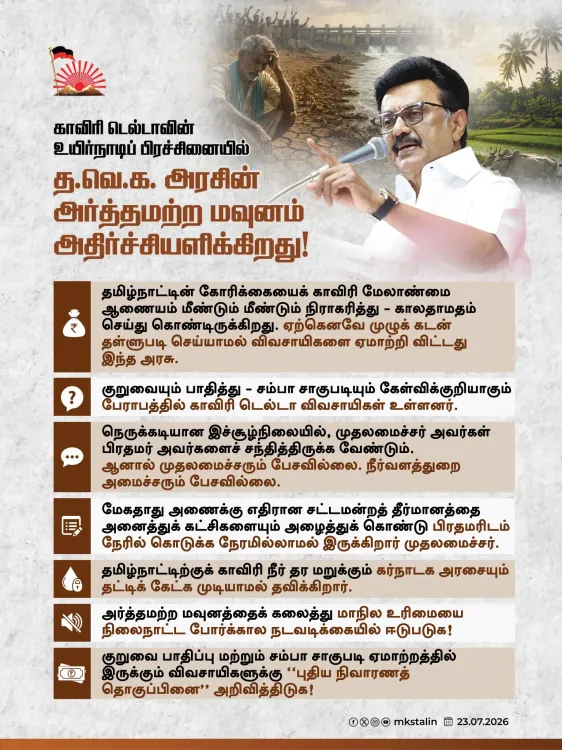
Stalin questioned why the CM has not raised the CWMA's repeated rejection of Tamil Nadu's demands with the Prime Minister .
He demanded accountability for the Water Resources Minister and called out the state's silence against Karnataka's refusal to release water.
Stalin asked why an all-party meeting has not been convened and when a delegation will carry the anti-Mekedatu legislative resolution to the PM in person.
He demanded a concrete relief package for suffering Cauvery delta farmers .
The Cauvery Water Management Authority was created by Supreme Court order in 2018 to regulate inter-state water sharing.
DMK president M. K. Stalin on Thursday, 23 July 2026, publicly directed six pointed questions at the Tamil Nadu Chief Minister's Office, demanding accountability on the state's handling of the Cauvery water dispute, the proposed Mekedatu dam, and the absence of relief for distressed delta farmers.
Posting in Tamil on X, Stalin listed his questions in sequence, asking: 'When the Cauvery Water Management Authority has repeatedly rejected Tamil Nadu's demands, why has the Chief Minister not raised this with the Prime Minister? What is the state's Water Resources Minister doing? What is the fear in speaking out against the Karnataka government that is refusing to release water to Tamil Nadu?'
He further demanded to know why an all-party meeting had not been convened, when a delegation carrying the legislative resolution against the Mekedatu dam would be taken in person to the Prime Minister, and where the relief package was for 'suffering delta farmers.'
Context
The Cauvery Water Disputes Tribunal delivered its final award in 2007, prescribing annual water shares among the basin states. The Supreme Court modified the award in 2018, adjusting Tamil Nadu's allocation and ordering the creation of the Cauvery Water Management Authority (CWMA) to oversee day-to-day regulation and distress sharing.
Despite the CWMA's mandate, distress years continue to generate friction between Tamil Nadu and Karnataka, the upper riparian state controlling reservoir releases. Tamil Nadu governments have historically combined legal challenges with direct political pressure on the Centre whenever Karnataka withholds flows.
Policy Backdrop
The Mekedatu balancing reservoir project, proposed by Karnataka on the Cauvery near Bengaluru, has been a flashpoint for years. Tamil Nadu's legislature has passed resolutions opposing the project, arguing it would further restrict downstream flows to the Cauvery delta, the state's primary rice-growing belt.
All-party delegations from Tamil Nadu met the Prime Minister in 2016 and 2017 during periods of monsoon failure and acute distress releases. Stalin's question on whether a similar delegation — carrying the anti-Mekedatu resolution — should now be led to the Prime Minister echoes that precedent of cross-party political mobilisation on water rights.
Stakeholders and Impact
Cauvery delta farmers, who depend on timely releases for kuruvai (short-term) and samba (long-duration) paddy cultivation, are the most directly affected constituency. Delayed or reduced flows translate into crop loss, debt distress, and agrarian unemployment across districts including Thanjavur, Tiruvarur and Nagapattinam.
Stalin's demand for a 'relief package' for these farmers signals that the water shortfall is already causing measurable agricultural damage. His question about the Water Resources Minister's role puts the state cabinet's internal accountability under public scrutiny.
What's Next
The immediate pressure points are the convening of an all-party meeting at the state level, any fresh representation to the CWMA, and a potential cross-party delegation to the Prime Minister's Office in New Delhi. The Tamil Nadu assembly calendar and the CWMA's next scheduled meeting will determine whether political pressure translates into formal action.
With the Cauvery dispute entering another contested season, Stalin's public questionnaire raises the political cost of inaction for the ruling dispensation in Tamil Nadu — and signals that the opposition intends to hold the government accountable on both water diplomacy and farmer welfare simultaneously.
Point of View
Cabinet performance, and farmer welfare — three issues with high electoral salience in the Cauvery delta. By framing the questions publicly rather than in the assembly, he bypasses the government's ability to deflect through procedural responses. The move fits a broader DMK pattern of using the Cauvery dispute as a litmus test for the ruling party's willingness to confront the Centre and Karnataka. If the government fails to convene an all-party meeting or announce a relief package quickly, Stalin has effectively set the terms of the next political news cycle on water and agriculture.
NationPress
23 Jul 2026
Frequently Asked Questions
What did MK Stalin say about the Cauvery water dispute?
Stalin posed six public questions to the Tamil Nadu Chief Minister on 23 July 2026, demanding to know why the state has not pressed the Prime Minister on the Cauvery Water Management Authority's rejection of Tamil Nadu's demands, and why no all-party meeting has been called.
What is the Cauvery Water Management Authority?
The Cauvery Water Management Authority (CWMA) is a central body created by Supreme Court order in 2018 to oversee the implementation of the Cauvery water-sharing award among basin states, primarily Tamil Nadu and Karnataka.
Why is Tamil Nadu opposed to the Mekedatu dam?
Tamil Nadu opposes the Mekedatu balancing reservoir proposed by Karnataka on the Cauvery river, arguing it would further restrict downstream water flows to the Cauvery delta, harming farmers in districts like Thanjavur, Tiruvarur and Nagapattinam. The Tamil Nadu legislature has passed resolutions against the project.
Who are the Cauvery delta farmers and why are they distressed?
Cauvery delta farmers are paddy cultivators in Tamil Nadu's coastal districts who depend on river releases for seasonal crops. Reduced or delayed water releases from Karnataka lead to crop failure, debt, and loss of livelihoods, making them a key constituency in any Cauvery dispute.
Has Tamil Nadu sent all-party delegations to the Prime Minister on Cauvery before?
Yes. All-party delegations from Tamil Nadu met the Prime Minister in 2016 and 2017 during periods of acute monsoon failure and distress releases, a precedent Stalin invoked when demanding a similar delegation be sent now with the anti-Mekedatu legislative resolution.