Jal Shakti Minister Paatil Highlights India's 7.6% GDP Growth
Synopsis
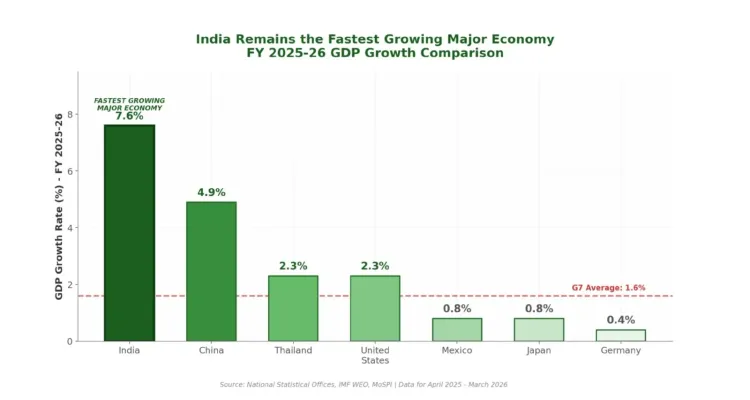
Union Jal Shakti Minister C. R. Paatil has highlighted India's 7.6% GDP growth in FY 2025-26, outpacing China at 4.9%, the US at 2.3%, and the G7 average of 1.6%. Attributing the performance to PM Modi's policy reforms and the Viksit Bharat 2047 vision, he called it a landmark for 140 crore Indians.
Key Takeaways
India recorded a 7.6% GDP growth rate in FY 2025-26 , according to Union Minister C.
India outpaced China (4.9%) , the United States (2.3%) , and the G7 average (1.6%) in the same period.
Quarterly growth ranged between 6.7% and 8.4% throughout FY 2025-26 despite global uncertainties.
Minister Paatil credited Atmanirbhar Bharat , infrastructure expansion, and digital transformation as key drivers.
The performance is framed as a milestone toward the Viksit Bharat 2047 goal of becoming a developed nation.
The National Statistical Office's next quarterly estimates will be the key data point to watch.
Union Jal Shakti Minister C. R. Paatil on Friday, June 5, 2026, highlighted India's economic performance in fiscal year 2025-26, citing a 7.6% GDP growth rate that he said positions the country as the world's fastest-growing major economy. The senior BJP leader credited the achievement to policy reforms under Prime Minister Narendra Modi and the collective effort of 140 crore Indians.
Context
In his post, Minister Paatil drew a direct comparison with other major economies, noting that China recorded 4.9% growth, the United States posted 2.3%, and the average for G7 nations stood at 1.6% for the same period. He stated that India maintained quarterly growth in the range of 6.7% to 8.4% throughout the year, even as global uncertainties persisted.
'वैश्विक चुनौतियों और आर्थिक अनिश्चितताओं के बावजूद' ('Despite global challenges and economic uncertainties'), Paatil wrote, India sustained robust momentum across every quarter of the fiscal year.
Policy Backdrop
The minister attributed the growth trajectory to four pillars: policy reforms, infrastructure expansion, digital transformation, and the Atmanirbhar Bharat (self-reliant India) initiative. The Atmanirbhar Bharat Abhiyan, launched in May 2020, was designed to reduce import dependence and stimulate domestic manufacturing through a broad package of economic incentives.
Complementing that drive, the government's National Infrastructure Pipeline—announced in 2019 with a target of ₹111 lakh crore in investment over five years—channelled capital into roads, railways, and ports. The Digital India programme, rolled out in 2015, and the Goods and Services Tax unified in July 2017, are also part of the supply-side reform architecture that successive budgets have built upon.
Stakeholders and Impact
Paatil framed the growth figure as a milestone on the road to Viksit Bharat 2047, the government's long-term vision to transform India into a developed nation by the centenary of independence. He described the achievement as a symbol of the hard work, innovation, and nation-building commitment of 140 crore Indians.
The domestic workforce and industries across manufacturing, services, and digital sectors stand as the primary stakeholders in sustaining this pace. Consistent high-single-digit growth is widely seen as a prerequisite for India to move from lower-middle-income toward upper-middle-income status before 2047.
What's Next
The immediate marker to watch is the next quarterly GDP estimate from the National Statistical Office, which will indicate whether the growth pace holds into the first quarter of FY 2026-27. Any mid-term review of the National Infrastructure Pipeline allocations will also signal how aggressively the government intends to sustain capital expenditure as a growth engine.
If India maintains its current trajectory, it would further consolidate its position as the standout performer among the world's top economies—a narrative the ruling party is expected to amplify ahead of upcoming electoral cycles and international forums.
Point of View
Using comparative GDP data to reinforce the ruling party's central governance narrative ahead of what is expected to be an active political season. By placing India's 7.6% figure alongside sluggish G7 and Chinese numbers, the post constructs a 'India versus the world' frame that has proven electorally resonant since 2014. The invocation of Viksit Bharat 2047 ties a single data point to a decade-long aspirational arc, making the statistic feel like progress rather than a quarterly snapshot. That a Jal Shakti minister—rather than the Finance Ministry—is amplifying macro-economic data also reflects how broadly the BJP has distributed its economic communication strategy across the Cabinet.
NationPress
22 Sept 2026
Frequently Asked Questions
What is India's GDP growth rate for FY 2025-26?
Union Jal Shakti Minister C. R. Paatil stated that India recorded a 7.6% GDP growth rate in FY 2025-26, which he described as the highest among major global economies for that period.
How does India's GDP growth compare to China and the US in 2025-26?
According to Minister Paatil's post, India grew at 7.6%, significantly ahead of China at 4.9%, the United States at 2.3%, and the G7 nations' average of 1.6%.
What is Viksit Bharat 2047?
Viksit Bharat 2047 is the Indian government's long-term vision to transform India into a fully developed nation by 2047, the centenary of independence, through sustained economic growth, infrastructure investment, and social development.
What is Atmanirbhar Bharat and how does it relate to India's growth?
Atmanirbhar Bharat, launched in May 2020, is a self-reliance initiative encompassing economic reforms, manufacturing incentives, and infrastructure spending aimed at reducing import dependence. Minister Paatil cited it as one of the key drivers of India's strong GDP performance.
Who is C. R. Paatil?
C. R. Paatil is the Union Minister of Jal Shakti in the Government of India, a senior BJP leader, and a former president of the BJP's Gujarat state unit.