Sachin Pilot raises alarm over women's safety in Rajasthan
Synopsis
Congress leader Sachin Pilot has publicly condemned a surge in crimes against women in Rajasthan, naming Banswara, Alwar, and Jaipur, and alleging victim intimidation and police complicity. He demands strict accountability and justice for victims from the state government and administration.
Key Takeaways
Congress leader Sachin Pilot posted on 28 May 2026 condemning serious crimes against women in Rajasthan .
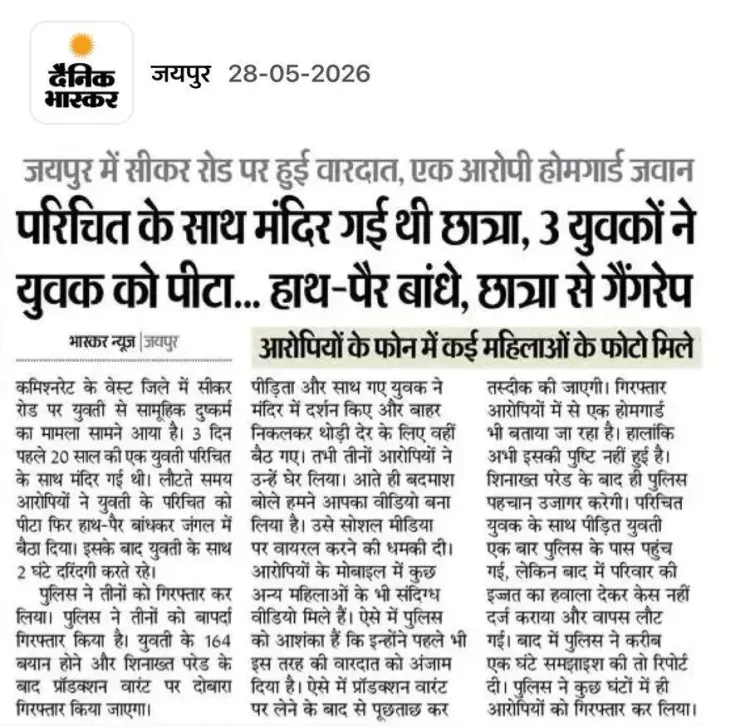
He specifically named Banswara , Alwar , and Jaipur as districts where heinous incidents have been reported.
Pilot alleged that victims and their families are being pressured to reach out-of-court settlements in some cases.
He also alleged that in certain incidents, individuals responsible for law enforcement are themselves found to be involved in the crimes.
The statement calls for strict accountability from the state government, administration, and police, and demands justice for all victims.
The critique is notable as it comes from within the ruling Indian National Congress party that governs Rajasthan.
Congress leader and former Rajasthan Deputy Chief Minister Sachin Pilot on Thursday, 28 May 2026, issued a sharp public indictment of law and order in Rajasthan, citing a pattern of serious crimes against women in districts including Banswara, Alwar, and Jaipur and demanding immediate accountability from the state government, administration, and police.
Context
In his post, Pilot wrote that incidents involving women in the state raise grave questions not just about law and order but about the entire security apparatus — 'पूरी सुरक षा व्यवस्था पर भी गंभीर सवाल' ('serious questions on the entire security system'). He named Banswara, Alwar, and Jaipur as districts where 'heinous crimes' against women have come to light, calling the situation 'extremely worrying and shameful.'
Pilot further alleged that in some of these cases, victims and their families are being pressured to settle out of court, and that in certain instances, those responsible for maintaining law and order are themselves found to be complicit in the crimes — a charge that directly implicates elements within the police establishment.
Policy Backdrop
India's legal framework for crimes against women was significantly strengthened by the Criminal Law (Amendment) Act, 2013, enacted in the aftermath of the Nirbhaya case. The legislation introduced stricter penalties, faster trial procedures, and expanded definitions of sexual offences, and applies uniformly across all states including Rajasthan.
Despite this legislative architecture, advocates and political leaders have consistently pointed to gaps in ground-level implementation — including delayed FIR registration, inadequate victim support, and pressure on complainants to withdraw cases. Pilot's post reflects this long-standing concern about the distance between statute and street-level reality.
Stakeholders and Impact
The statement directly affects women in Rajasthan, particularly in the districts named, and their families who may be navigating active cases. State police and district administrations in Banswara, Alwar, and Jaipur face renewed public scrutiny over their handling of these incidents.
Notably, the intervention comes from within the Indian National Congress itself, the party that leads the Rajasthan government. This makes Pilot's critique an intra-party pressure signal as much as an opposition-style accountability demand, reflecting the internal leadership dynamics that have historically characterised Congress politics in the state.
Victims' rights groups and civil society organisations working on women's safety in Rajasthan are likely to amplify the call for swift judicial action and independent inquiry into the alleged settlement pressure and police complicity.
What's Next
Pilot has called for 'strict accountability and effective action' — 'जवाबदेही और प्रभावी कार्रवाई' — so that 'criminals fear the law and the public retains confidence in the system.' He demanded that victims and their families receive justice and that perpetrators face stringent punishment.
Observers will watch whether the Rajasthan government orders a formal inquiry or issues a public response, and whether the matter is taken up during the next sitting of the state assembly. Any official acknowledgement of the alleged pressure on victims would significantly raise the political stakes for the ruling establishment in Jaipur.
Point of View
He raises the bar beyond routine political rhetoric — forcing the state administration into a corner where silence itself becomes a statement. This mirrors a pattern seen across Indian states where senior leaders use social media to bypass party hierarchies and speak directly to public sentiment on law and order. The timing and specificity of the post suggest Pilot is positioning himself as a voice of accountability within Congress, a role he has consistently cultivated since his public break with the previous Rajasthan government in 2020.
NationPress
12 Oct 2026
Frequently Asked Questions
What did Sachin Pilot say about women's safety in Rajasthan?
Sachin Pilot posted on 28 May 2026 that crimes against women in Rajasthan — particularly in Banswara, Alwar, and Jaipur — raise serious questions about the entire law and order apparatus. He alleged victim intimidation and possible police complicity, and demanded strict accountability and justice.
Which districts in Rajasthan did Sachin Pilot mention in his post?
Pilot specifically named Banswara, Alwar, and Jaipur as districts where serious crimes against women have recently come to light.
Is Sachin Pilot in the Rajasthan government?
Sachin Pilot is not currently serving in the Rajasthan government. He is the general secretary of the Indian National Congress with responsibility for Chhattisgarh, and is a former Deputy Chief Minister of Rajasthan.
What allegations did Sachin Pilot make against Rajasthan police?
Pilot alleged that in some cases, victims and their families are being pressured to settle out of court, and that in certain incidents, those responsible for maintaining law and order are themselves found to be complicit in the crimes.
What action did Sachin Pilot demand over crimes against women in Rajasthan?
Pilot demanded strict accountability and effective action from the state government, administration, and police, so that criminals fear the law, public trust is maintained, and victims and their families receive justice.