PLI Textiles Round 3: 22 new firms approved, ₹2,339 crore investment, 36,000 jobs targeted
Synopsis
The Centre has quietly but steadily expanded its PLI Textiles bet — 22 more companies cleared in Round 3, pushing total commitments to ₹12,822 crore and projected turnover to over ₹58,000 crore. The real pivot here is the focus on Man-Made Fibres and Technical Textiles, segments where India has long ceded ground to China and Vietnam. Whether the jobs and turnover projections hold is the question the next disbursement cycle will answer.
Key Takeaways
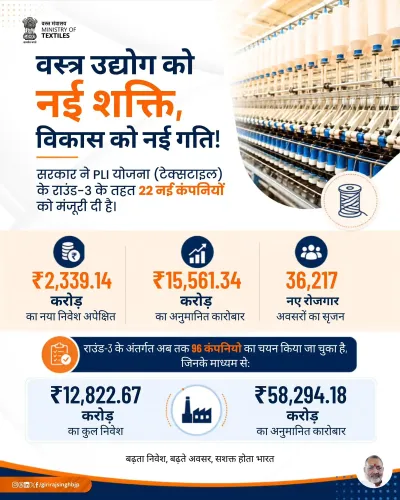
The Centre approved 22 new companies under PLI Textiles Round 3 , projecting investments of ₹2,339.14 crore .
The new approvals are expected to create 36,217 jobs and generate a turnover of ₹15,561.34 crore .
Total companies selected under Round 3 now stand at 96 , with cumulative investment commitments of ₹12,822.67 crore .
Combined projected turnover from all Round 3 firms reaches ₹58,294.18 crore .
Focus segments are MMF Apparel , MMF Fabrics , and Technical Textiles — high-growth, export-oriented areas.
The Centre on Wednesday approved 22 new companies under the third round of the Production Linked Incentive (PLI) Scheme for Textiles, unlocking projected investments of ₹2,339.14 crore and an estimated 36,217 jobs across the textile value chain. The approvals, announced from New Delhi, mark the latest expansion of a scheme that has now onboarded 96 companies in its third round alone.
Scale of the Latest Approvals
According to official data, the 22 newly approved projects are expected to generate a turnover of ₹15,561.34 crore from notified textile products. The employment figure of 36,217 spans roles across the full textile value chain, from fibre processing to finished apparel.
The approved firms operate in the scheme's key focus segments: Man-Made Fibre (MMF) Apparel, MMF Fabrics, and Technical Textiles — areas the government has identified as high-growth and export-ready.
Cumulative Impact of Round 3
With these additions, the 96 companies selected under the third round have collectively committed investments of ₹12,822.67 crore and are projected to generate a combined turnover of ₹58,294.18 crore. The cumulative scale underlines sustained industry appetite for the scheme, even as earlier PLI rounds in other sectors have drawn scrutiny over employment outcome verification.
Why These Segments Matter
MMF and Technical Textiles represent a deliberate pivot away from India's traditional cotton-dominant textile identity. Globally, MMF accounts for the majority of textile trade volumes, an area where China and Vietnam have historically outcompeted Indian exporters. The PLI's focus on these segments is an attempt to close that gap and reposition India higher up the global textile supply chain.
Technical Textiles — used in sectors ranging from healthcare to defence and infrastructure — carry significant value-addition potential and are increasingly prioritised in government procurement norms, adding a domestic demand lever alongside the export push.
Government's Stated Objectives
Officials said the proposed investments and production capacities are expected to contribute to a 'robust and globally competitive textile ecosystem'. The initiative is aligned with the government's Aatmanirbhar Bharat vision, with the twin goals of boosting domestic manufacturing and generating large-scale employment. The PLI Scheme for Textiles has been positioned as a key policy instrument for driving growth in segments with significant export potential and higher value addition.
What Comes Next
The newly approved companies will now move toward formalising investment commitments and establishing production capacities within the scheme's stipulated timelines. Industry observers will watch whether the projected turnover and employment numbers translate into verified outcomes — a challenge that has dogged earlier PLI iterations across sectors. The government's ability to track and enforce milestone-linked disbursements will be critical to the scheme's credibility.
Point of View
But the PLI Textiles scheme's credibility will ultimately rest on verified outcomes, not approvals. India's textile sector has seen repeated policy pushes — from Technology Upgradation Fund Scheme to earlier PLI rounds — where projected employment and turnover figures outpaced actual delivery. The deliberate focus on MMF and Technical Textiles is strategically sound, but these are capital-intensive segments with long gestation periods. The real test is whether disbursement timelines hold and whether job-creation claims are independently audited. Without that, 36,000 projected jobs risk becoming another number on a government press release.
NationPress
26 Sept 2026
Frequently Asked Questions
What is the PLI Scheme for Textiles and what does Round 3 cover?
The Production Linked Incentive (PLI) Scheme for Textiles is a central government programme designed to boost domestic manufacturing in high-value textile segments by linking financial incentives to production milestones. Round 3 focuses on Man-Made Fibre Apparel, MMF Fabrics, and Technical Textiles, with 96 companies now selected under this round.
How many jobs are expected from the latest PLI Textiles approvals?
The 22 newly approved companies are projected to create 36,217 employment opportunities across the textile value chain, according to official data. These figures represent projections tied to investment and production commitments, not yet verified outcomes.
What is the total investment committed under PLI Textiles Round 3?
Across all 96 companies selected in Round 3, cumulative investment commitments stand at ₹12,822.67 crore, with a projected combined turnover of ₹58,294.18 crore from notified textile products.
Why is the government focusing on Man-Made Fibres and Technical Textiles?
MMF accounts for the majority of global textile trade, an area where India has historically lagged behind China and Vietnam. Technical Textiles carry high value-addition potential and serve sectors including healthcare, defence, and infrastructure. The PLI scheme targets these segments to reposition India higher in global textile supply chains and diversify beyond traditional cotton-based exports.
What happens after a company is approved under the PLI Textiles scheme?
Approved companies are required to formalise investment commitments and establish production capacities within the scheme's stipulated timelines. Incentive disbursements are linked to production milestones, meaning firms must demonstrate output before receiving payouts under the scheme's structure.