PM Modi: 'What Was Once a Dream Is Now Reality'
Synopsis
Prime Minister Narendra Modi on June 19, 2026, posted on X declaring that a long-held national aspiration has been realised, invoking the 'New India' identity. The Hindi post, accompanied by a video, fits a decade-long pattern of framing policy and infrastructure achievements as the fulfilment of earlier dreams.
Key Takeaways
PM Narendra Modi posted on X on June 19, 2026 , in Hindi, declaring 'what was once a dream is today a reality.' The post invokes the 'New India' identity, a phrase central to BJP government communications since 2014 .
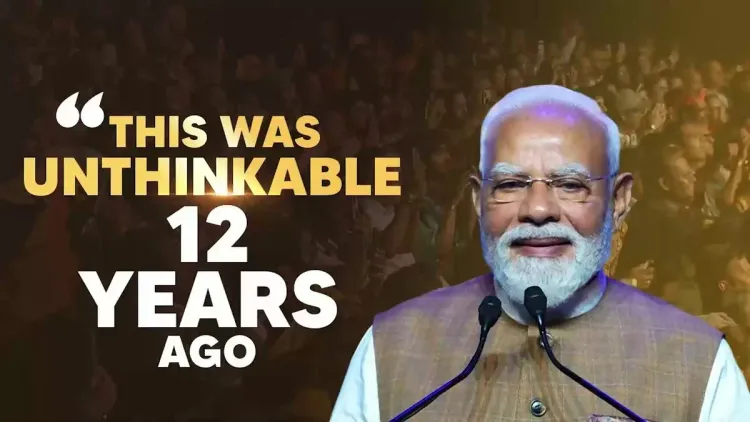
An accompanying video signals a specific development milestone, the precise details of which are conveyed visually rather than in the post text.
The messaging follows an established pattern of presenting completed projects or policy outcomes as systemic national transformation.
The post is directed at the broad Indian citizenry, particularly beneficiaries of government schemes in rural and semi-urban areas.
Formal identification of the referenced milestone is expected through follow-up official government communications.
Prime Minister Narendra Modi took to X on Friday, June 19, 2026, to mark what he described as the realisation of a long-held national aspiration, framing the moment as a defining feature of the 'New India' vision his government has championed since 2014.
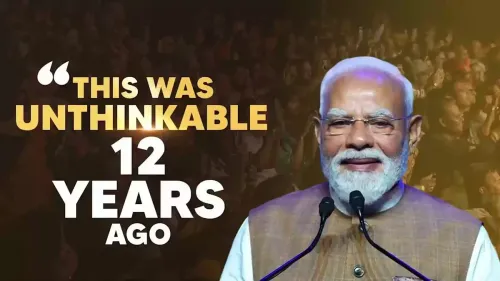
In the post, written in Hindi, Modi declared: 'Jo kabhi sapna tha, woh aaj sacchaayi hai.' ('What was once a dream is today a reality.') He added: 'This is the identity of the new India!' The post was accompanied by a video, the contents of which underscore a specific development milestone, though the precise project has not been independently detailed in the post itself.
Context
The phrase 'New India' has been central to BJP and government communications since Modi's first term began in 2014. It entered official usage as an umbrella descriptor for the administration's agenda spanning infrastructure expansion, digital public services, and welfare delivery programmes. The framing — positioning present achievements as the fulfilment of earlier aspirations — is a recurring rhetorical device in the Prime Minister's public communication.
Such messaging is typically timed to coincide with project inaugurations, policy anniversaries, or the crossing of significant delivery benchmarks. The accompanying video suggests this post marks one such occasion, though the specific milestone is conveyed through the visual medium rather than the text alone.
Policy Backdrop
Over more than a decade in office, the Modi government has repeatedly pointed to completed infrastructure projects, expanded digital access, and welfare scheme reach as evidence of systemic transformation. Flagship programmes across sectors — from rural electrification and housing to broadband connectivity and financial inclusion — have each been presented at various stages as the conversion of 'dreams' into 'reality'.
This rhetorical pattern serves a dual purpose: it reinforces the government's developmental narrative ahead of policy cycles and budget sessions, and it sustains public engagement with long-gestation projects whose benefits may not be immediately visible to all citizens. The June 2026 post fits squarely within this established communication arc.
Stakeholders and Impact
The primary audience for this kind of messaging is the broad Indian citizenry — particularly beneficiaries of government schemes in rural and semi-urban areas where the gap between aspiration and delivery has historically been most acute. By invoking the 'New India' identity, the Prime Minister signals that the transformation is collective and national in scope, not limited to any single region or demographic.
Opposition parties have, over the years, contested the 'dream-to-reality' framing, arguing that ground-level implementation gaps persist across several flagship programmes. Civil society groups and independent monitors have offered mixed assessments, with some schemes showing robust delivery data and others falling short of stated targets.
What's Next
Observers will watch for the formal identification of the milestone referenced in the video, which is expected to emerge through official government communications or project inauguration events in the days following the post. Broader signals to track include upcoming budget sessions, infrastructure project completions, and any follow-up announcements from relevant ministries that may contextualise the specific 'dream realised' the Prime Minister has alluded to.
If the post marks a major infrastructure or welfare milestone, it is likely to be followed by ground-level events, ministerial briefings, and state-level amplification — a pattern consistent with how the government has rolled out similar announcements over the past decade.
Point of View
The government sidesteps the granular — specific numbers, project names, timelines — in favour of an emotional register that travels further and faster on social media. The accompanying video does the evidentiary work while the text sets the ideological tone, a deliberate division of labour. Politically, this kind of post serves as a low-risk, high-reach signal to the base that the government's long-term promises are being kept, without opening the administration to fact-checking on specifics it has not named.
NationPress
19 Sept 2026
Frequently Asked Questions
What did PM Modi post on X on June 19 2026?
PM Modi posted in Hindi saying 'what was once a dream is today a reality,' describing the moment as the identity of the new India, alongside a video of an apparent development milestone.
What does 'New India' mean in Modi's posts?
'New India' is an official BJP and government phrase introduced after the 2014 election victory to describe a programme of economic, infrastructure, and governance reforms aimed at systemic national transformation.
Which project or scheme is PM Modi referring to in this post?
The specific project is conveyed through the accompanying video rather than the post text; the precise milestone has not been independently named in the post and will likely be clarified through follow-up official government communications.
Why does PM Modi frequently use the 'dream to reality' framing?
This framing is a recurring rhetorical device in the Prime Minister's communication strategy, used to present completed infrastructure, welfare, or digital milestones as the fulfilment of aspirations articulated at the start of his tenure in 2014 .
How has the opposition responded to Modi's 'New India' claims?
Opposition parties have consistently contested the 'dream-to-reality' narrative, pointing to implementation gaps in several flagship schemes, while independent assessments have produced mixed findings depending on the programme and region.